Planning a thoughtful discussion takes more than asking an AI tool for “10 questions about this topic.” A basic request can produce material that is usable, but usable is not always rigorous, sequenced, relevant, or ready for a real classroom.
The difference lies in prompt design. When instructional goals remain implied, an AI model has to guess how to build complexity, surface misconceptions, encourage peer dialogue, and connect learning to the world beyond the classroom. A stronger prompt makes those decisions explicit.
This guide shows how to transform a broad discussion-question request into a reusable curriculum framework. It also examines a grades 9–10 Social Studies case study, led by teacher Alice, on digital citizenship and online privacy—revealing both the value and the limits of even well-optimized prompts.
Key Takeaways
- Specify role, deliverable, progression, and constraints to move from generic questions to instructional design.
- Require a Bloom’s progression, real-world relevance, misconception checks, and a probing follow-up for every question.
- Claude, Gemini, and Minimax meet basic question requirements but prioritize different forms of classroom value.
- Explicit Bloom’s labels and discussion protocols are essential additions for facilitator-ready outputs.
Table of Contents
- The Prompt Transformation: Before and After
- Why the Optimized Prompt Works
- Case Study: Digital Citizenship and Online Privacy
- Three Model Approaches to the Same Teaching Goal
- The Shared Strength—and the Shared Gap
- How to Make the Output Facilitator-Ready
- Beyond Optimized Prompts: The AI Curriculum Assistant
- Final Thoughts
The Prompt Transformation: Before and After
A raw prompt may contain good intentions, but it often leaves essential instructional choices open to interpretation. Consider this starting point.
The Raw Prompt
Create a set of 10 discussion questions about [TOPIC] for my [GRADE LEVEL] [SUBJECT] class. The questions should:
- Progress from basic recall to higher-order thinking following Bloom's Taxonomy
- Encourage critical thinking and analysis
- Promote student-to-student interaction
- Connect the topic to relevant real-world scenarios
- Address potential misconceptions or challenging aspects of the topic
Include follow-up questions for each main question to deepen the discussion.
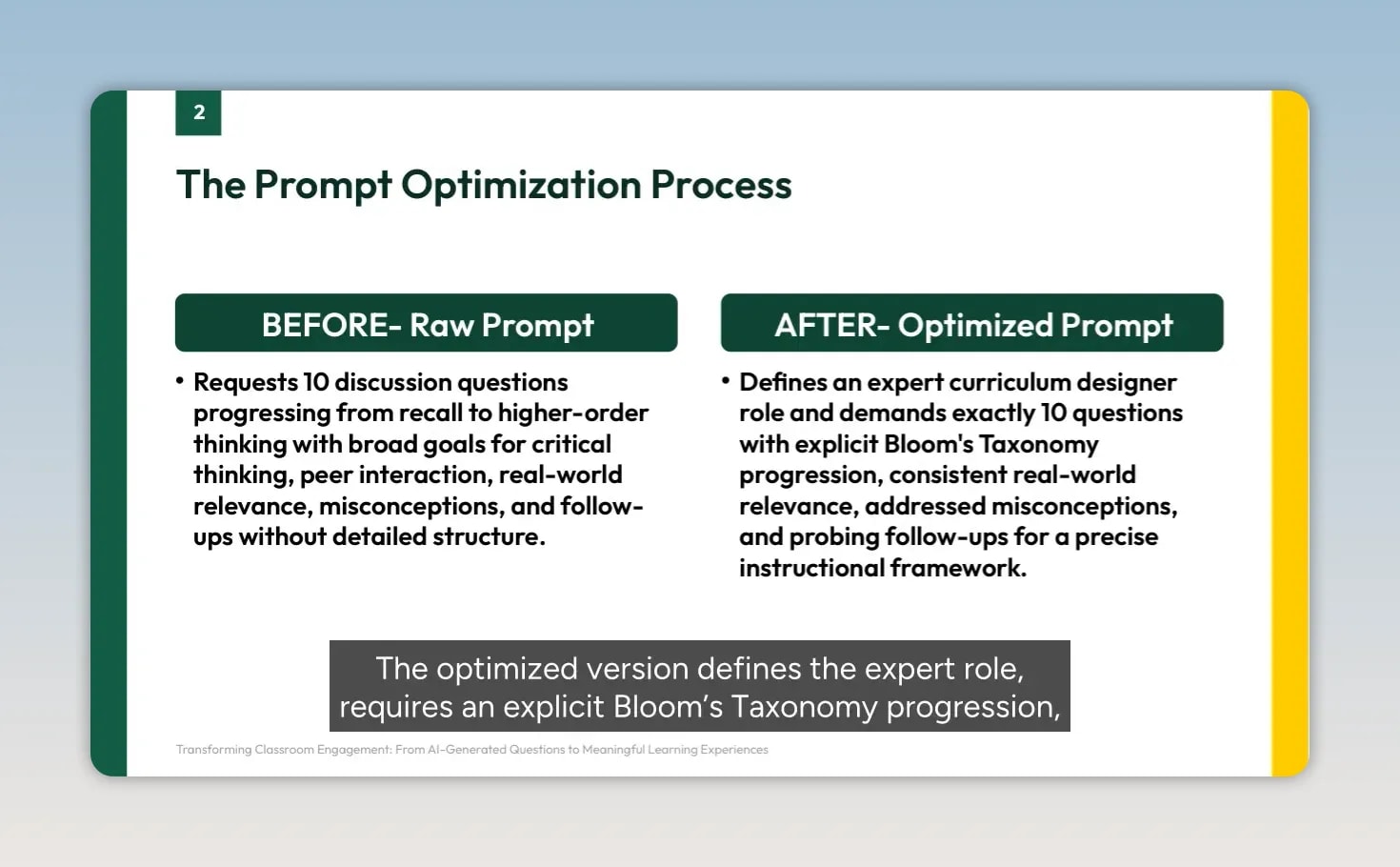
This is a sensible request. Yet it does not require the model to show the progression through Bloom’s Taxonomy, define the role it should take, or make real-world relevance and follow-up depth consistently visible.
The Optimized Prompt
You are an expert curriculum designer and pedagogical specialist, highly skilled in developing engaging, standards-aligned classroom materials that foster deep conceptual understanding.

Generate exactly 10 high-quality discussion questions for a [GRADE LEVEL] [SUBJECT] class on [TOPIC].

The questions must:
1. Show a clear progression from recall and comprehension to analysis, evaluation, or creation, explicitly mapping each question to Bloom's Taxonomy.
2. Encourage critical thinking, analysis, synthesis, interpretation, and justification.
3. Promote meaningful student-to-student dialogue rather than simple teacher-led responses.
4. Connect the topic to contemporary or historical real-world scenarios, applications, or ethical considerations.
5. Address common misconceptions and challenging concepts related to the topic.
6. Include at least one targeted probing follow-up immediately after every main question.

Use these variables:
- [TOPIC]
- [GRADE LEVEL]
- [SUBJECT]
The optimized version does not simply ask for better questions. It defines the professional lens, the exact deliverable, the progression, and the quality-control criteria. Instead of hoping the model recognizes instructional priorities, it makes those priorities operational.
Why the Optimized Prompt Works
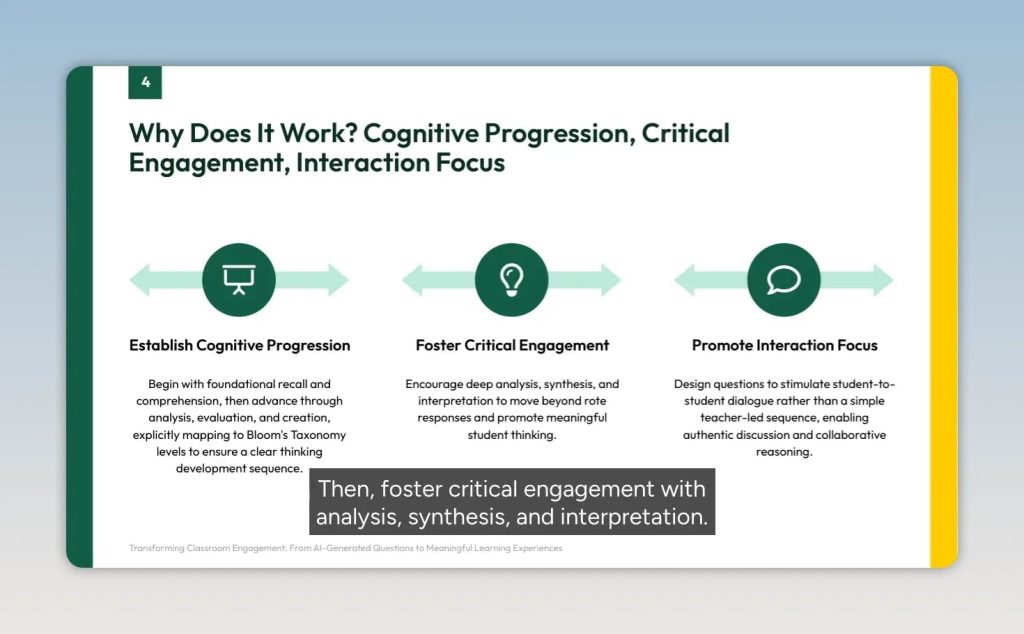
It establishes an expert instructional role
Positioning the model as an expert curriculum designer and pedagogical specialist shifts its focus away from generic content generation. The result should prioritize conceptual depth, meaningful engagement, age-appropriate sequencing, and classroom usability.
It creates a visible cognitive pathway
Ten questions can appear varied while still asking students to perform the same kind of thinking. A sequence that moves from recall toward creation helps establish a learning journey: define key concepts, interpret evidence, analyze systems and consequences, evaluate competing positions, then design or propose something meaningful.
It turns discussion into dialogue
Questions should do more than invite answers. They should invite comparison, disagreement, justification, revision, and shared reasoning. A targeted follow-up can ask for evidence, consequences, counterarguments, stakeholder perspectives, or a stronger explanation of an initial claim.
It grounds concepts in real-world complexity
Relevance is not a decorative addition. Current events, historical cases, practical decisions, and ethical tensions give abstract concepts consequences. The prompt also requires attention to misconceptions, helping discussion become diagnostic as well as exploratory.
- What assumption might students bring to this topic?
- Which real-world decision makes the concept concrete?
- What evidence would students need to defend a position?
- What follow-up would move the conversation beyond a first impression?
Case Study: Digital Citizenship and Online Privacy
Alice, a grades 9–10 Social Studies teacher, needs a discussion sequence on digital citizenship and online privacy. Her goal is not only to cover personal online habits. She wants students to connect those habits with civic responsibility, ethics, institutional power, and the consequences of data collection.
| Variable | Alice’s input |
|---|---|
| Topic | Digital Citizenship and Online Privacy |
| Grade level | High School, Grades 9–10 |
| Subject | Social Studies |
This topic is an effective test of the framework because it moves naturally from individual choices to broader civic questions: Who is responsible for protecting personal data? How do platforms shape public trust? When should governments regulate digital systems? What rights and responsibilities accompany participation online?
Three Model Approaches to the Same Teaching Goal
Three models can meet the baseline requirements—10 discussion questions and follow-up probes—while still emphasizing very different instructional priorities.
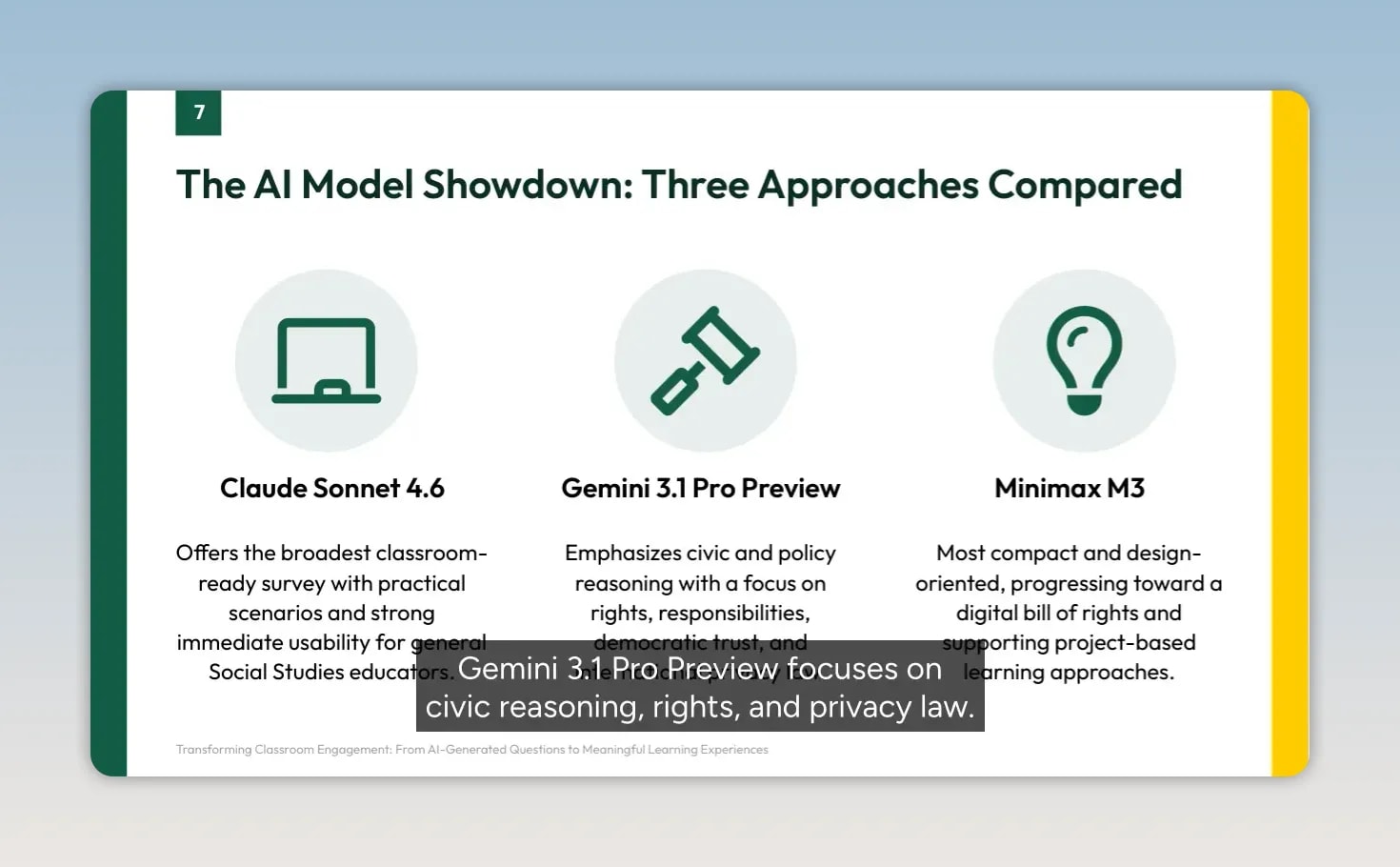
Claude Sonnet 4.6: Broad classroom relevance
Claude offers the broadest, most classroom-ready coverage. Its approach emphasizes familiar situations, such as digital footprints, online behavior, misinformation, privacy trade-offs, cyberbullying, and public-awareness communication. This framing can make an abstract topic immediately relevant to adolescents while connecting it to wider social consequences.
Gemini 3.1 Pro Preview: Civic and policy reasoning
Gemini focuses more strongly on citizenship, rights, privacy law, democratic trust, corporate responsibility, and government regulation. This makes it especially useful for civics or government-centered instruction. The trade-off is that students may need background sources before comparing legal frameworks or evaluating policy choices responsibly.
Minimax M3: Compact and design-oriented
Minimax provides the most concise route through the topic. Its strengths include attention to passive data collection, algorithms, echo chambers, breaches, and a culminating digital bill of rights. That design-oriented endpoint can support project-based learning, though complex concepts such as security and enforceable rights may need additional scaffolding.
The Shared Strength and the Shared Gap
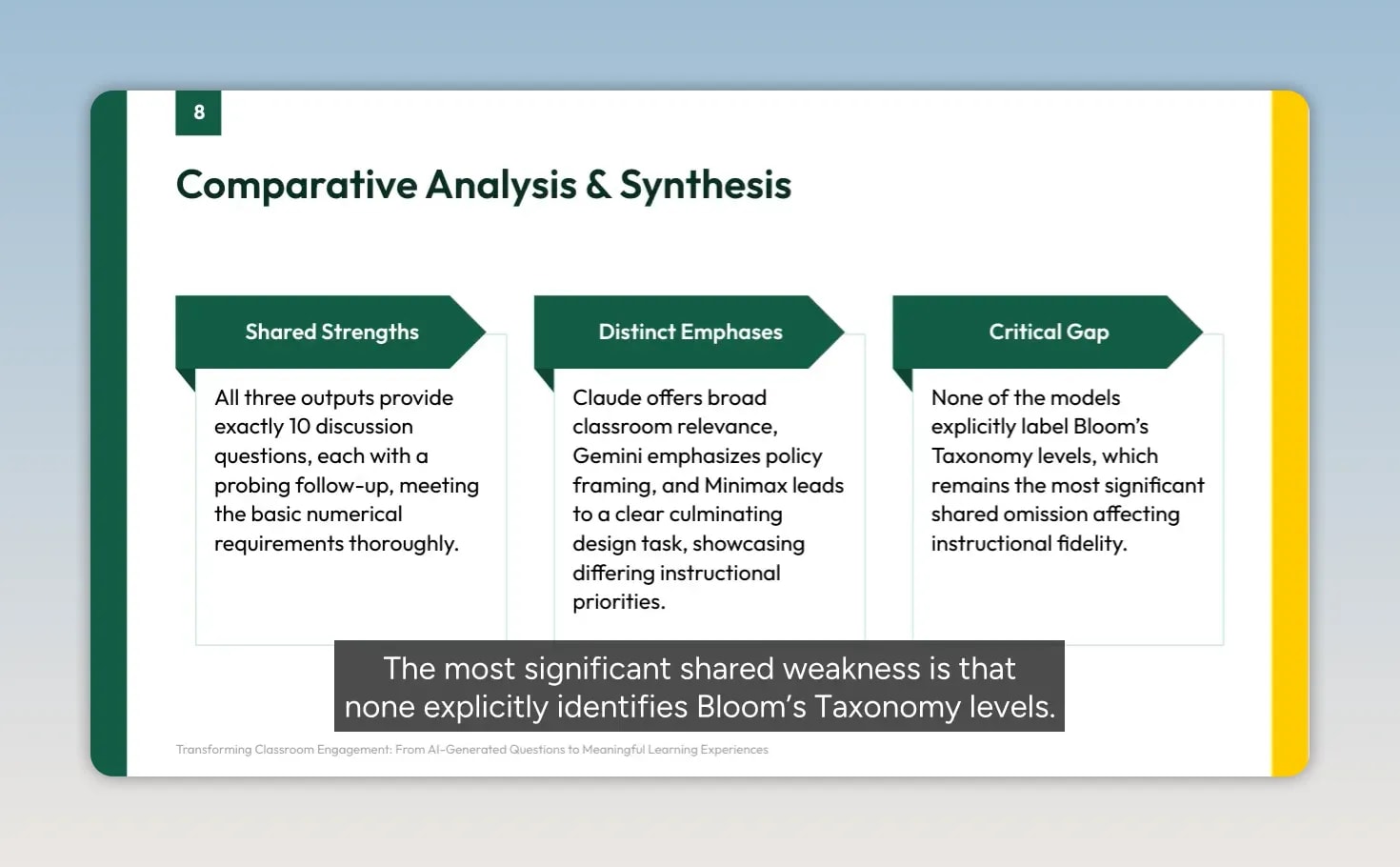
All three approaches can produce a complete set of ten questions with probing follow-ups. Their differences are primarily about emphasis:
- Claude favors broad classroom relevance and practical scenarios.
- Gemini favors civic reasoning, rights, and privacy-law framing.
- Minimax favors concise systems thinking and a final design task.
However, one major instructional-fidelity issue remains: none explicitly identifies Bloom’s Taxonomy levels, even when the prompt requests that mapping. The sequence may imply progression through verbs such as define, analyze, evaluate, and design, but an implied progression is harder to review and revise.
Interaction is another common weakness. “Discuss” and “justify” can encourage conversation, but they do not provide an actual discussion structure. A stronger output would specify whether students should conduct a stakeholder debate, respond to a peer claim, build consensus, use a continuum activity, or revise an initial position after hearing evidence.
How to Make the Output Facilitator-Ready
An optimized prompt is a powerful starting point, not a substitute for professional judgment. To turn a generated list into a truly sequenced discussion plan, require five elements for every question:
- Bloom’s level: Remember, Understand, Apply, Analyze, Evaluate, or Create.
- Misconception addressed: The belief or confusion the question is designed to surface.
- Interaction method: Debate, think-pair-share, stakeholder role-play, consensus protocol, or peer response.
- Probing follow-up: A prompt that asks for evidence, consequences, or a revised claim.
- Required background: The source material, example, or case students need before discussing.
For Alice’s privacy unit, a question about regulation could become a stakeholder debate between students representing young people, technology companies, schools, and government agencies. A question about convenience versus privacy could use a spectrum activity. A digital bill of rights could become a collaborative drafting, amendment, and ratification exercise.
Beyond Optimized Prompts: The AI Curriculum Assistant
Even an excellent template requires repeated effort. Teachers still need to replace variables, decide which misconceptions matter most, evaluate whether the sequence fits available time, and revise the output for student readiness.
A curriculum assistant can reduce that planning burden by gathering context conversationally. Rather than requiring a teacher to reconstruct the full prompt every time, it can ask the questions a curriculum designer would ask:
- What do students already know?
- How much time is available for the discussion?
- Which misconception is most important to address?
- Will students have readings, data, or case studies?
- Should the lesson end in debate, reflection, consensus, or creation?
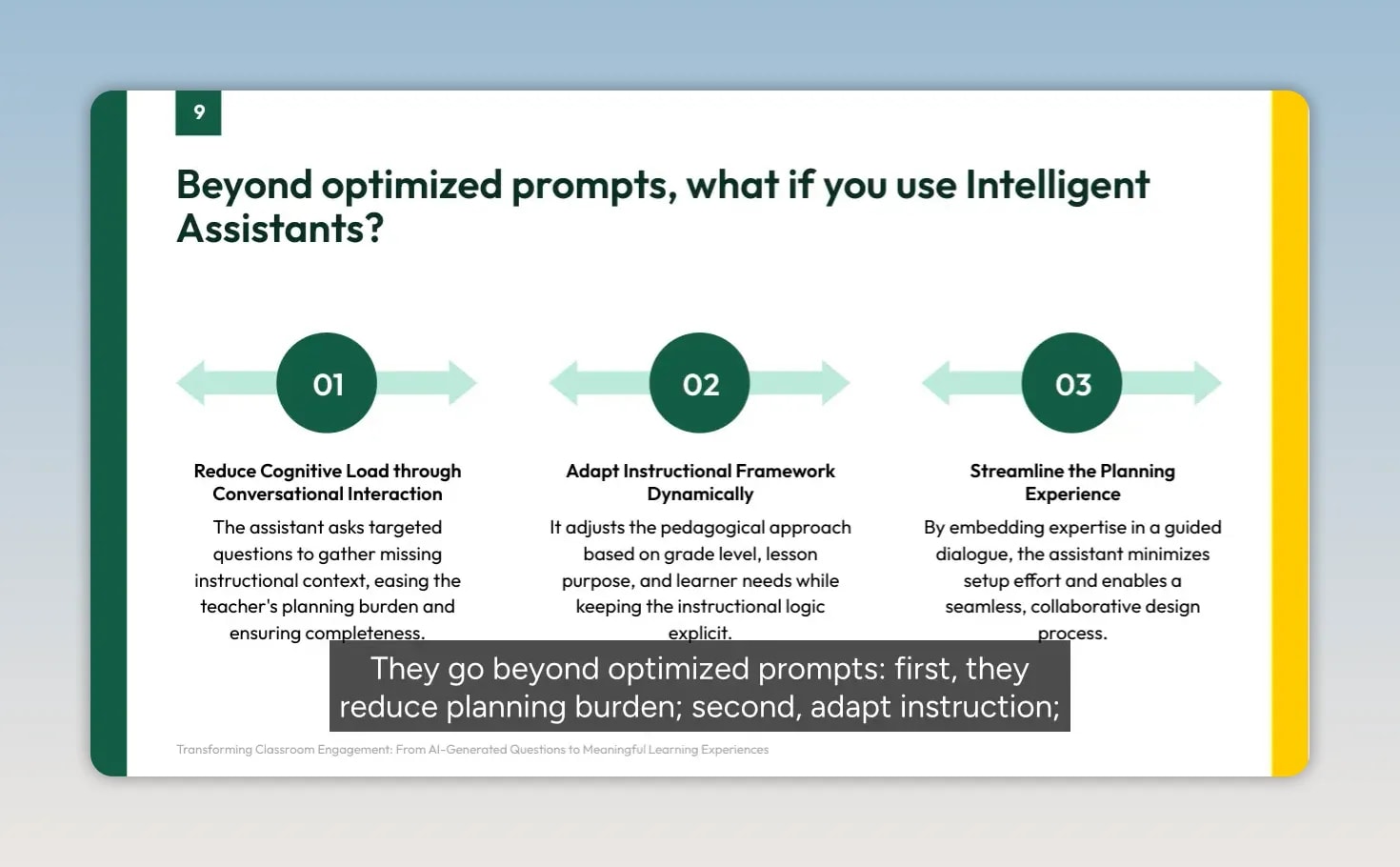
The central idea is straightforward: prompts encode expertise, while assistants can guide the use of that expertise. Both still require teacher review, but a guided workflow can make instructional planning more consistent, responsive, and manageable. That is what you get with the ‘Discussion Questions Generator for Classroom Engagement’ AI Assistant.
Final Thoughts
Generic AI question lists can save time, but they often leave too much to interpretation. A classroom-ready prompt makes the instructional architecture visible: an expert role, exact deliverable, cognitive progression, real-world relevance, misconception checks, student interaction, and targeted follow-ups.
Alice’s digital citizenship case also shows why the work does not end with a stronger prompt. Different models can interpret the same criteria through different lenses—broad classroom relevance, civic-policy reasoning, or project design. The best result comes from combining a clear framework with educator judgment and the evidence students need to think well.
Frequently Asked Questions
Why is an optimized prompt better than asking for discussion questions directly?
An optimized prompt makes instructional expectations explicit. It defines the model’s role, the number of questions, cognitive progression, relevance, misconceptions, dialogue, and the required follow-up structure.
What was the biggest weakness across the three model approaches?
None of the approaches explicitly mapped individual questions to Bloom’s Taxonomy levels, despite the requirement for visible cognitive progression.
Which model approach is best for a Social Studies privacy unit?
Claude is strongest for broad classroom-ready relevance, Gemini is strongest for civic and policy analysis, and Minimax is strongest for concise project-based design. The best choice depends on the lesson goal and the background knowledge available.


