Articles for author: Ariel Elyah

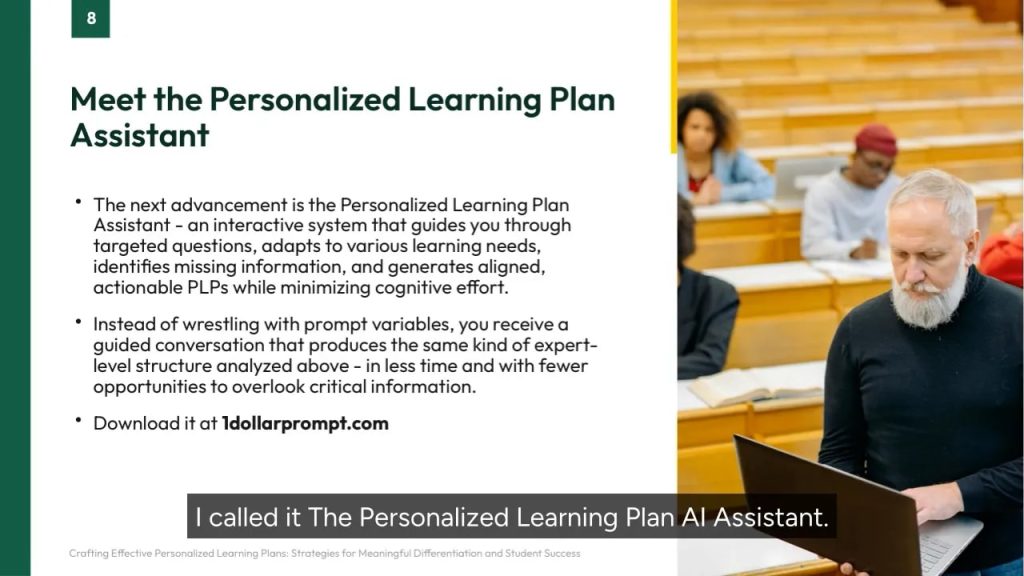
Slide titled Meet the Personalized Learning Plan Assistant

6 Foundations for Turning AI Prompts Into Actionable Personalized Learning Plans

A personalized learning plan can look complete on paper and still fail to guide meaningful support. That problem is especially familiar in differentiated and inclusive classrooms. An AI-generated plan may mention goals, strategies, progress monitoring, and family involvement, yet leave the educator to decide what those ideas mean in practice. The result is a polished document that does not reliably connect a student’s needs to Monday morning instruction. An actionable Personalized Learning Plan (PLP) does more. It links academic strengths and areas for growth to measurable goals, specific strategies, resources, evidence, assigned responsibilities, and scheduled review points. AI can help
Slide introducing the Interactive SEL Activity Designer AI Assistant beside an edtech keyboard image

How to Turn These 5 SEL Competencies Into Classroom-Ready AI Activities

Asking AI for social-emotional learning activities sounds simple: cover the key competencies, keep materials minimal, make the work engaging, and adapt it for a particular group of students. But a plausible answer is not necessarily a usable lesson. Activities may have uneven timing, repeat the same discussion format, overlook emotional regulation in favor of emotion identification, or fail to address the peer conflict and anxiety that made support necessary in the first place. The difference between a generic request and a classroom-ready result is instructional architecture. A stronger prompt gives the model a professional lens, a measurable deliverable, clear constraints,

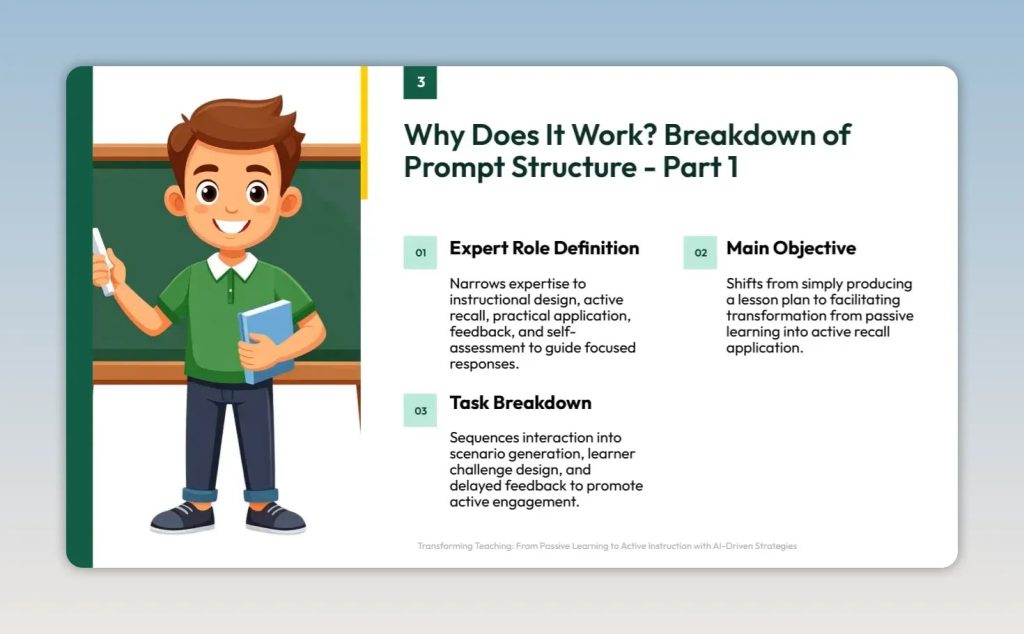
Slide titled Why Does It Work with expert role definition main objective and task breakdown

How to Build 15-Minute Mini-Lesson Challenges With This 4-Stage AI Workflow

You can understand an instructional strategy on paper and still struggle to use it when a real teaching problem appears. The gap is familiar to teachers, corporate trainers, and learning-and-development leaders: theory makes sense, but a low-energy group, mixed experience levels, and an unclear misconception require quick professional judgment. AI can help close that gap—but not when it simply produces a lesson plan on demand. A stronger approach turns AI into a practice environment: it gives you a realistic scenario, asks you to design a response, and withholds the expert model until you have committed to your own plan. This

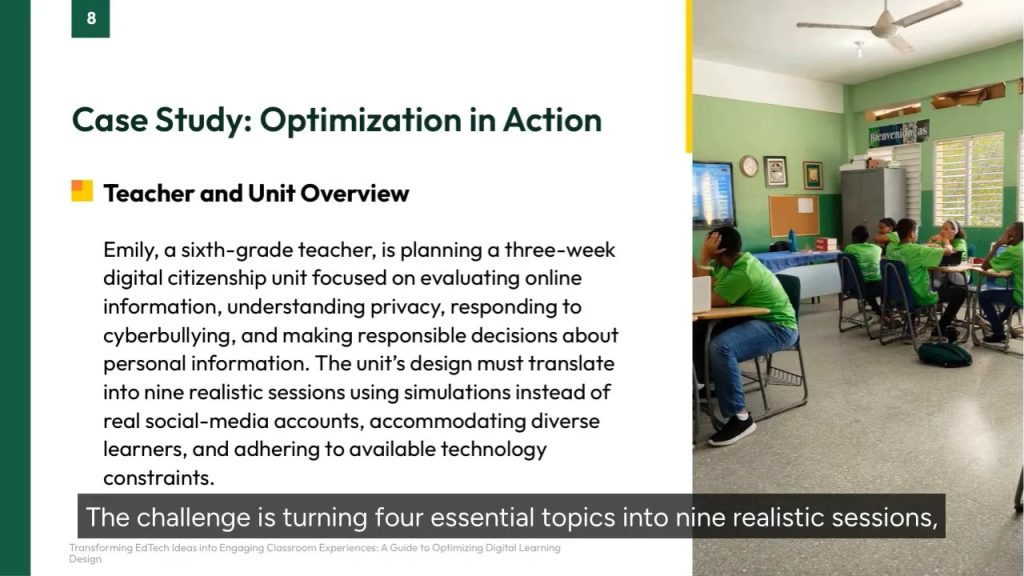
Slide titled Case Study Optimization in Action with classroom photo

6 Prompt Requirements That Turn Vague EdTech Ideas Into Classroom-Ready Learning Plans

Technology-supported learning can sound simple in principle: choose a topic, select a tool, and ask students to create something meaningful. In practice, effective planning has to balance objectives, pacing, accessibility, feedback, student agency, available technology, and uneven access beyond school hours. AI can help organize that complexity—but only when the planning request gives it a useful structure. A loosely written prompt may produce creative activities, yet still leave key decisions unresolved: Which objective comes first? What can realistically fit into the schedule? Which tools are actually approved? How will students with different reading levels and technology skills participate? The solution

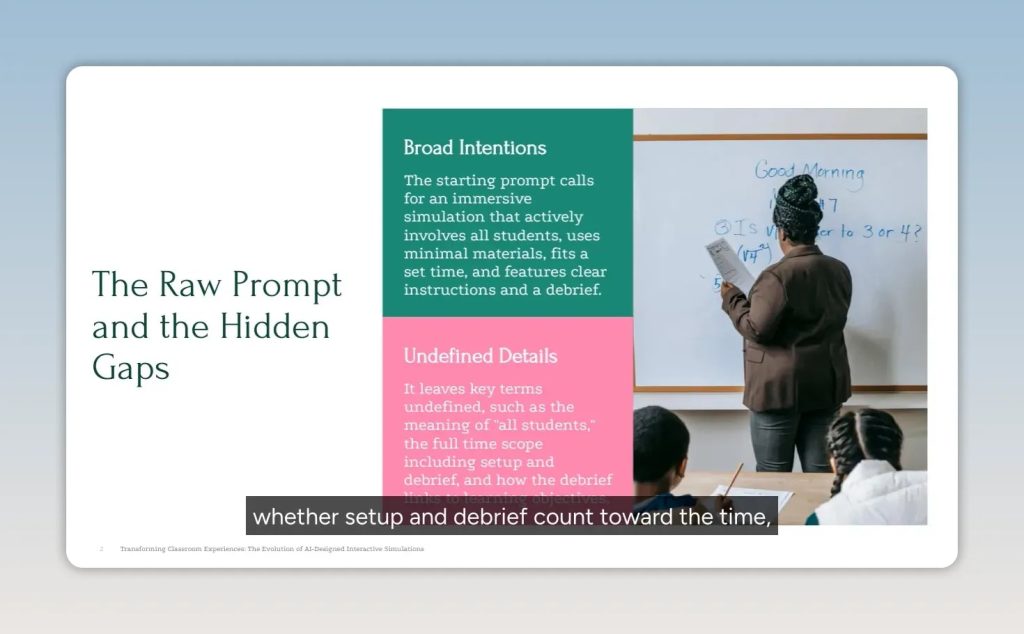
Slide titled The Raw Prompt and the Hidden Gaps with broad intentions and undefined details

6 Checks for Making AI-Generated Simulations Classroom-Ready

A teacher asks AI to design an interactive simulation about photosynthesis and receives an idea that sounds energetic – but cannot fit the class, the materials, the timetable, or the science. This is the central challenge of educational AI. A broad request may express admirable intentions: make an abstract concept concrete, involve every student, use minimal materials, and include a debrief. Yet those intentions alone leave too much for the model to interpret. The result can be a lesson with more roles than students, excessive preparation, vague facilitation, or an oversimplified scientific model. Better prompt design does not mean adding

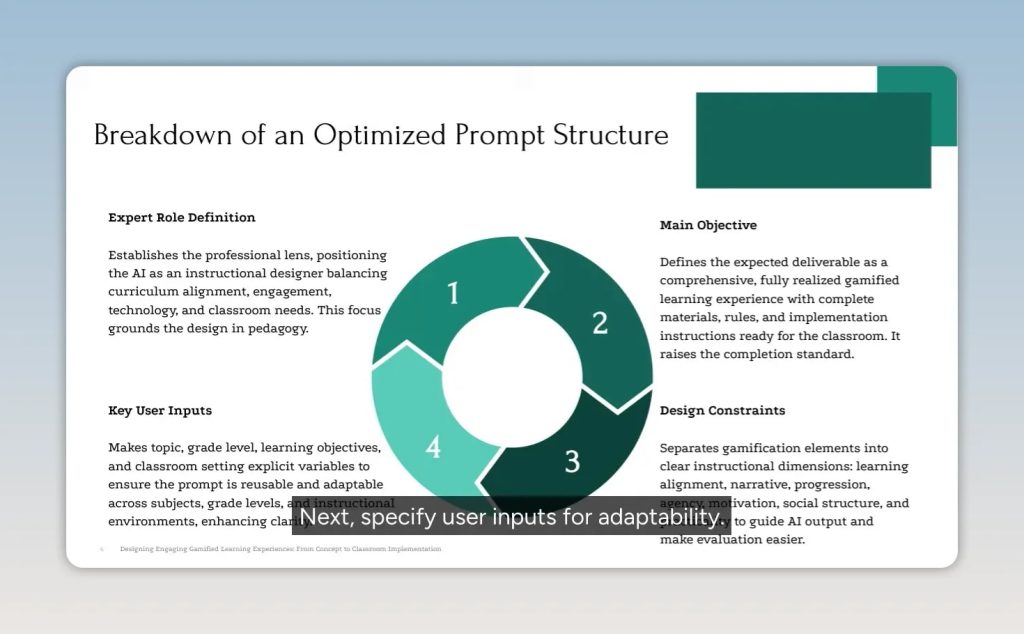
Slide showing a circular four-part breakdown of an optimized prompt structure

7 Design Constraints That Turn Gamification Prompts Into Classroom-Ready Learning Systems

Gamification often sounds easier than it is. The initial idea is appealing: give a unit an immersive theme, let students make choices, reward progress, and build collaboration into the experience. But practical questions arrive quickly. How will the game reinforce the actual learning objectives? Will the challenges build skills instead of simply adding entertainment? Can the system work for English language learners, students with IEPs, and a classroom with limited technology? And where are the handouts, source packets, rubrics, rules, and teacher procedures? A short AI request may generate an engaging concept, but it leaves too many instructional decisions open.

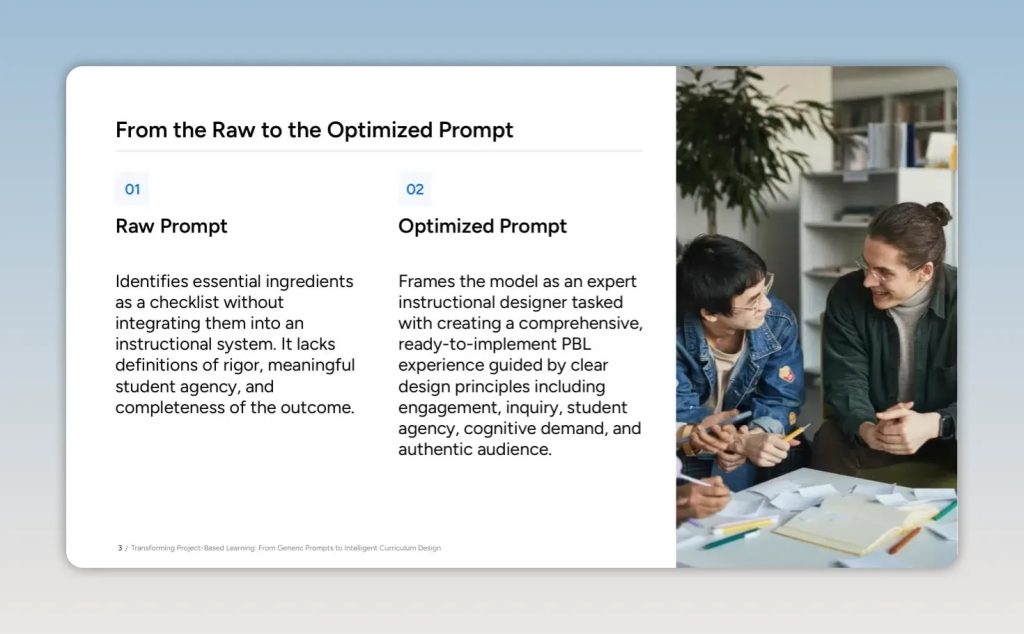
Slide comparing a raw prompt with an optimized prompt

Make AI-Generated PBL Plans More Rigorous With These 5 Core Design Principles

Project-based learning (PBL) can turn a classroom topic into meaningful work: students investigate a real problem, make decisions, collaborate, and create something for an audience beyond the teacher. But designing that kind of experience takes careful planning. Standards, time, available technology, student needs, assessment, and authentic outcomes all need to work together. AI can support that planning, but the quality of the result depends heavily on the request. A generic prompt may list the ingredients of a project without explaining the level of rigor, the instructional priorities, or what a usable final plan should contain. A stronger prompt makes those

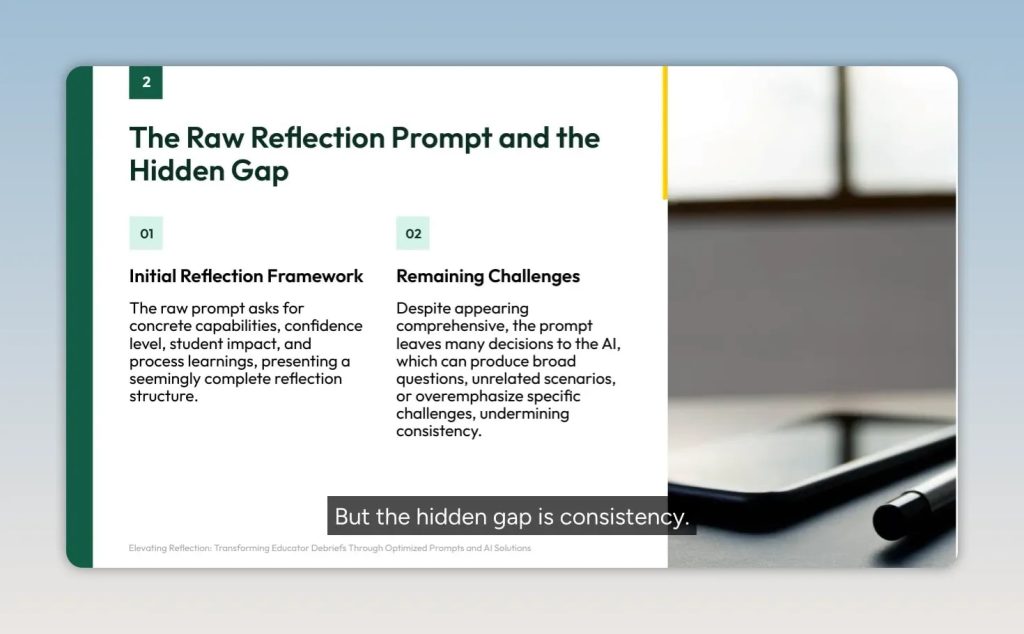
Slide titled The Raw Reflection Prompt and the Hidden Gap with columns for reflection framework and remaining challenges

Turn Educator Reflection Into Action With a 4-Part AI Debrief Framework

A professional learning cycle can create real classroom change—and still end with a reflection that barely captures what changed, why it mattered, and what should happen next. The familiar questions, What went well? and What would you do differently?, are not wrong. They are simply too broad on their own. They often produce sincere but general answers, leaving educators without a clear account of new capabilities, confidence, student outcomes, or next-cycle actions. That is not necessarily a reflection problem. It is often a prompt-design problem. A well-designed AI reflection prompt can turn a loose retrospective into a structured coaching debrief.

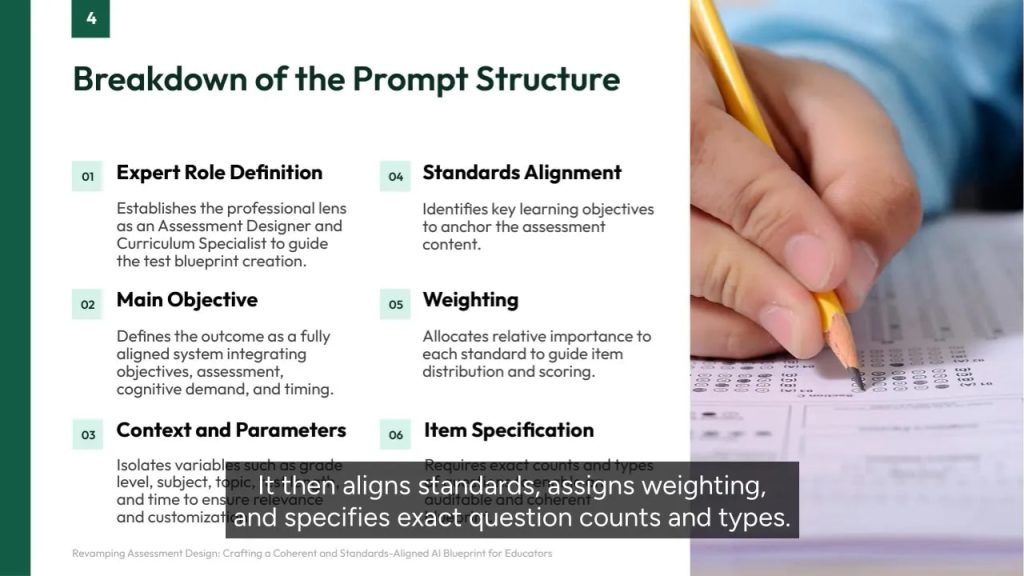
Slide showing a breakdown of prompt structure with six assessment components

How to Build Auditable AI Test Blueprints Across 6 Essential Components

A summative assessment can look polished and still be fundamentally misaligned. A test may cover the right topic, contain a reasonable mix of formats, and fit into a familiar class period. Yet a closer review can reveal a mismatch between standards and items, weighting that does not reflect instructional priorities, cognitive demand that stays too low, or totals that simply do not add up. AI can speed up assessment planning, but it cannot replace assessment judgment. The useful goal is not merely to generate a test blueprint. It is to produce an artifact that is coherent, standards-aligned, instructionally useful, mathematically

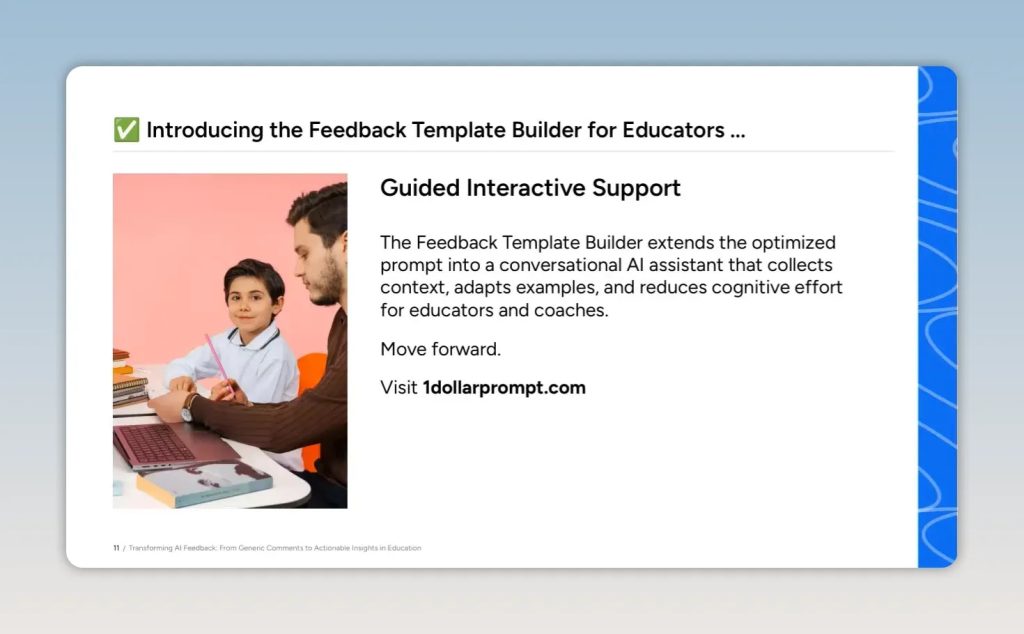
Slide introducing Feedback Template Builder for Educators with guided interactive support

Turn Generic Feedback Into Action With this 5-Part Coaching Framework

“Go deeper.” “Connect this to theory.” “Make your goal more specific.” “Consider the student perspective.” These are familiar feedback comments – and often accurate ones. But accuracy alone does not show a learner what to change, how to change it, or how to approach the next attempt with confidence. AI can help educators create reusable feedback faster, but a general request often creates general results. The real opportunity is not simply generating more comments. It is designing a feedback system that moves clearly from diagnosis to action. A stronger prompt gives an AI model a professional role, an educational objective,