“Go deeper.” “Connect this to theory.” “Make your goal more specific.” “Consider the student perspective.” These are familiar feedback comments – and often accurate ones. But accuracy alone does not show a learner what to change, how to change it, or how to approach the next attempt with confidence.
AI can help educators create reusable feedback faster, but a general request often creates general results. The real opportunity is not simply generating more comments. It is designing a feedback system that moves clearly from diagnosis to action.
A stronger prompt gives an AI model a professional role, an educational objective, relevant context, and a required structure for each response. The result is more precise, more consistent, and much easier to adapt across assignments.
Key Takeaways
- Generic feedback becomes more useful when it explains the gap, gives revision steps, reinforces strengths, and models improvement.
- An optimized prompt should define an expert role, a reusable learning objective, relevant context, and required feedback components.
- Claude favors depth, Gemini favors concise accessibility, and Minimax M3 offers a practical middle ground.
- Guided AI assistants can collect context conversationally while educators retain professional judgment.
Table of Contents
- The Prompt Transformation: From Raw Request to Instructional Framework
- Why the Optimized Structure Produces Better Feedback
- Case Study: Bethany’s Reflective Teaching Journals
- Three AI Models, Three Feedback Styles
- How to Choose the Right Model for the Job
- From Optimized Prompts to a Guided AI Assistant
- Final Thoughts
The Prompt Transformation: From Raw Request to Instructional Framework
A raw prompt may include the basic ingredients of useful feedback, yet still leave too much open to interpretation. The model may not know the intended tone, how detailed the guidance should be, or whether the feedback is meant for quick marking, a coaching conversation, or a reusable template bank.
The Starting Point: Raw Prompt
Create a set of feedback templates for common issues I see in student
[ASSIGNMENT TYPE] for my [SUBJECT] class. For each issue, provide:

1. A brief explanation of the issue
2. Constructive feedback that identifies the problem
3. Specific guidance on how to improve
4. A positive reinforcement component
5. An example of how the work could be improved

The common issues I typically see include: [LIST COMMON ISSUES]
This is a sound starting point. It asks for explanation, guidance, encouragement, and an example. However, it does not establish the educational expertise behind the response or define what “specific guidance” must look like in practice.
The Transformation: Optimized Prompt
You are an expert Instructional Designer and experienced educator
specializing in creating high-quality, actionable, and constructive
feedback mechanisms for diverse academic settings.

Your primary objective is to develop a comprehensive set of reusable
feedback templates designed to address recurring performance gaps
observed in student submissions and support effective improvement.

Tailor the templates to this context:
- Assignment Type: [ASSIGNMENT TYPE]
- Subject Area: [SUBJECT]
- Identified Common Issues: [LIST COMMON ISSUES]

For each distinct issue, create a feedback template with:
1. Issue Explanation: A concise, jargon-free explanation.
2. Constructive Identification: Student-facing language that clearly
   names the observed gap.
3. Actionable Guidance: Detailed steps for correcting or avoiding it.
4. Positive Reinforcement: Encouragement that recognizes effort or a
   successful element.
5. Improvement Example: A short example of better application.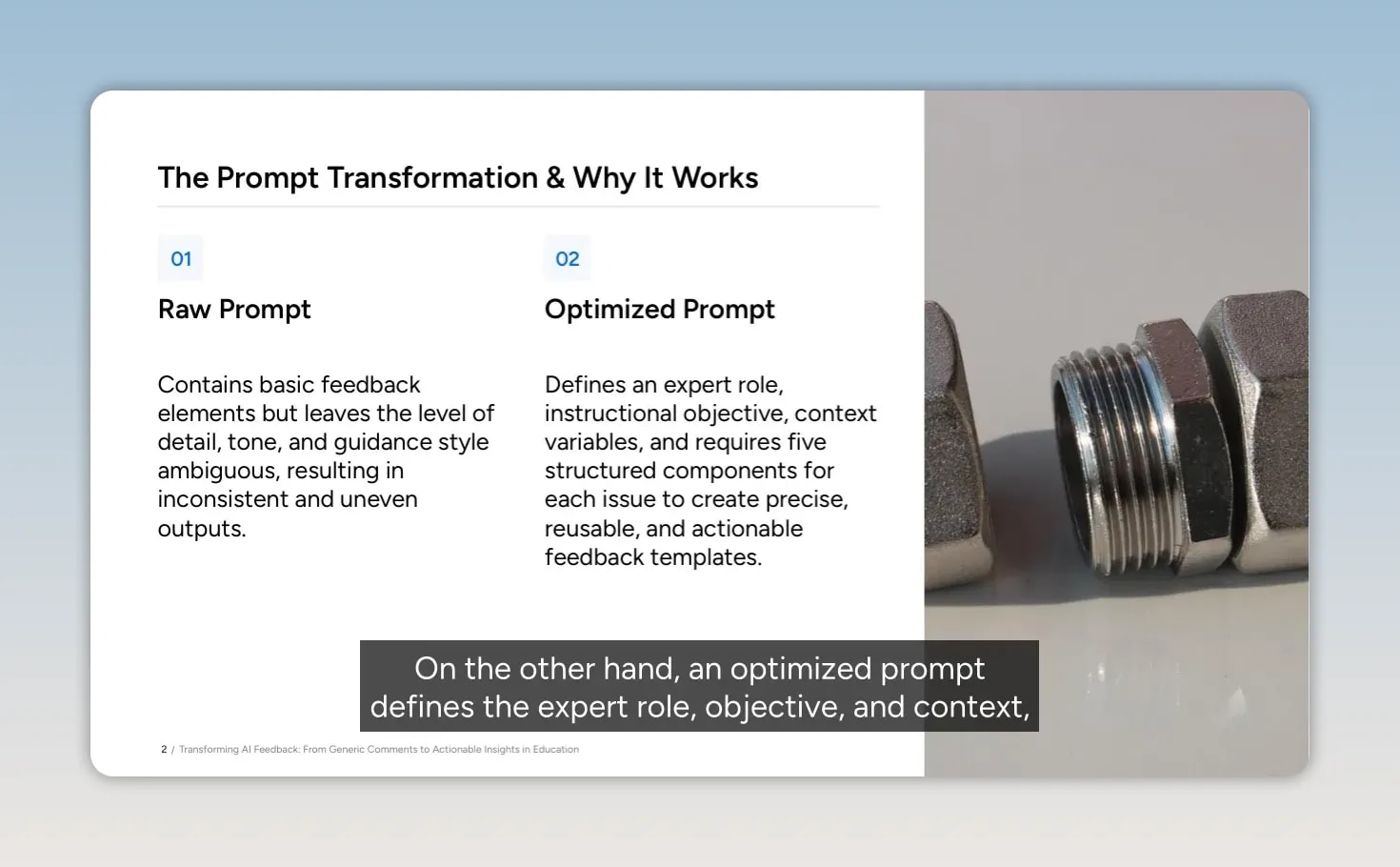
The difference is not unnecessary complexity. It is instructional clarity. The optimized version establishes the standard the AI should work toward, separates stable instructions from variables, and ensures every identified issue becomes a pathway from a performance gap to a practical next step.
Why the Optimized Structure Produces Better Feedback
The framework rests on three structural choices: professional role, clear objective, and organized context with explicit components.
1. Define the Expert Role
Asking the model to act as an instructional designer and experienced educator gives it a useful professional lens. The task becomes more than identifying errors. It must create feedback that is constructive, actionable, and appropriate for learning.
2. Clarify the Objective
The goal is a reusable feedback bank for recurring gaps, not a one-off grading remark. That distinction matters. A brief comment such as “Your reflection needs more analysis” may be correct, but a reusable template needs to explain what analysis involves and suggest a repeatable revision method.
3. Separate Context From Requirements
Assignment type, subject area, and recurring issues should be variable inputs. The feedback architecture should remain stable. This makes the same system useful for reflective journals, laboratory reports, essays, lesson plans, professional-training evaluations, and many other forms of work.
The five required components provide the learning pathway:
- Issue explanation makes the underlying concept understandable.
- Constructive identification gives educators adaptable language for naming the gap.
- Actionable guidance translates broad advice into steps a learner can follow.
- Positive reinforcement preserves motivation and identifies strengths to build on.
- Improvement examples make an abstract expectation visible and practical.
Case Study: Bethany’s Reflective Teaching Journals
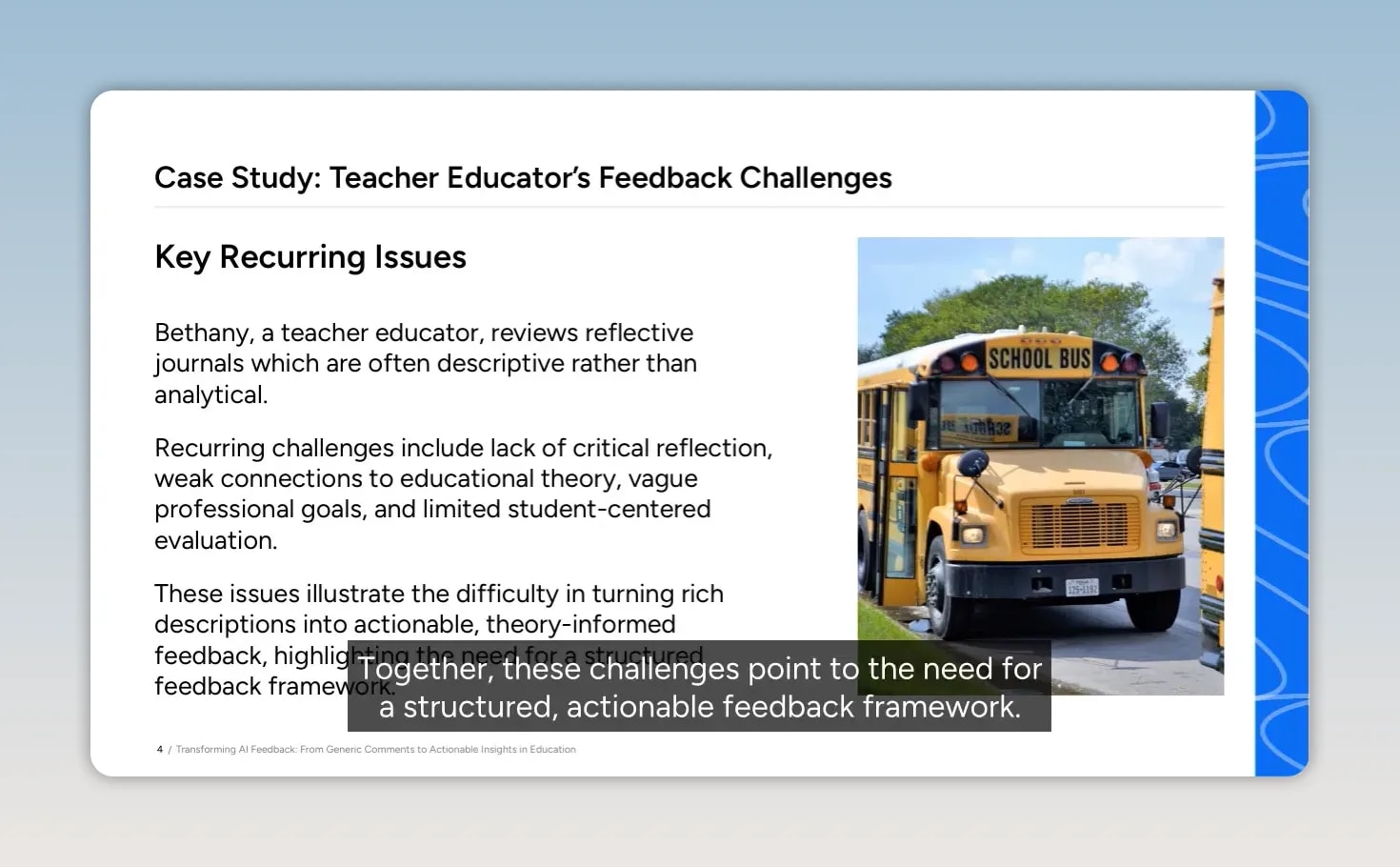
Bethany is a teacher educator reviewing reflective journals from aspiring teachers. The entries describe classroom experiences, lesson delivery, and teaching decisions, but several performance gaps appear repeatedly.
- Reflection remains descriptive rather than critically analytical.
- Links between educational theory and classroom practice are weak.
- Professional-development goals are vague rather than measurable.
- Lesson effectiveness is considered mainly from the teacher’s perspective, with limited attention to students.
In this context, a useful critical-reflection template would not stop at “analyze your teaching decisions.” It could ask the writer to identify a decision, explain why it was made, consider alternatives, examine the impact on students, and determine what evidence would support a revised approach.
Similarly, feedback on vague goals should encourage a defined action, a measurable indicator, and a review point. Feedback on student-centered reflection should ask for evidence of what students were doing, thinking, and learning – not merely whether the lesson was delivered as planned.
Three AI Models, Three Feedback Styles
The same optimized prompt was tested across Claude Sonnet 4.6, Gemini 3.1 Pro Preview, and Minimax M3. All three can produce structured feedback templates, but their practical strengths differ. The core trade-off is depth versus accessibility.
Claude Sonnet 4.6: Comprehensive Coaching
Claude Sonnet 4.6 offers the most expansive approach. Its strength is implementation depth: detailed coaching questions, evidence-collection strategies, and full improvement cycles. It can encourage educators to use practical evidence such as exit tickets, daily tallies, and student-feedback surveys.
This makes it especially useful for instructional coaching, teacher-education programs, and structured professional development. The trade-off is reading load. For rapid margin comments or high-volume marking, its richness may require more editing than a shorter response.
Gemini 3.1 Pro Preview: Concise and Accessible
Gemini 3.1 Pro Preview provides the most concise response, at approximately 1,089 words in this comparison. Its key value is clarity. It frames the move from description to critical analysis and from teacher delivery to student engagement in accessible language.
That makes it a useful option for beginning educators, short feedback banks, and situations where scannability matters most. Its limitation is that some guidance is less developed, so educators may need to add more concrete methods for collecting evidence or monitoring improvement.
Minimax M3: Balanced and Actionable
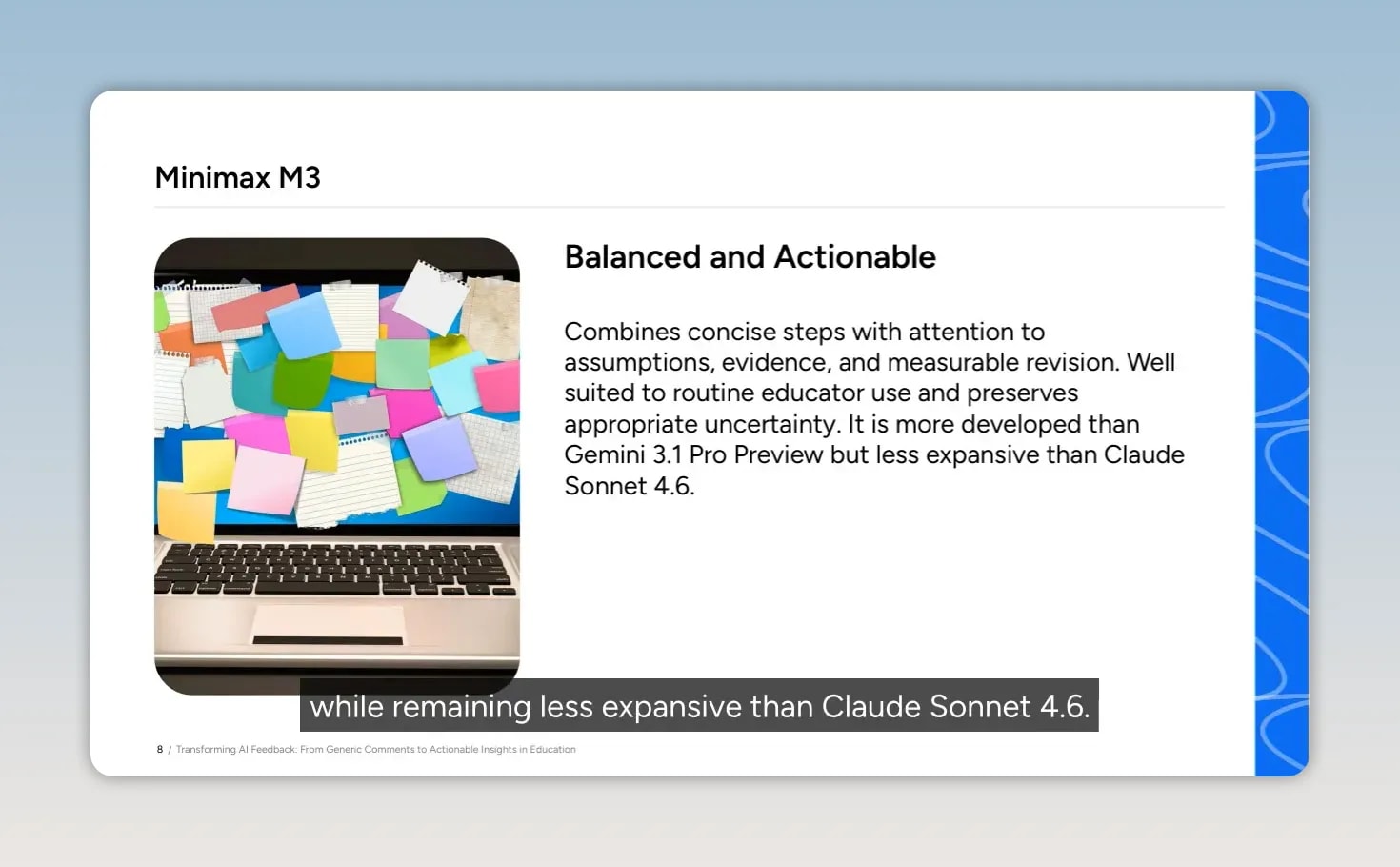
Minimax M3 sits between the two. It combines concise action steps with attention to assumptions, evidence, and measurable revision. This balance makes it well suited to routine educator use, mentoring conversations, and feedback frameworks that need to remain readable without becoming superficial.
Its approach supports questions such as: What decision was made? What evidence supports this interpretation? What should change next? How will progress be measured? It provides more developed practical guidance than the concise option while remaining less expansive than the comprehensive coaching model.
How to Choose the Right Model for the Job
| Model | Best fit | Primary strength | Trade-off |
|---|---|---|---|
| Claude Sonnet 4.6 | Coaching and complex instructional work | Detailed implementation and evidence cycles | Higher reading load |
| Gemini 3.1 Pro Preview | Beginning educators and quick feedback banks | Concise, easy-to-scan guidance | Less operational detail |
| Minimax M3 | Routine educator feedback and mentoring | Practical balance of evidence and action | Less comprehensive than Claude |
No model output should replace professional judgment. Educators still need to verify examples, calibrate tone, determine whether the suggested evidence fits the assignment, and adapt the feedback to learners’ experience levels. A well-designed prompt improves consistency; it does not remove the need for expert review.
From Optimized Prompts to a Guided AI Assistant
Even an excellent prompt leaves administrative and cognitive work behind the scenes. Someone must enter the assignment type, identify recurring issues, choose the required level of detail, assess the results, and rewrite the prompt when the context changes.
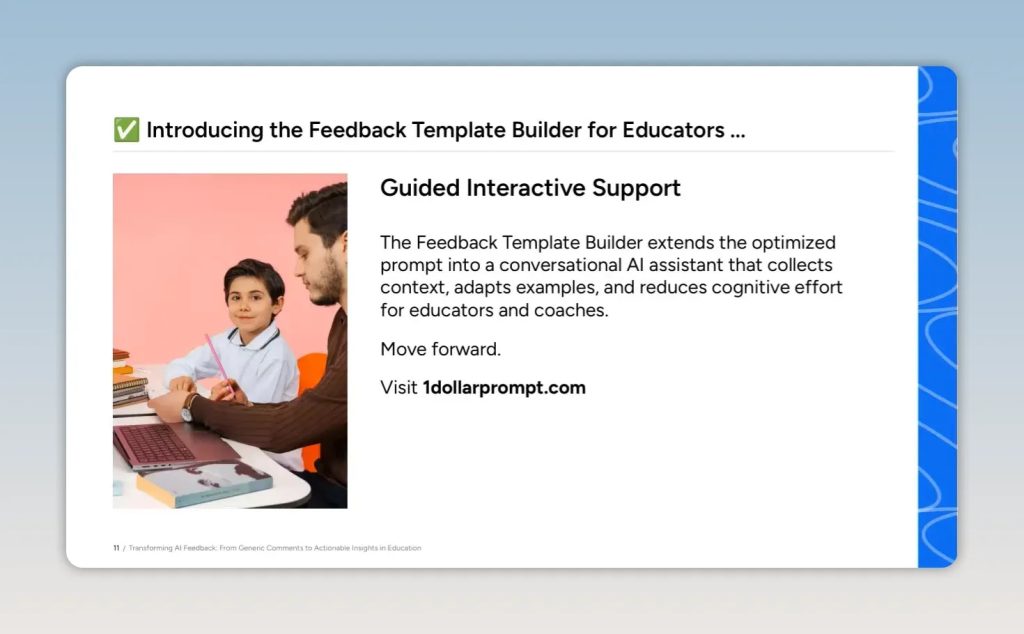
A guided feedback-template assistant changes that input process. Rather than requiring a completed specification upfront, it can ask focused questions about the work being reviewed, subject area, learner experience, recurring gaps, intended tone, and use case. It can then tailor the same feedback framework to the situation.
The Feedback Template Builder For Educators is designed around this conversational approach. It gathers context, adapts examples, and reduces repetitive prompt formatting, while educators remain responsible for interpreting the output and ensuring it serves learner needs.
Final Thoughts
High-quality feedback is not simply more detailed criticism. It is a structured form of coaching: identify the issue, explain why it matters, show a practical way forward, recognize what is working, and provide an example of improvement.
The optimized prompt makes that structure repeatable. It defines a professional role, establishes a learning objective, organizes context, and requires five components that turn comments into actionable guidance. Whether the preferred model is comprehensive, concise, or balanced, that prompt architecture creates a stronger foundation for thoughtful educational feedback.
Frequently Asked Questions
What makes AI feedback actionable?
Actionable feedback identifies the specific issue, explains why it matters, provides concrete improvement steps, includes encouragement, and shows a brief example of stronger work.
What information should an educator include in a feedback prompt?
Include the assignment type, subject area, recurring performance gaps, intended audience, desired tone, and the required structure for each feedback template.
Which AI model is best for educator feedback?
The best choice depends on the workflow. Claude Sonnet 4.6 is suited to detailed coaching, Gemini 3.1 Pro Preview to concise and accessible feedback, and Minimax M3 to balanced routine use.


