Articles for author: Ariel Elyah

How to Write Reliable Rubrics with Generative AI

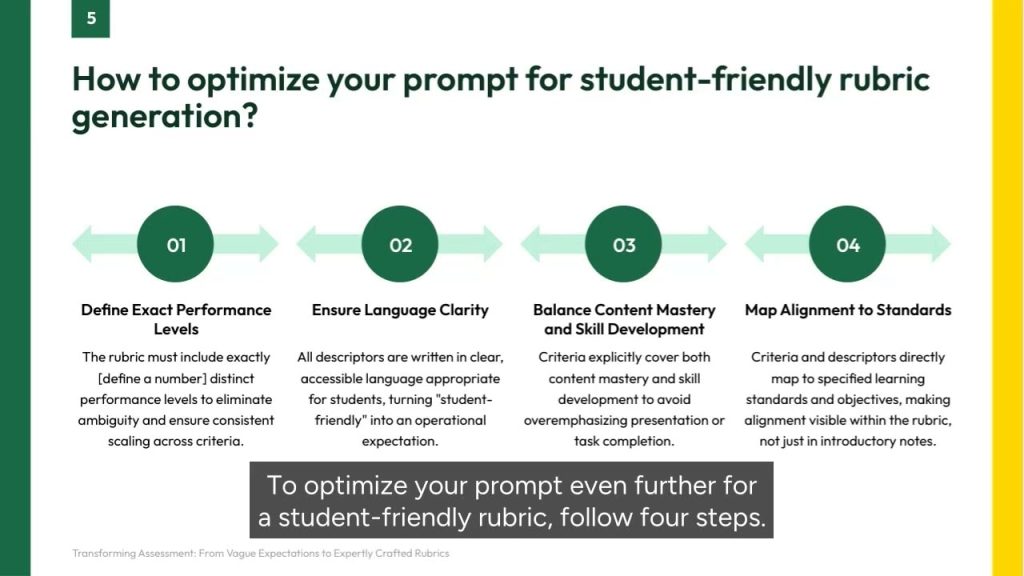
4 Requirements That Turn AI-Generated Rubrics Into Reliable Assessment Systems

A rubric can determine whether an assignment feels transparent or arbitrary. When expectations are concrete, students can plan, self-assess, revise, and understand how their work will be evaluated. When expectations are vague, students may focus on the wrong details while instructors spend more time clarifying requirements and defending grades. Generative AI can draft a rubric quickly, but polished language does not automatically create a reliable assessment instrument. A generic request may overlook standards alignment, formative assessment, accessibility, collaboration, or required deliverables. The answer is not simply asking for a longer rubric. It is providing a stronger instructional design framework. Key
Slide showing role definition scope specification and required components

5 Prompt Elements That Turn Formative Assessment Ideas Into Classroom Decisions

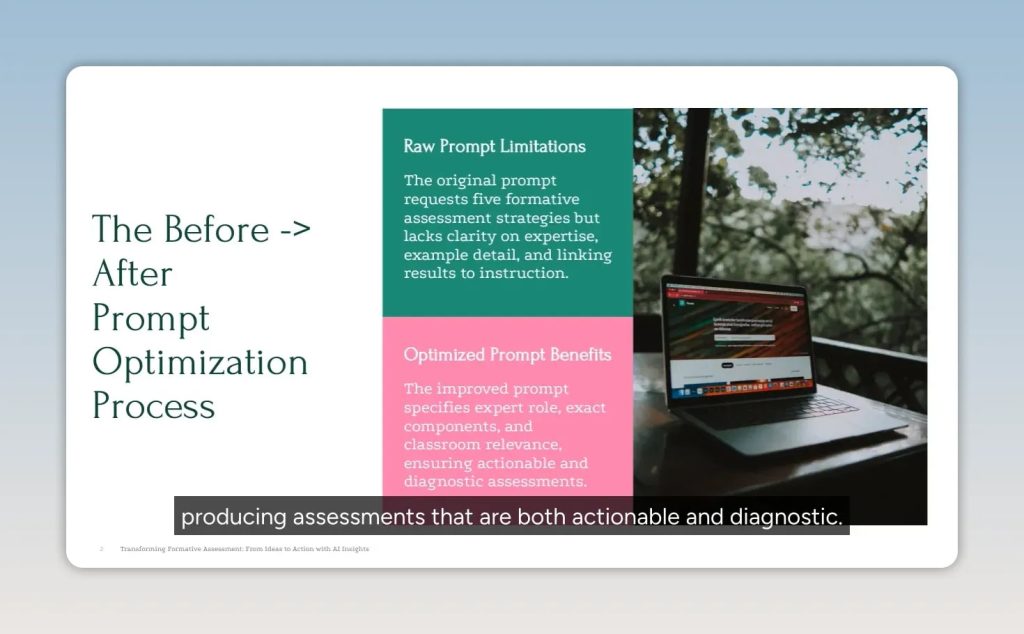
Formative assessment matters because it helps teachers understand what students can do now and what teaching move should come next. The challenge is moving beyond a request such as “Give me some assessment ideas” toward strategies that reveal understanding, support different learners, fit the time available, and produce evidence worth acting on. Generative AI can help, but a broad request often produces broad answers: familiar activity names without ready-to-use materials, accessibility supports, or a clear explanation of how results should change instruction. The solution is not simply to ask for more ideas. It is to turn the request into a

Slide comparing a raw prompt and optimized prompt

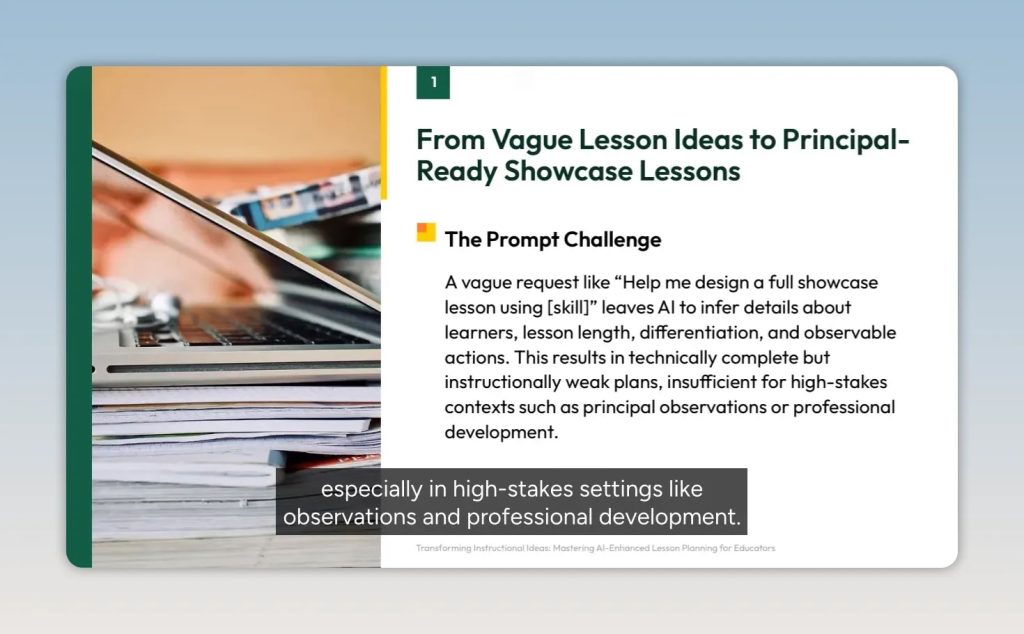
Turn Vague Ideas Into Principal-Ready Lessons With a 3-Part AI Prompt

A teacher can have a strong instructional idea and still receive a weak AI-generated lesson plan. The problem is often not teaching expertise. It is an incomplete request. A prompt such as “Help me create a showcase lesson using Think-Pair-Share” leaves essential decisions to the AI: learner needs, subject content, lesson duration, observable outcomes, differentiation, assessment alignment, and the precise role of the named strategy. The result may look polished while remaining difficult to teach, assess, or defend during a principal observation. For high-stakes settings—including classroom observations, curriculum rollouts, and professional learning—technical completeness is not instructional quality. A stronger approach

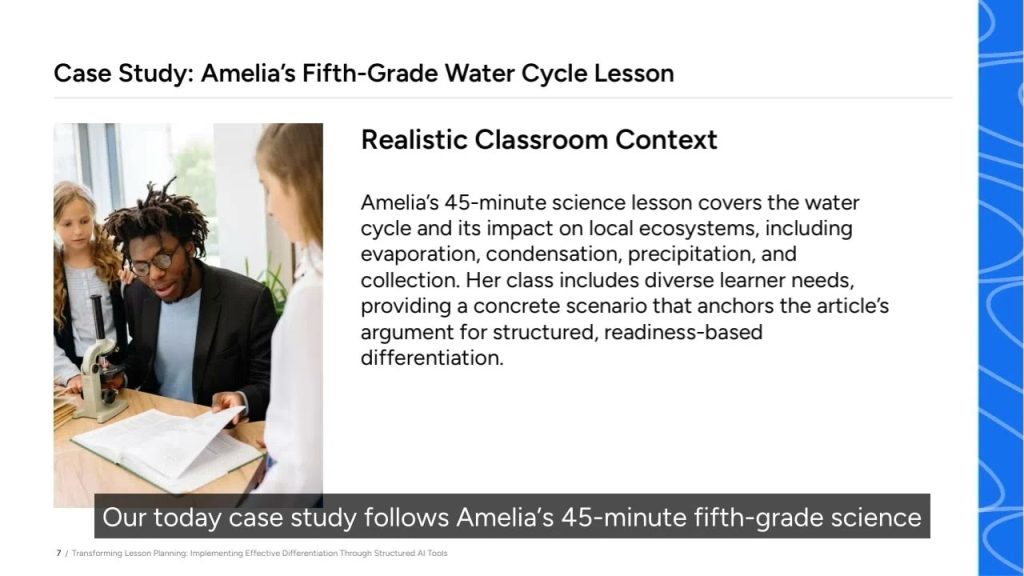
How to Prompt AI for Differentiated Lesson Plans (UDL & Readiness Tiers)

Turn One Lesson Into 3 Readiness Tiers Without Lowering the Learning Goal

Differentiating a lesson is more demanding than creating three versions of a worksheet. It means preserving a common learning objective while adjusting the level of support, independence, complexity, and evidence of mastery for different student needs. AI can accelerate that work, but only when the request provides an instructional structure. A vague request may produce reasonable-sounding ideas while leaving important choices unresolved: What stays consistent? What changes? How should assessment align with instruction? And how can a support pathway increase access without lowering rigor? A stronger prompt turns AI from an idea generator into a more reliable planning partner. It

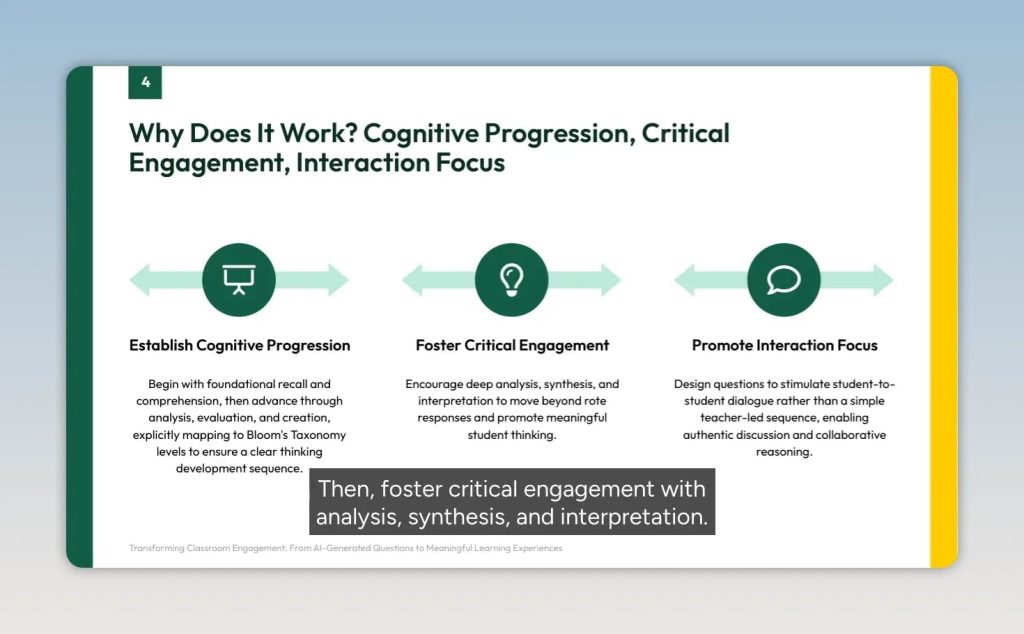
Slide showing cognitive progression critical engagement and interaction focus

The 5-Part Framework That Turns AI Questions Into Classroom-Ready Discussions

Planning a thoughtful discussion takes more than asking an AI tool for “10 questions about this topic.” A basic request can produce material that is usable, but usable is not always rigorous, sequenced, relevant, or ready for a real classroom. The difference lies in prompt design. When instructional goals remain implied, an AI model has to guess how to build complexity, surface misconceptions, encourage peer dialogue, and connect learning to the world beyond the classroom. A stronger prompt makes those decisions explicit. This guide shows how to transform a broad discussion-question request into a reusable curriculum framework. It also examines

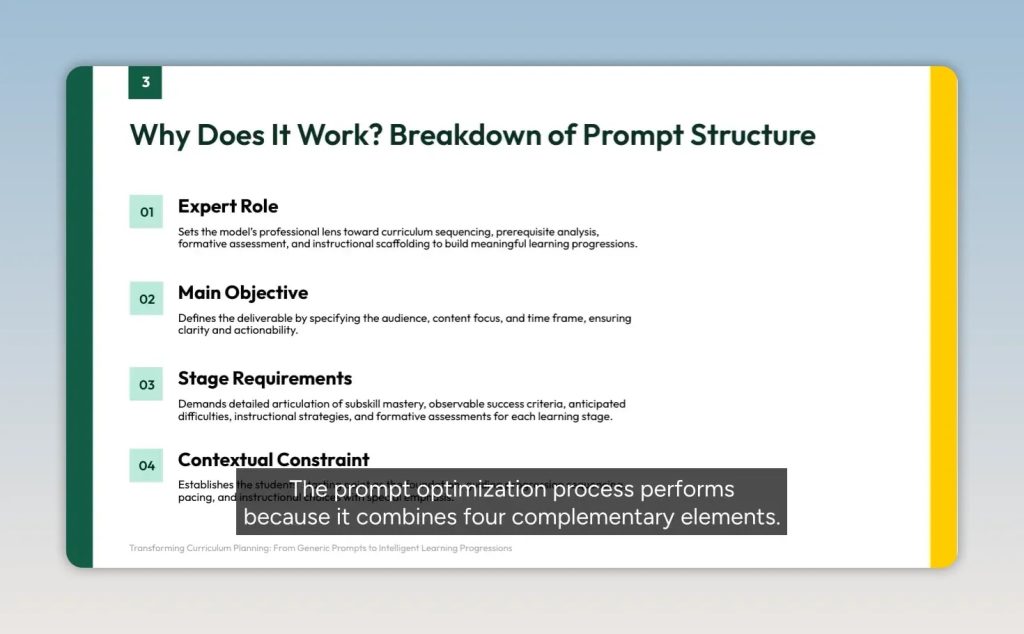
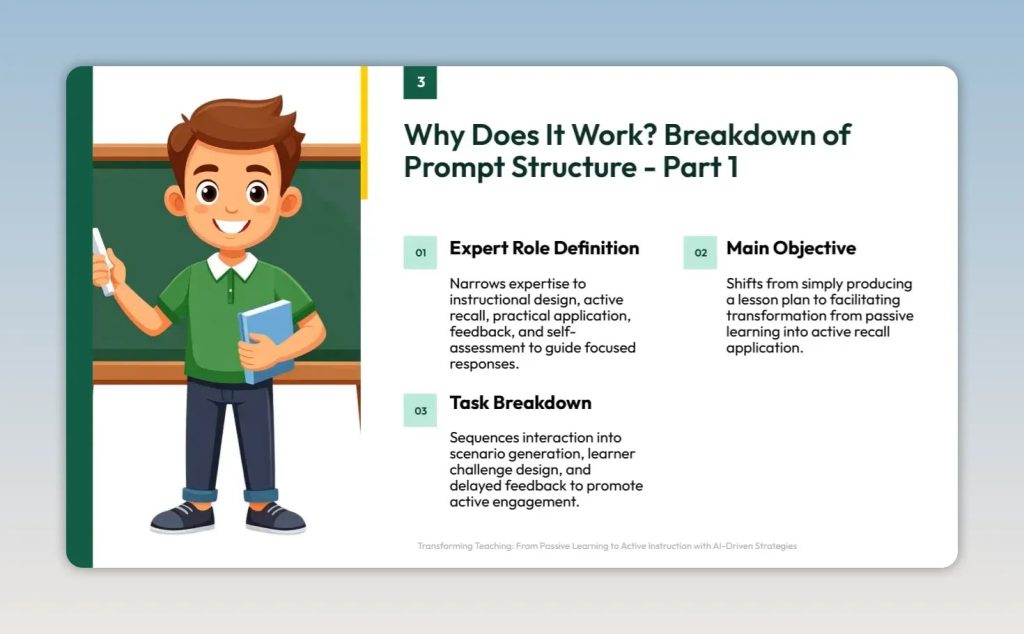
Slide listing expert role, main objective, stage requirements, and contextual constraints

How 4 Prompt Elements Turn AI Outlines Into Usable Learning Progressions

A learning progression is one of the most valuable tools an educator can build—and one of the easiest to make only superficially. An AI-generated plan may arrive with polished headings, activities, and assessments. Yet it can still be difficult to use in practice: stages may not fit the calendar, success criteria may be impossible to observe, assessments may not match instruction, or the sequence may overlook what students already know. The issue is often not the educational goal. It is the gap between what an educator intends and what the prompt actually communicates. A generic request can produce a useful

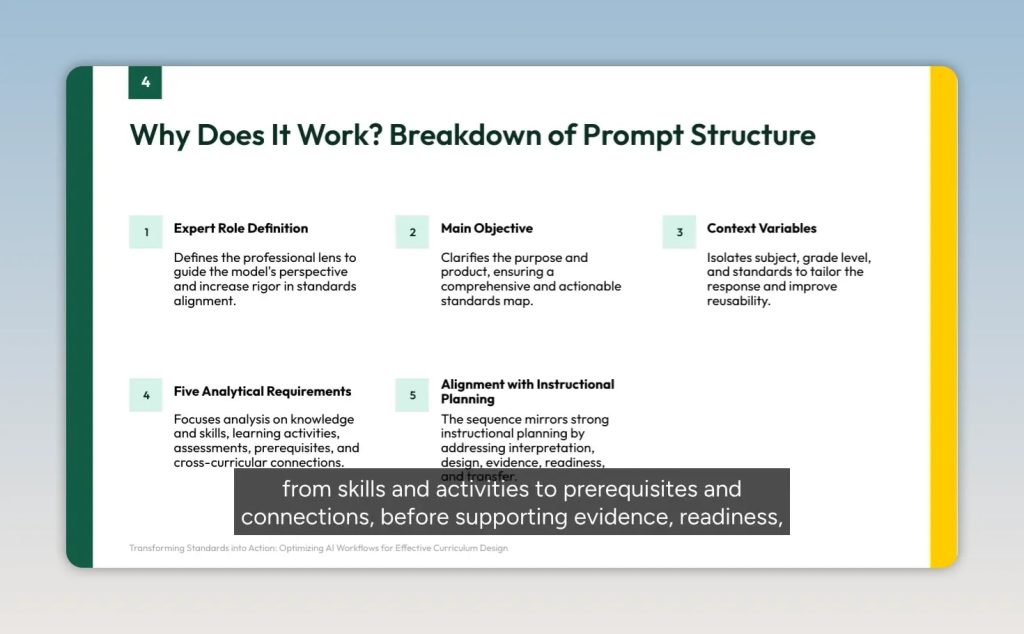
Slide showing five parts of prompt structure including expert role and analytical requirements

Build Classroom-Ready Curriculum Maps With a 5-Part AI Prompt Framework

Key Takeaways Table of Contents Introduction Standards alignment often appears straightforward—until a dense performance expectation needs to become teachable goals, meaningful learning experiences, and credible evidence of mastery. That work requires more than listing vocabulary and suggesting a few activities. You need to identify what learners must know, what they must be able to do, which foundations need to be in place first, and how an assessment can demonstrate the performance the standard actually requires. Many AI requests begin with a simple instruction: break down these standards and suggest activities. The output may look polished while remaining difficult to apply.

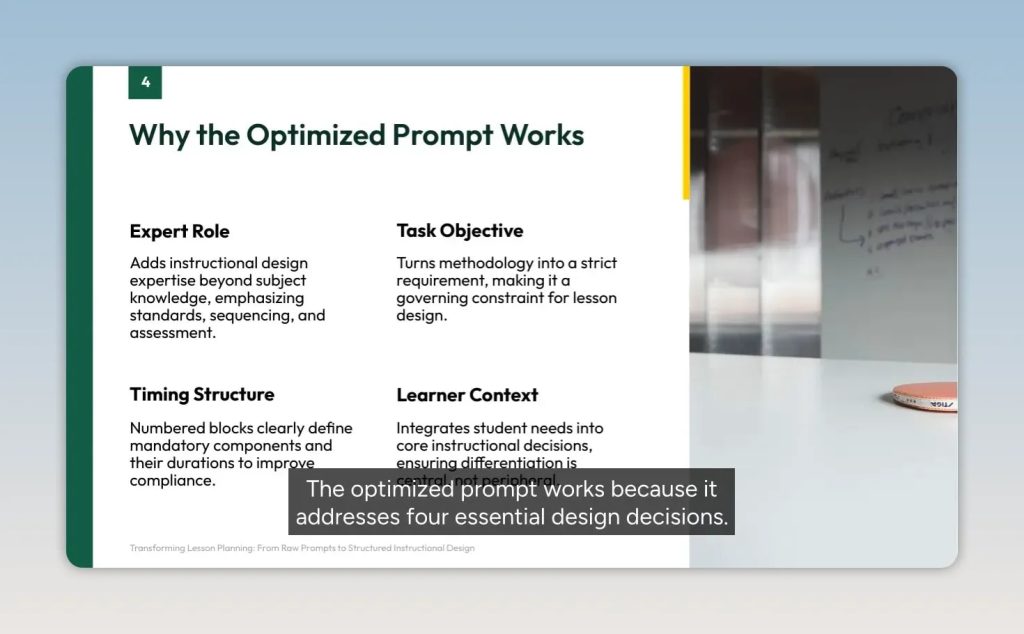
Slide titled Why the Optimized Prompt Works showing Expert Role, Task Objective, Timing Structure, and Learner Context

4 Prompt Design Decisions That Turn AI Drafts Into Teachable Lessons

A detailed lesson-planning prompt can still produce a weak lesson. You can specify a subject, grade level, standards, methodology, timing, materials, misconceptions, and learner needs—then receive a response that appears complete but is not ready to teach. It may include every requested heading while missing scientific accuracy, meaningful differentiation, or a realistic sequence of activities. Completeness is not the same as instructional quality. The practical goal is to turn a broad request into a standards-aligned, teachable lesson with a clear internal logic: objectives shape activities, activities create evidence of learning, timing reflects classroom reality, and learner needs influence the design