A detailed lesson-planning prompt can still produce a weak lesson.
You can specify a subject, grade level, standards, methodology, timing, materials, misconceptions, and learner needs—then receive a response that appears complete but is not ready to teach. It may include every requested heading while missing scientific accuracy, meaningful differentiation, or a realistic sequence of activities.
Completeness is not the same as instructional quality.
The practical goal is to turn a broad request into a standards-aligned, teachable lesson with a clear internal logic: objectives shape activities, activities create evidence of learning, timing reflects classroom reality, and learner needs influence the design from the beginning.
Key Takeaways
- Detailed prompts can still fail when requirements are presented as an unstructured checklist.
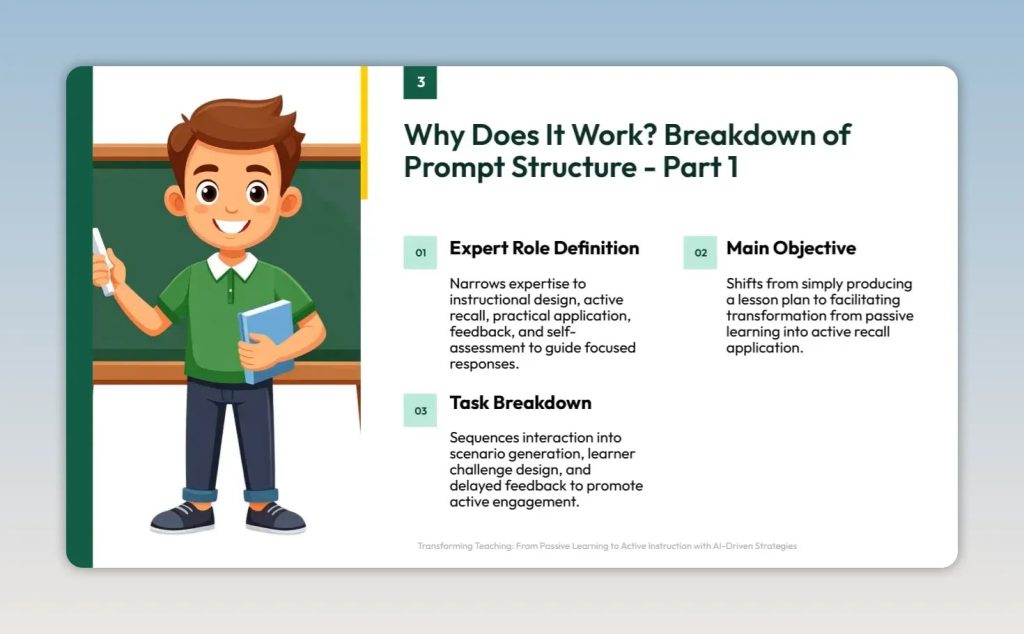
- Strong lesson-planning prompts define an expert role, task objective, timing structure, and learner context.
- AI outputs require human review for standards alignment, timing, differentiation, and scientific accuracy.
- A guided workflow can reduce planning friction while preserving educator judgment.
Table of Contents
- The Core Problem: A Raw Prompt Has Many Ingredients but No Hierarchy
- The Better Approach: Give the Model an Instructional Architecture
- A Reusable Prompt Framework
- What a Strong Lesson-Planning Prompt Should Make Easy to Check
- Three AI Outputs, Three Different Strengths and Risks
- From an Optimized Prompt to a Guided Workflow
- Final Thoughts
The Core Problem: A Raw Prompt Has Many Ingredients but No Hierarchy
A typical lesson-planning prompt often combines roles, objectives, instructional methods, standards, timing, materials, assessment, and differentiation in one large request. Every detail may matter, but the model is not told which requirements govern the others.
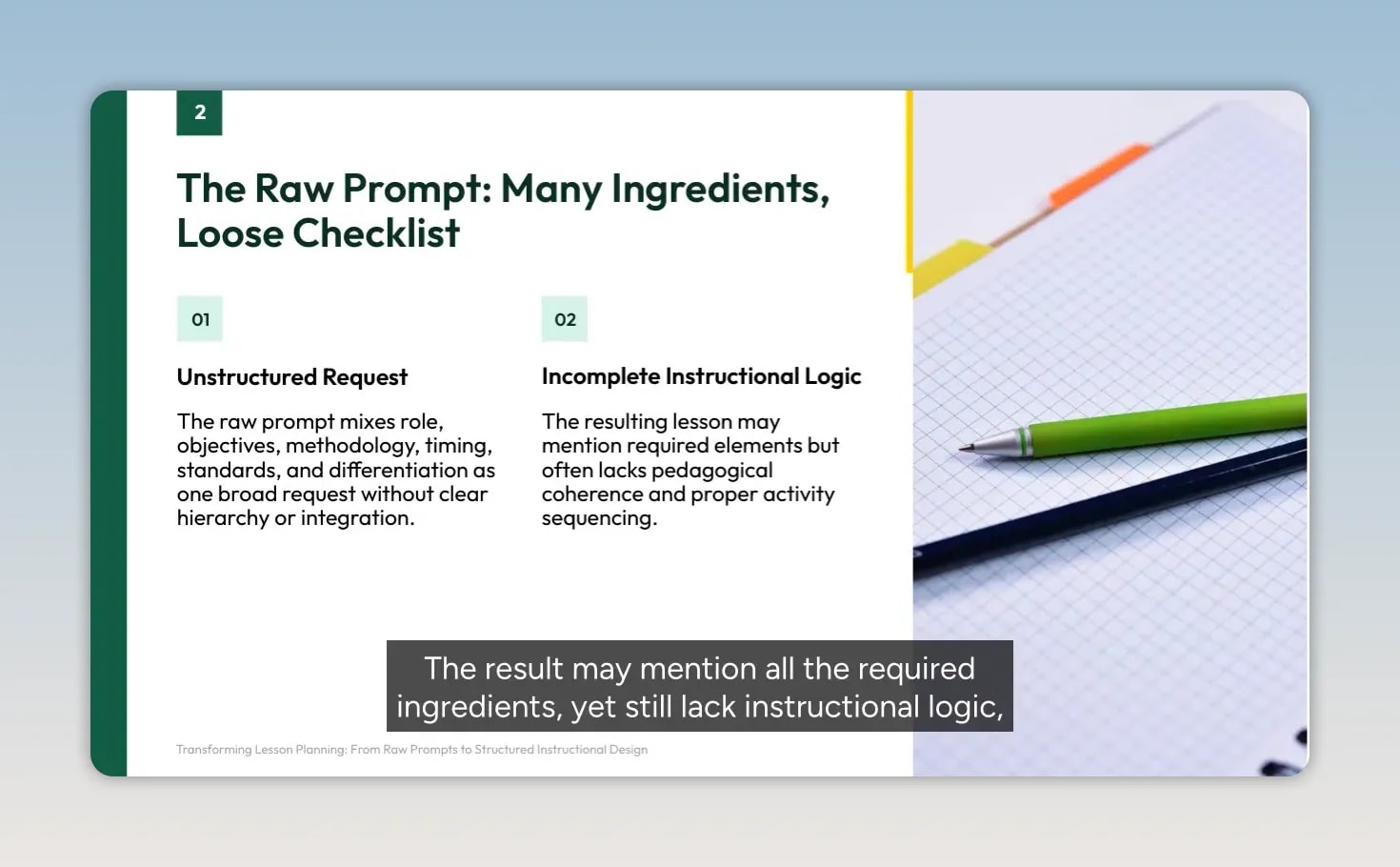
That is where output quality can break down. An AI tool may mention the selected framework, cite a standard, list materials, and add accommodations at the end. Yet the activities may not actually follow the framework. The standard may be named without being assessed. Differentiation may remain a generic note rather than a choice reflected in grouping, vocabulary, task design, and response options.
A lesson plan should do more than assemble components. It should make instructional decisions visible.
The Better Approach: Give the Model an Instructional Architecture
An optimized prompt does not simply add more words. It organizes the information so the model can understand the job it is being asked to perform.
Position the AI as both an experienced subject teacher and an instructional designer. The teacher role supplies subject and classroom awareness; the instructional-design role signals the need to connect standards, objectives, pedagogy, assessment, and feasibility into one plan.
Structure turns generated text into intentional instruction.
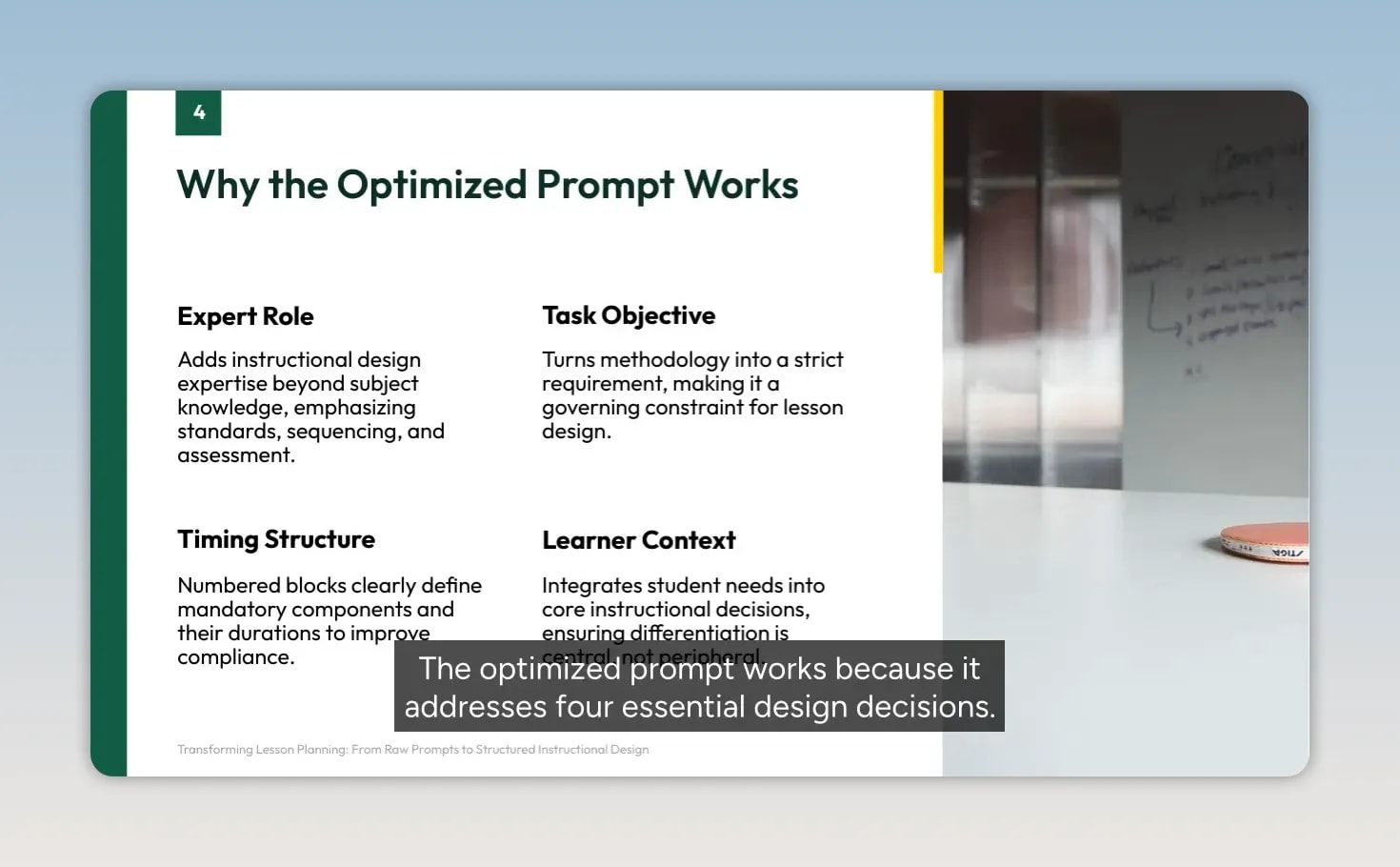
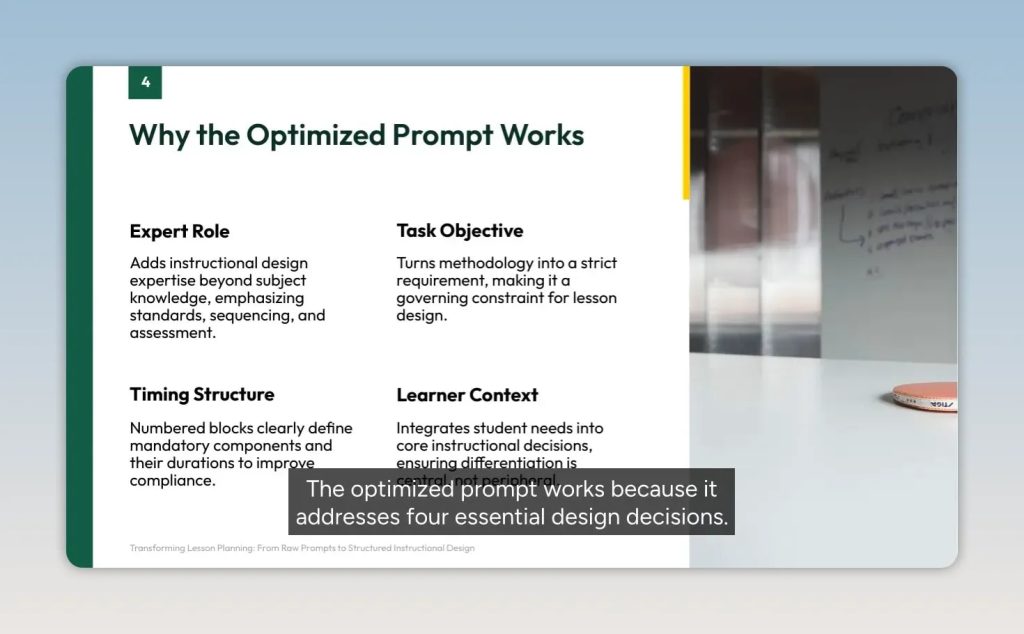
The strongest prompt structure addresses four essential decisions:
- Expert role: Ask for instructional-design expertise as well as subject expertise.
- Task objective: State the core instructional outcome and make the selected methodology a firm constraint.
- Timing structure: Define the required lesson components and their durations.
- Learner context: Make student needs a central input to instructional decisions rather than an afterthought.
This architecture is reusable across subjects and grade levels. It can support a biology lesson, a history inquiry, a literacy workshop, or a staff-training session because it focuses on how the plan is built—not on a single topic.
A Reusable Prompt Framework
The following format converts a loose request into a design specification. Replace the bracketed fields with the details of the lesson you need.
You are an expert instructional designer and an experienced
[SUBJECT] teacher specializing in [GRADE LEVEL].

Your primary objective is to design a comprehensive, time-bound
lesson on [TOPIC]. The lesson must adhere to the
[TEACHING METHODOLOGY] framework.

Structure the lesson around these mandatory components:
1. Hook or introduction: [TIME]
2. Main instruction: [TIME]
3. Guided practice: [TIME]
4. Assessment: [TIME]

Explicitly include:
- Alignment with these standards: [STANDARDS]
- Common misconceptions and how the lesson will address them
- Complete materials and resources
- Learning objectives and evidence of student learning

Tailor every activity and instructional choice to this learner
context: [LEARNER NEEDS AND PRIOR KNOWLEDGE].
The point is not to treat this wording as magic. Its value is the hierarchy. The role establishes expertise; the objective establishes the outcome; the numbered components make time visible; and the learner profile sets an expectation that supports will be integrated throughout the plan.
For standards-based planning, it is also useful to link directly to the official source of the standard, such as the Next Generation Science Standards, before asking AI to draft the lesson. That gives the final review a more reliable reference point.
What a Strong Lesson-Planning Prompt Should Make Easy to Check
Well-structured outputs are not automatically correct, but they are easier to review. Before using an AI-generated lesson, inspect it against a short compliance checklist.
- Does the lesson actually follow the requested framework? A 5E lesson, for example, should not place most direct instruction in Explore and delay student investigation until Explain.
- Do the timings add up? Attractive activities become impractical when their listed durations exceed the available class period.
- Does every learner complete the standards-based task? A core modeling expectation should not be reserved only for advanced learners.
- Are learner supports embedded in the activity? Look for simplified language, visual aids, sentence starters, chunked directions, additional processing time, and meaningful extensions where appropriate.
- Are subject-matter claims accurate? Polished wording can still contain a conceptual error, especially in science.
This review is not a limitation of AI. It is the professional work that makes AI useful. The tool can speed up drafting and organization, but it cannot replace the educator’s responsibility to verify content, fit the lesson to the class, and make final instructional decisions.
Three AI Outputs, Three Different Strengths and Risks
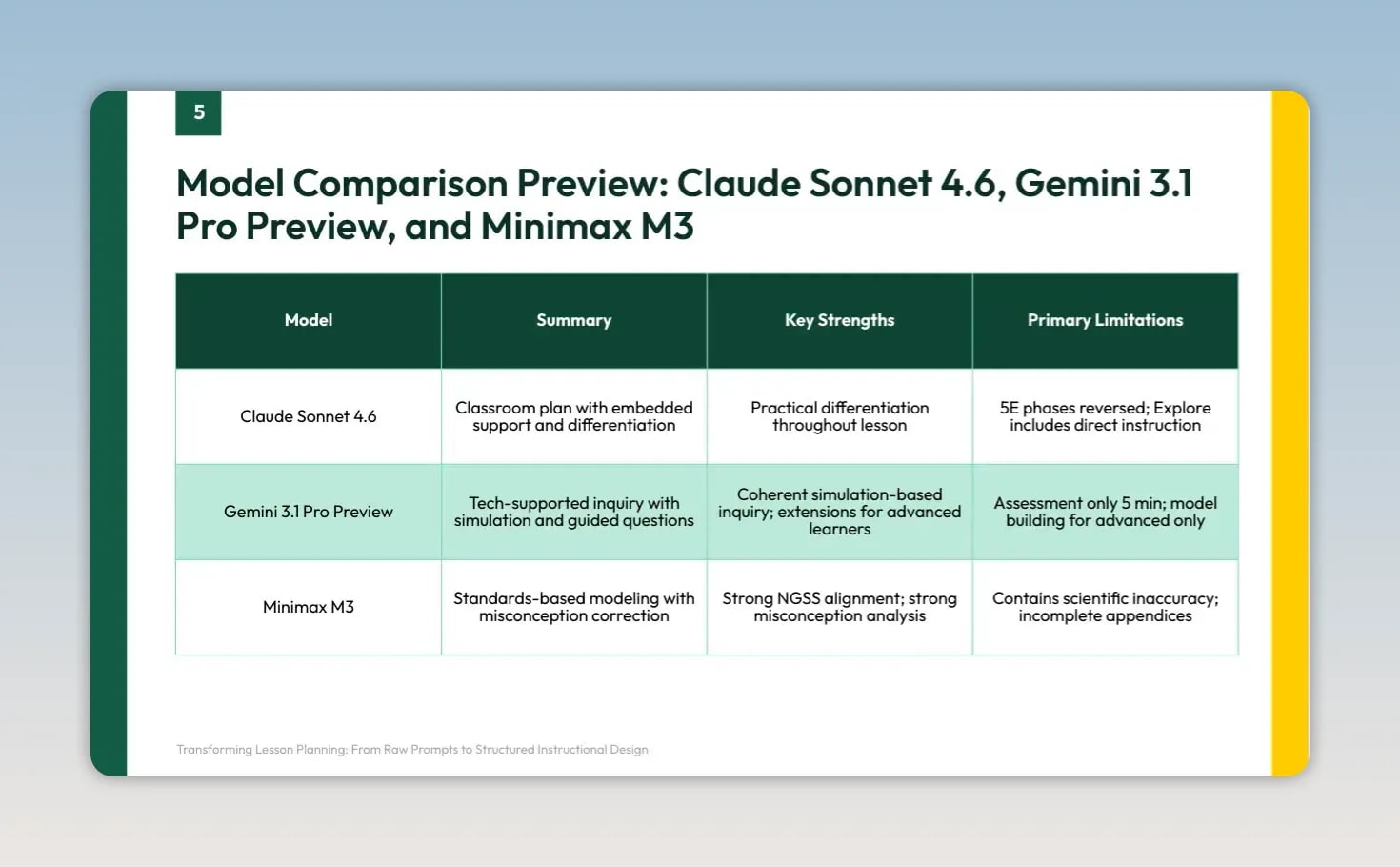
Even with the same optimized request, different models can prioritize different parts of the task. A comparison of Claude Sonnet 4.6, Gemini 3.1 Pro Preview, and Minimax M3 illustrates why a better prompt improves consistency without eliminating the need for review.
Claude Sonnet 4.6: Differentiation Embedded Throughout
Claude Sonnet 4.6’s strongest feature is practical flexibility. Supports such as simplified language, sentence starters, visual aids, chunked information, extra processing time, and additional reading materials are integrated into the lesson rather than appended as a separate accommodations list.
That makes the plan more accessible and classroom-ready. Its weakness is instructional fidelity: the 5E sequence is partly reversed, with direct instruction placed where learner exploration should lead. The labels may be present, but the pedagogy needs to be checked.
Gemini 3.1 Pro Preview: Inquiry First, but Timing Falls Short
Gemini 3.1 Pro Preview offers the clearest technology-supported inquiry sequence. An interactive simulation is paired with guiding questions, followed by teacher explanation. That explore-before-explain progression is a coherent approach for inquiry-based learning.
However, the plan allocates only five minutes to evaluation when the required assessment period is ten minutes. It also reserves explicit molecular model-building for advanced learners, even though model use is central to the requested NGSS alignment. An activity that demonstrates the standard should be universal, with extensions adding complexity rather than access.
Minimax M3: Strong Standards Alignment, Essential Science Check
Minimax M3 is especially strong at aligning the standard, activity, and assessment. Every group engages in representing reactant bonds breaking and product bonds forming, reinforcing the idea of energy transfer in cellular respiration.
Its central scientific flaw is serious, however: it suggests that breaking bonds releases energy. Breaking chemical bonds requires energy. Energy is released when new bonds form, and a reaction has a net energy release only when the overall balance of bond breaking and bond formation produces it. That distinction must be corrected before classroom use.
The lesson is a useful reminder that stronger alignment does not excuse inaccurate content. AI-generated science teaching materials should always receive subject-matter review.
From an Optimized Prompt to a Guided Workflow
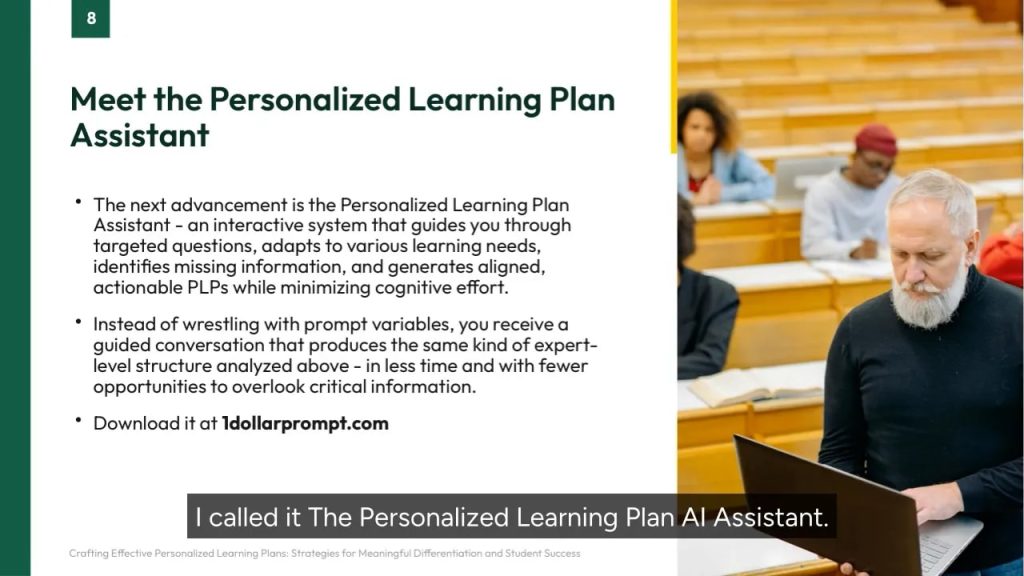
A reusable prompt reduces the effort of starting from scratch, but each lesson still requires entering variables, checking requirements, and noticing what is missing. A guided lesson-planning workflow makes the process more manageable by gathering the needed information in sequence: topic, objectives, standards, methodology, time available, materials, and learner context.
That is exactly what you get with the Comprehensive Lesson Plan Designer AI Assistant.
This approach keeps instructional logic visible and allows the plan to adapt when conditions change. If devices are unavailable, the workflow can surface an offline alternative. If an assessment needs another five minutes, it can prompt a revision before the lesson is finalized.
The goal is not to automate professional judgment away. It is to reduce repetitive setup work so educators can devote more attention to the decisions that matter: accuracy, relationships, access, pacing, and learning evidence.
Final Thoughts
The progression is straightforward: a raw request captures intent, an optimized prompt organizes that intent, and a guided workflow makes the process easier to repeat.
Use AI lesson planning as a drafting partner, not an authority. Ask for a clear instructional architecture. Require visible timing and standards alignment. Build learner context into every phase. Then review the output for pedagogical coherence, classroom feasibility, and factual accuracy.
Educational AI is most valuable when it does more than generate text. It should help make the choices behind effective instruction easier to see, test, and improve.
Frequently Asked Questions
What is the biggest weakness of a generic AI lesson-planning prompt?
Generic prompts often list many requirements without showing how they should be prioritized or connected. The output may look complete while lacking a coherent instructional sequence.
How can I make AI-generated lesson plans more differentiated?
Provide a specific learner profile and explicitly require that all activities and instructional choices be adapted to it. Look for supports embedded in directions, materials, grouping, vocabulary, processing time, and assessment options.
Should AI-generated lesson plans be used without editing?
No. Review every plan for factual accuracy, standards alignment, realistic timing, methodology fidelity, resource availability, and suitability for the learners in the classroom.