You can understand an instructional strategy on paper and still struggle to use it when a real teaching problem appears. The gap is familiar to teachers, corporate trainers, and learning-and-development leaders: theory makes sense, but a low-energy group, mixed experience levels, and an unclear misconception require quick professional judgment.
AI can help close that gap—but not when it simply produces a lesson plan on demand. A stronger approach turns AI into a practice environment: it gives you a realistic scenario, asks you to design a response, and withholds the expert model until you have committed to your own plan.
This structured approach moves professional learning from passive reading toward active teaching through realistic mini-lesson challenges, feedback, reflection, and self-assessment.
Key Takeaways
- Active-teaching prompts should require an attempted lesson plan before revealing an expert model.
- Explicit roles, objectives, user inputs, and stopping points make AI workflows more reliable.
- Claude Sonnet offers the strongest balance of fidelity and completeness for detailed instructional briefs.
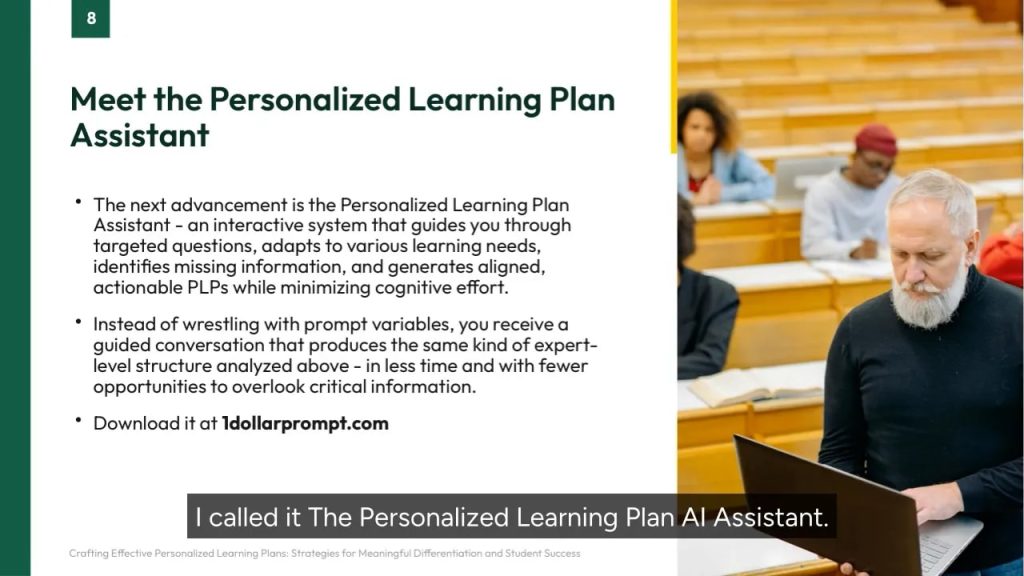
- Intelligent assistants can guide the same practice workflow with targeted questions and less prompt-management effort.
Table of Contents
- The Prompt Transformation: Raw Prompt vs. Optimized Prompt
- Why This Structure Works
- Case Study: Evelyn’s 15-Minute Training Challenge
- The AI Model Showdown: Fidelity, Diagnosis, and Speed
- From Reusable Prompts to Intelligent Assistants
- Final Thoughts
The Prompt Transformation: Raw Prompt vs. Optimized Prompt
The Starting Point: Raw Prompt
The raw request contains a sound idea: apply a skill before receiving an expert version of the answer. Its weakness is that it leaves the model to infer the role, sequence, stopping point, and interaction design.
You are a learning scientist. Help me transform my passive learning about [skill] into an active recall exercise. Instead of just reading about the skill, I want to apply it.

Generate a realistic classroom scenario and challenge me to create a 15-minute mini-lesson plan that uses the new skill to address the scenario.

After I draft it, provide me with a Master Teacher version of the plan and a checklist so I can compare my attempt, identify gaps, and learn from the comparison.

The skill I'm learning: [Insert skill.]
The classroom scenario: [Provide a brief scenario.]
Without explicit sequencing, an AI model may provide the master plan too soon. That removes the productive struggle that makes the exercise valuable.
The Transformation: Optimized Prompt
Act as an expert Learning Scientist specializing in instructional design and active recall methodologies.

Your primary objective is to transform my passive learning regarding a specific skill into a robust active recall exercise centered on practical application. The exercise must simulate a real-world teaching challenge.

First, generate a realistic, detailed classroom scenario based on the context below. Then issue a direct challenge: design a complete 15-minute mini-lesson plan that explicitly applies the specified skill to resolve the scenario.

After I submit my draft, provide:
1. A Master Teacher version of the lesson plan demonstrating best practices.
2. A detailed comparison checklist to help me self-assess my draft, identify gaps, and improve.

Incorporate these user-defined inputs precisely:
• Skill for Application: [Insert skill.]
• Classroom Context/Scenario: [Provide a brief scenario.]
The optimized version does not merely ask for a deliverable. It creates a staged learning workflow in which the AI supports practice rather than replacing it.
Why This Structure Works
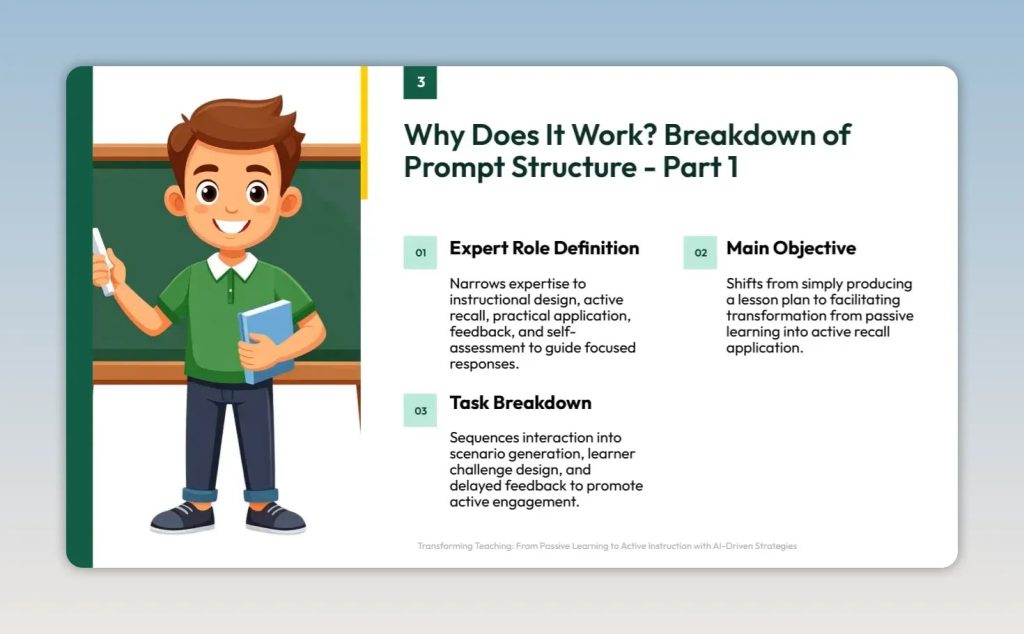
Prompt optimization works because it resolves three major sources of ambiguity: expertise, objective, and process.
1. Define the Expert Role
A broad instruction such as “act as a learning scientist” can lead in many directions. Specifying instructional design and active recall narrows the model’s attention toward application, feedback, and self-assessment—not simply a polished activity.
2. State the Learning Transformation
The goal is not just to receive a 15-minute lesson plan. It is to retrieve a skill, apply it under realistic constraints, and compare your decisions with an expert model. This resembles the principle of active recall: effortful retrieval strengthens learning more than recognition alone.
3. Break the Work into Four Stages
- Generate a realistic scenario: Include enough context for instructional choices to matter.
- Issue the teaching challenge: Ask for a complete mini-lesson within a fixed time limit.
- Stop and wait: Do not reveal the expert answer before the learner attempts the task.
- Provide delayed feedback: Offer a Master Teacher plan and a detailed self-assessment checklist after submission.
The stopping point is essential. When the answer arrives first, AI becomes a shortcut. When the answer follows an attempt, it becomes feedback.
Case Study: Evelyn’s 15-Minute Training Challenge
Consider Evelyn, a learning-and-development manager coaching corporate trainers with between two and 15 years of experience. She needs to address three linked problems in a professional-development workshop: post-lunch fatigue, uncertainty about accessibility in virtual training, and a knowledge-transfer challenge—all within 15 minutes.
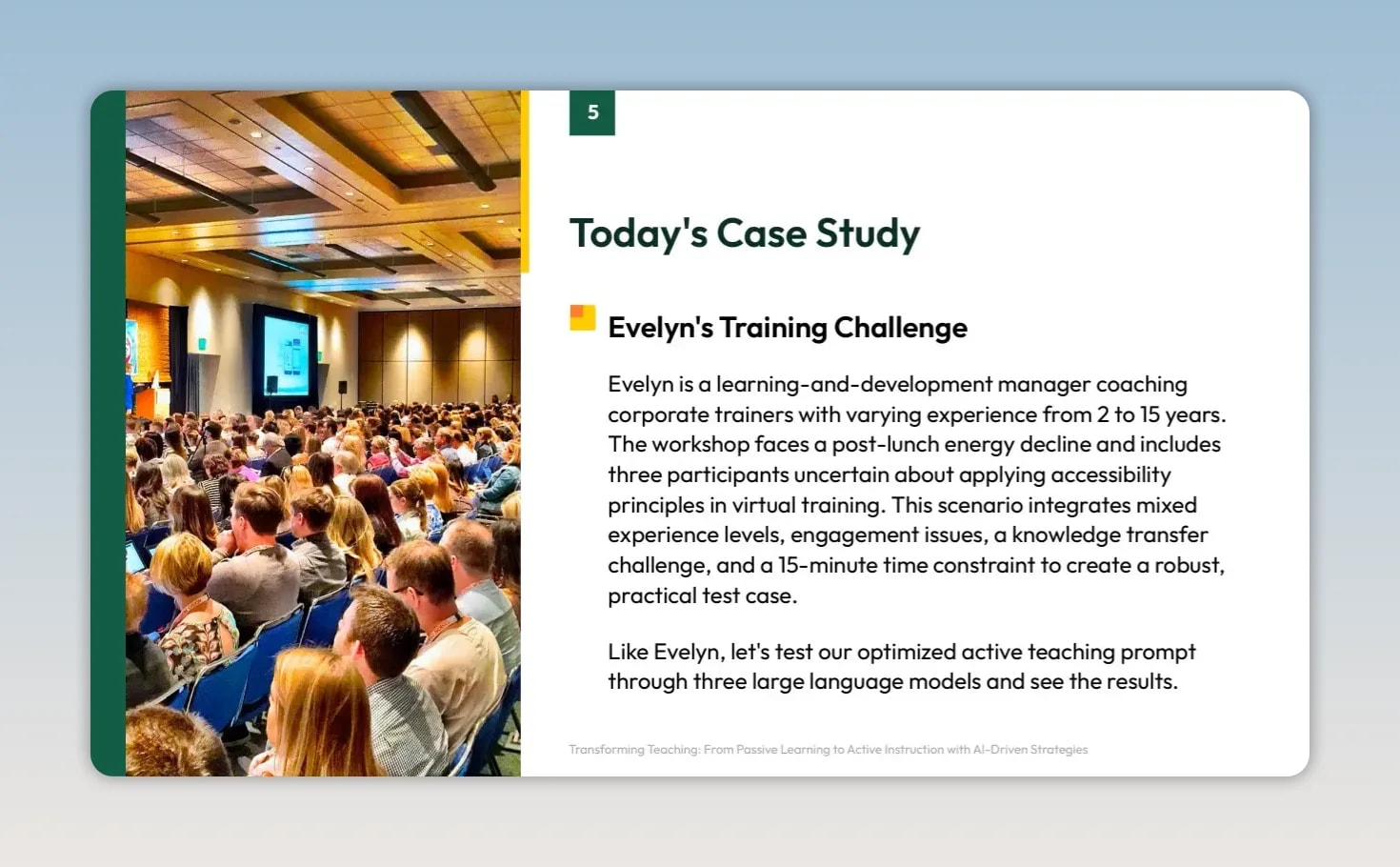
Her chosen skill is implementing formative assessment through exit tickets to gauge understanding and adjust instruction in real time. The scenario is particularly useful because it requires more than repeating accessibility concepts. Evelyn must help trainers translate those concepts into their own virtual facilitation practice.
A strong mini-lesson response should account for:
- A group of 20 corporate trainers with varied professional experience.
- Low energy after lunch.
- Three participants who seem uncertain about virtual accessibility.
- A short 15-minute instructional window.
- An exit-ticket mechanism that can inform immediate adjustment.
For the final condition to work, the plan should not simply place an exit ticket at the final second. It should specify the exact prompt, how responses are collected, what counts as understanding, and how Evelyn will respond to different patterns in the answers.
The AI Model Showdown: Fidelity, Diagnosis, and Speed
Applying the optimized active-teaching prompt across three language models reveals a clear trade-off. Each can create a usable challenge, but they differ in how faithfully they preserve the instructional brief and how much interpretation they add.
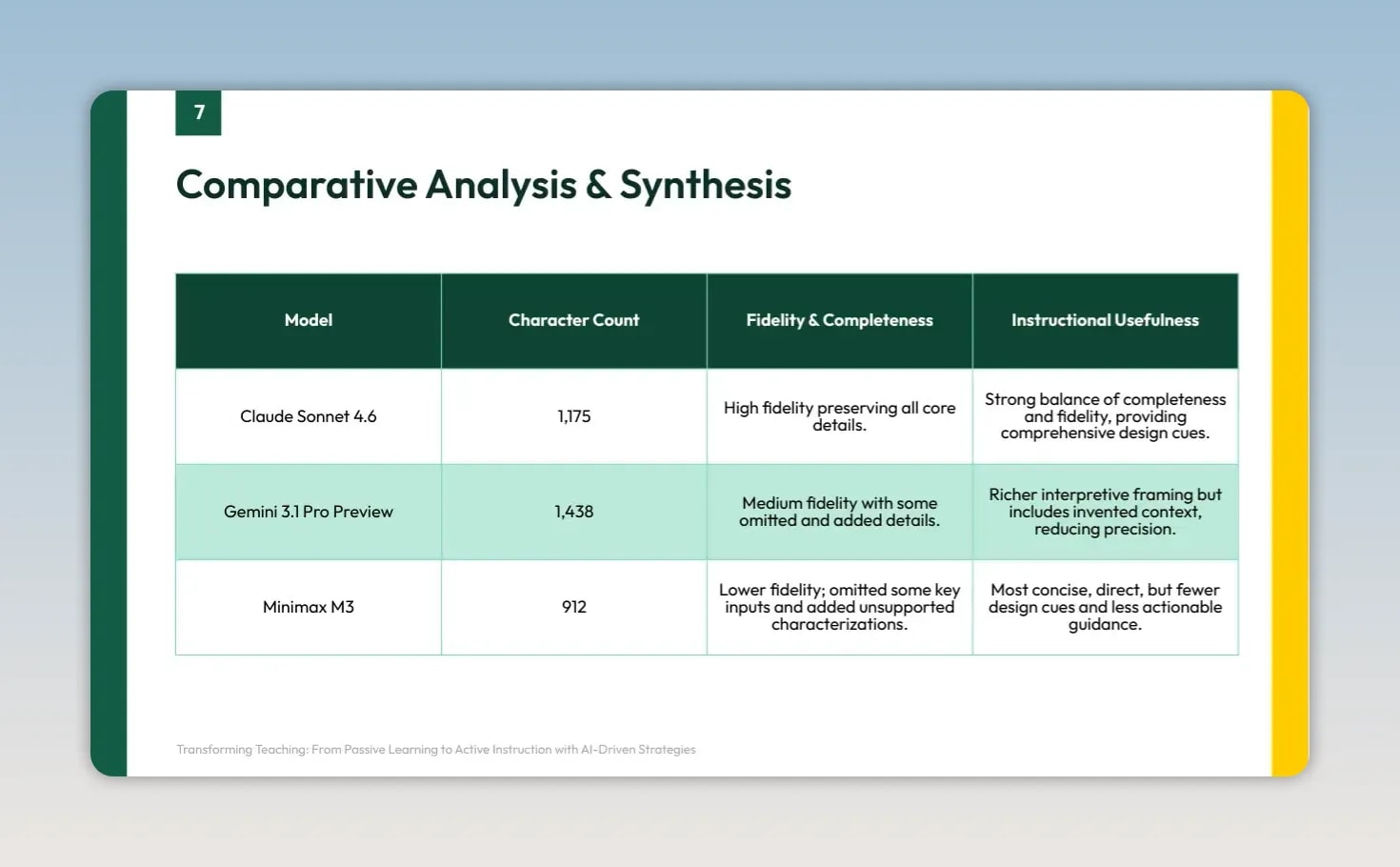
| Model | Primary Strength | Trade-Off | Best Fit |
|---|---|---|---|
| Claude Sonnet | Preserves nearly every supplied detail | May add small narrative embellishments | Detailed ready-to-use teaching challenges |
| Gemini Pro Preview | Rich diagnostic framing | Adds unsupported context | Experienced facilitators seeking interpretation |
| Minimax M3 | Fast, readable, concise output | Compresses or omits important inputs | Lightweight workshops and rapid activities |
Claude Sonnet: Strongest Overall Fidelity
Claude Sonnet offers the best balance of completeness, instructional value, and precision. It is especially effective when the experience range, virtual context, time limit, and observed confusion must all shape the resulting challenge. This makes it well suited to facilitators who need a dependable first draft aligned with a detailed brief.
Gemini Pro Preview: Richer Diagnosis, Less Restraint
Gemini Pro Preview provides the richest narrative interpretation. It is useful when an experienced facilitator wants to frame the problem as a theory-to-practice transfer issue rather than a simple knowledge gap. The trade-off is that it may introduce details that were not supplied, such as timing, participant actions, or workshop logistics. Those additions can make a scenario vivid while weakening fidelity.
Minimax M3: Concise and Fast
Minimax M3 is direct and highly scannable. It quickly connects the need to assess understanding with the need to adjust instruction. Yet its compression can remove variables that matter—such as the two-to-15-year experience range—and provide fewer cues for differentiation, engagement, and whole-group checking for understanding.
From Reusable Prompts to Intelligent Assistants
An optimized prompt is a major improvement, but it still requires effort. You must remember the variables, format the context, preserve the process sequence, and judge whether the output reflects observation rather than speculation.
An intelligent assistant can retain the same active-recall design while reducing that operational load. Instead of completing a long template, you can be guided through targeted questions:
- What skill are you trying to apply?
- Who are the learners?
- What challenge are you observing?
- How much time is available?
- What evidence would demonstrate understanding?
- What should happen after you submit your plan?
The Active Recall Teaching Challenge Generator follows this logic by guiding the creation of teaching challenges, mini-lesson plans, and reflection checklists. The important distinction remains unchanged: the assistant should help structure your practice, then wait for your attempt before presenting the Master Teacher model.
Final Thoughts
The progression is straightforward: a raw request expresses a good idea, an optimized prompt makes the learning workflow explicit, and an intelligent assistant makes that workflow easier to use repeatedly.
For teachers, trainers, and instructional leaders, the goal is not merely better AI-generated lesson plans. It is better opportunities to retrieve knowledge, make instructional decisions under constraints, receive meaningful feedback, and improve professional judgment. AI is most useful when it does not answer in your place—but helps you rehearse the thinking required to teach well.
Frequently Asked Questions
What makes an AI prompt an active-recall exercise?
An active-recall prompt presents a realistic problem, requires you to retrieve and apply a skill, and delays the expert answer until after you submit your own attempt.
Why should the Master Teacher plan be delayed?
Seeing the expert plan first can turn the task into recognition rather than application. Delayed feedback preserves productive struggle and makes comparison more useful.
Which model is best for detailed mini-lesson challenges?
Claude Sonnet is the strongest choice when fidelity to a detailed instructional brief matters most. Gemini Pro Preview is useful for richer diagnosis, while Minimax M3 fits faster, lighter-weight challenges.