A learning progression is one of the most valuable tools an educator can build—and one of the easiest to make only superficially.
An AI-generated plan may arrive with polished headings, activities, and assessments. Yet it can still be difficult to use in practice: stages may not fit the calendar, success criteria may be impossible to observe, assessments may not match instruction, or the sequence may overlook what students already know.
The issue is often not the educational goal. It is the gap between what an educator intends and what the prompt actually communicates.
A generic request can produce a useful outline. A structured request can produce a learning progression that connects readiness, instruction, assessment, and the next step in learning. The difference comes from defining the instructional lens, the desired outcome, the evidence of mastery, and the learners’ starting point.
Key Takeaways
- Structured curriculum prompts define expertise, learner context, mastery evidence, and formative assessment.
- Claude Sonnet 4.6 is strongest for a complete experimental-cycle framework; Minimax M3 excels in data literacy and transfer.
- Gemini 3.1 Pro Preview provides clear concept-by-concept scaffolding but needs added semester pacing.
- Guided planning assistants can gather missing context while keeping teacher judgment central.
Table of Contents
- The Prompt Transformation: From Checklist to Design Brief
- Why Structured Prompts Produce Better Plans
- Case Study: Maya’s Seventh-Grade Science Unit
- What Three AI Approaches Reveal
- Choose the Framework That Fits the Job
- The Next Step: A Guided Planning Conversation
- Final Thoughts
The Prompt Transformation: From Checklist to Design Brief
A raw curriculum prompt may ask for a learning progression, required components, activities, and assessments. It contains the right ingredients, but it leaves major decisions to interpretation: What expertise should guide the plan? What does successful mastery look like? How should each stage prepare students for the next?
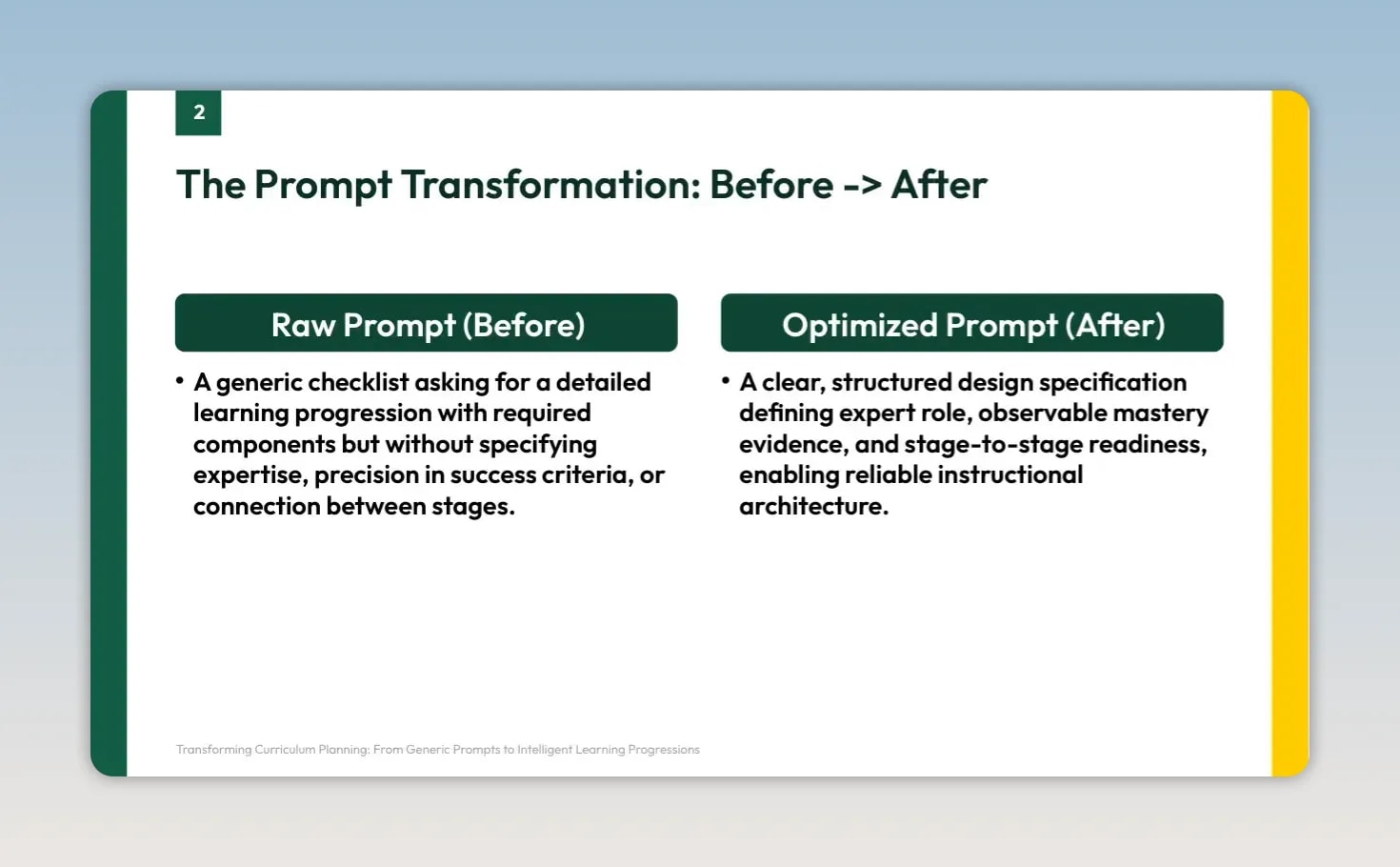
An optimized prompt makes those decisions visible. It asks the model to act as an expert curriculum designer and instructional strategist, specifies the grade level and time frame, and requires each stage to include observable mastery evidence, anticipated difficulties, targeted instructional design, and formative assessment.
Most importantly, it frames students’ current understanding as a constraint rather than a final detail. A progression should begin with learners’ actual readiness—not with an abstract list of topics.
You are an expert Curriculum Designer and Instructional Strategist
specializing in scaffolding complex K-12 knowledge.

Create a stage-by-stage learning progression for teaching
[BROAD SKILL] to [GRADE LEVEL] across [TIME PERIOD].

For each stage, include:
1. Precise subskills or concepts
2. Observable success criteria
3. Likely misconceptions or difficulties
4. Targeted teaching strategies and activities
5. Formative assessments that verify readiness to advance

Contextualize the progression using students' starting point:
[CURRENT UNDERSTANDING].
Why Structured Prompts Produce Better Plans
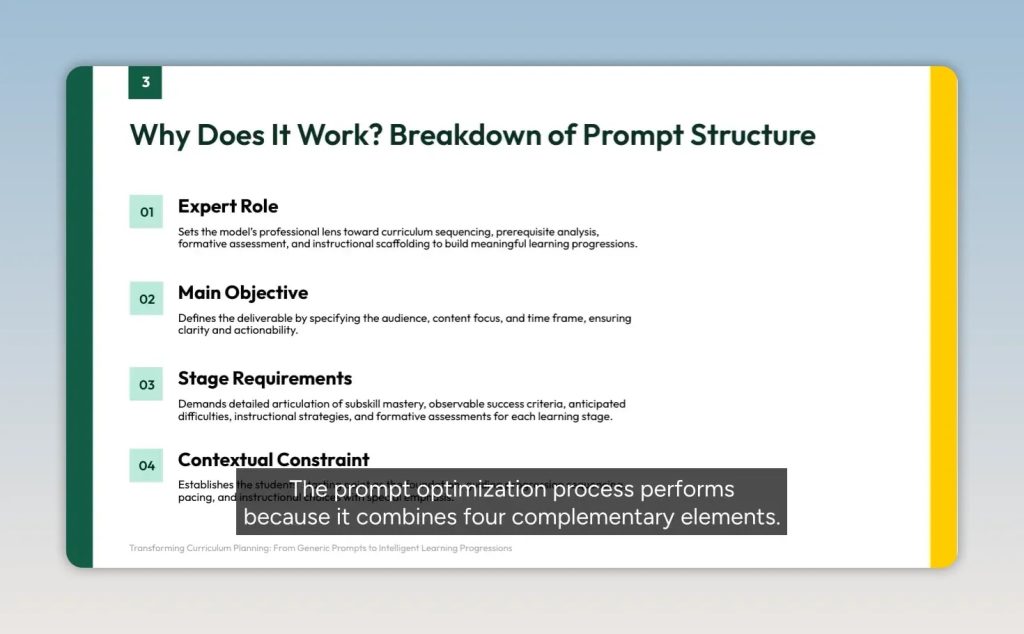
The strongest curriculum-planning prompts combine four complementary elements. Each corrects a common weakness in generic AI output.
- Expert role: Establishes an instructional lens focused on scaffolding, prerequisite knowledge, formative assessment, and sequencing.
- Main objective: Defines what is being taught, to whom, and within what time boundary.
- Stage requirements: Makes every stage consistent by requesting mastery targets, evidence, likely barriers, instruction, and assessment.
- Contextual constraints: Anchor pacing and instructional choices in what students already understand and can do.
Observable success criteria are especially important. “Understand experimental design” is not a teachable checkpoint. In contrast, students might correctly identify variables in an unfamiliar situation, write a testable hypothesis, construct a graph with labeled axes and units, or support a conclusion with specific data.
These are actions that can be seen, discussed, assessed, and used to determine whether students are ready to move ahead.
Case Study: Maya’s Seventh-Grade Science Unit
Consider Maya, a seventh-grade science teacher planning a 12-week unit on the scientific method and experimental design. Her students can recognize simple cause-and-effect relationships and have completed observation-based activities in elementary school. However, they have not had formal instruction in hypotheses, variable control, or systematic data collection.
| Planning variable | Maya’s context |
|---|---|
| Broad concept | Scientific method and experimental design |
| Grade level | Seventh grade |
| Time period | 12-week semester |
| Starting point | Everyday cause-and-effect reasoning, but limited formal inquiry skills |
This context changes the sequence. Maya should not begin with a fully independent investigation, and she does not need to spend weeks reteaching basic observation. Instead, the progression can move from observation and questioning to hypotheses and variables, experimental design, data collection, analysis, and evidence-based communication.
At every stage, Maya can ask a practical question: What evidence would show that students are ready for the next instructional demand? That question keeps pacing responsive rather than purely calendar-driven.
What Three AI Approaches Reveal
Using the same structured curriculum request, three AI models produced distinct strengths. The lesson is not that one model solves every planning need. It is that a solid prompt makes meaningful comparison possible.
Claude Sonnet 4.6: Complete Experimental Cycle
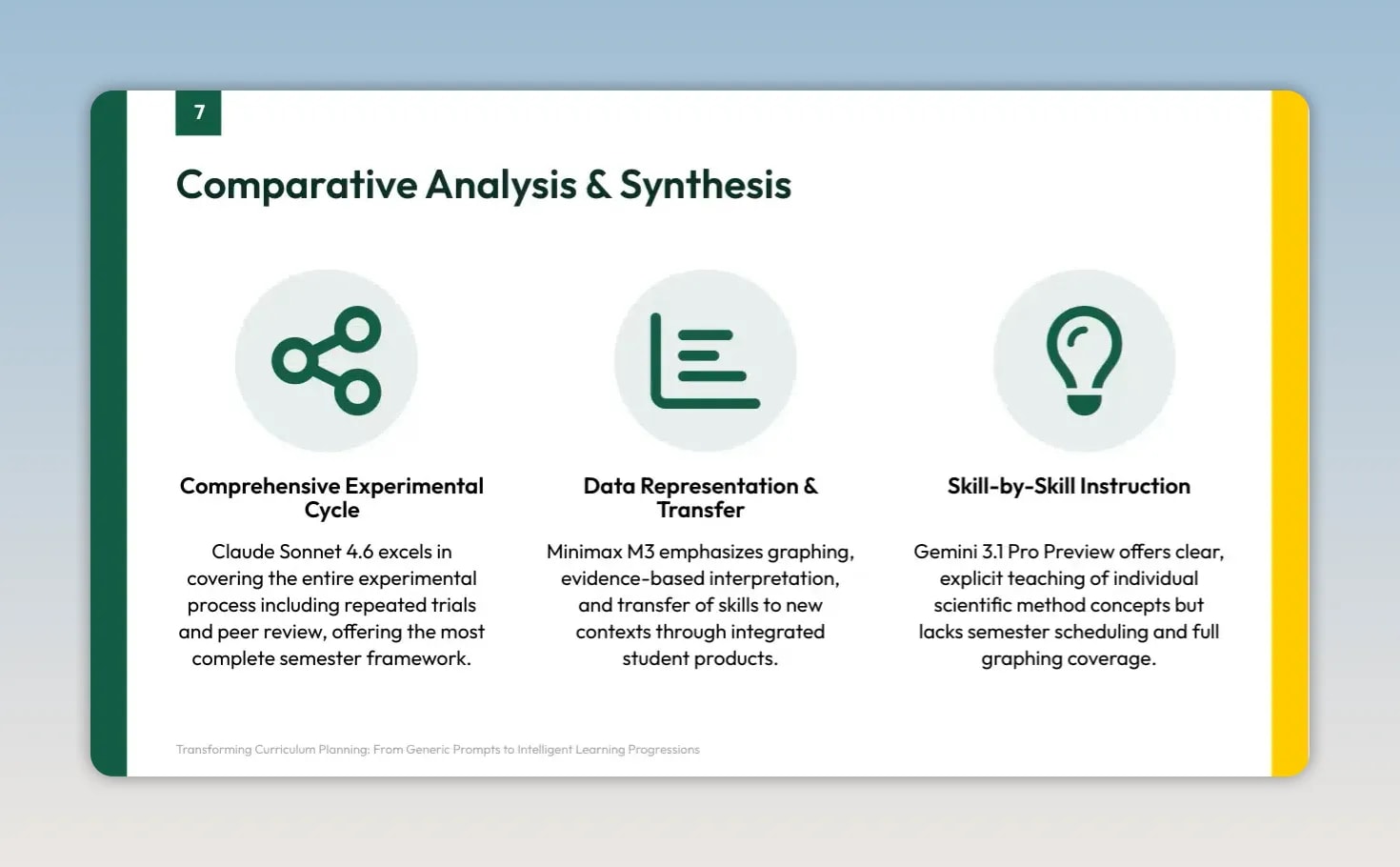
Claude Sonnet 4.6 offered the most comprehensive semester framework. Its progression follows the investigation process from observation and design through execution, analysis, and communication. It explicitly includes repeated trials, procedural deviations, data interpretation, Claim-Evidence-Reasoning conclusions, peer review, and replication.
This approach is particularly useful when Maya needs a curriculum backbone for an entire semester, with attention not only to scientific vocabulary but also to the realities of conducting and revising investigations.
Gemini 3.1 Pro Preview: Clear Conceptual Scaffolding
Gemini 3.1 Pro Preview separated variables, hypotheses, experimental design, data collection, analysis, and communication into accessible lessons. This makes it strong for direct instruction on individual concepts, especially for novice investigators who benefit from clear, focused explanations.
Its limitation is curriculum-level pacing: it does not provide an explicit 12-week schedule. It works best as a source of lesson-level scaffolds that Maya can place within a broader unit map.
Minimax M3: Data Literacy and Transfer
Minimax M3 integrates data literacy throughout the semester rather than treating graphing as an isolated skill. Students make qualitative and quantitative observations, distinguish among variable types, use graphing tools, interpret evidence, and apply their learning in a culminating science fair project showcase.
That visible connection between investigation, representation, and communication makes the approach valuable for project-based learning. Compared with Claude, it gives less emphasis to repeated trials and replication, but it stands out in graphing and evidence-based transfer.
Choose the Framework That Fits the Job
For a complete semester map, Claude Sonnet 4.6 is the strongest fit because it covers the full experimental cycle and includes methodological safeguards such as repeated trials and peer review.
For concept-by-concept teaching, Gemini 3.1 Pro Preview is useful for activities and explanations that isolate difficult ideas. It needs added pacing and more explicit graphing expectations to become a complete unit plan.
For an integrated sequence with strong student products, Minimax M3 offers a compelling model for data tables, graphing, evidence-based conclusions, and a final showcase.
Teacher judgment remains essential in every case. Class size, materials, accommodations, local standards, student language needs, and available instructional time all shape whether an AI-generated progression is feasible. Structured prompts improve the starting point; professional review makes the plan teachable.
The Next Step: A Guided Planning Conversation
An optimized prompt is a major improvement, but it still requires an educator to remember the right variables, complete placeholders, evaluate omissions, and adapt the structure for a new subject or class profile.
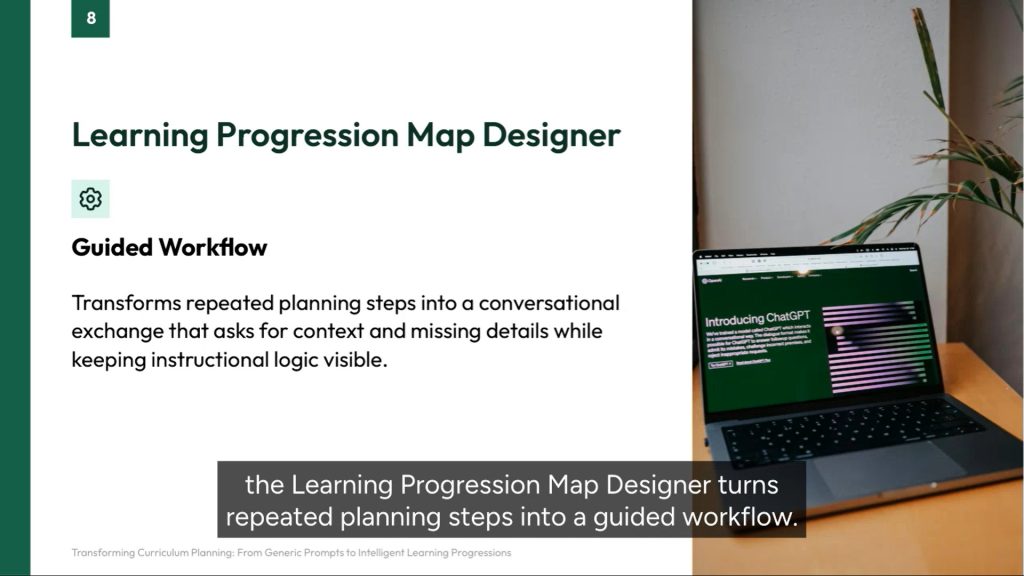
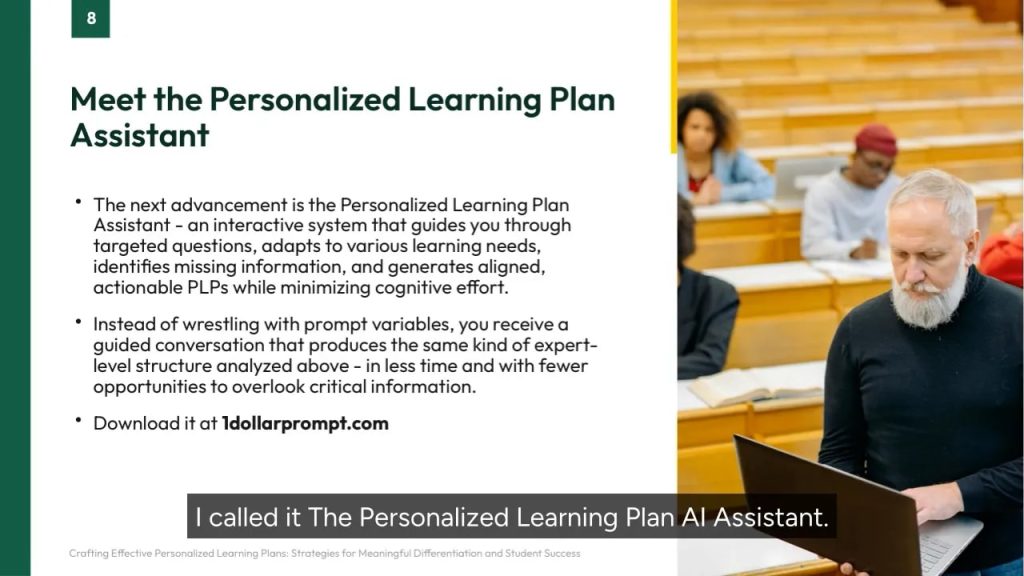
The Learning Progression Map Designer AI Assistant extends the structured-prompt approach into a conversational workflow. Rather than asking for a perfectly formatted request at the beginning, it gathers context, identifies missing details, and keeps the instructional logic visible throughout the planning process.
- It asks targeted questions about the concept, grade level, time frame, standards, resources, and learner readiness.
- It adapts follow-up questions as the planning context becomes clearer.
- It helps maintain alignment among progression stages, instructional choices, and assessment evidence.
- It leaves the final decision with the teacher, who can judge pacing and classroom feasibility.
The goal is not to replace curriculum expertise with automation. It is to make thoughtful instructional design easier to build, inspect, and adapt.
Final Thoughts
The journey begins with a reasonable request: create a learning progression, identify subskills, anticipate misconceptions, suggest activities, and assess readiness. Structure transforms that request into a more reliable instructional design framework.
Define the expert role. Clarify the learning objective. Require observable mastery evidence. Treat prior knowledge as a real constraint. Then evaluate the resulting plan for pacing, completeness, alignment, and classroom fit.
Better prompts support better planning. Teacher judgment ensures that planning remains grounded in real learners.
Frequently Asked Questions
What makes a curriculum-planning prompt effective?
An effective prompt defines the instructional role, the concept, learners, time frame, mastery stages, observable success criteria, likely difficulties, instructional strategies, formative assessments, and students’ starting knowledge.
Why should success criteria be observable?
Observable criteria distinguish exposure from mastery. They give teachers specific evidence to look for before moving students to the next stage of a learning progression.
Which model is best for a full semester science unit?
Claude Sonnet 4.6 is the strongest option in this comparison for a full semester because it maps the complete experimental cycle and includes repeated trials, peer review, replication, analysis, and communication.
Can AI replace teacher judgment in curriculum design?
No. AI can structure options and surface planning considerations, but teachers must still assess pacing, student readiness, resources, standards, accommodations, and classroom feasibility.