A teacher can have a strong instructional idea and still receive a weak AI-generated lesson plan. The problem is often not teaching expertise. It is an incomplete request.
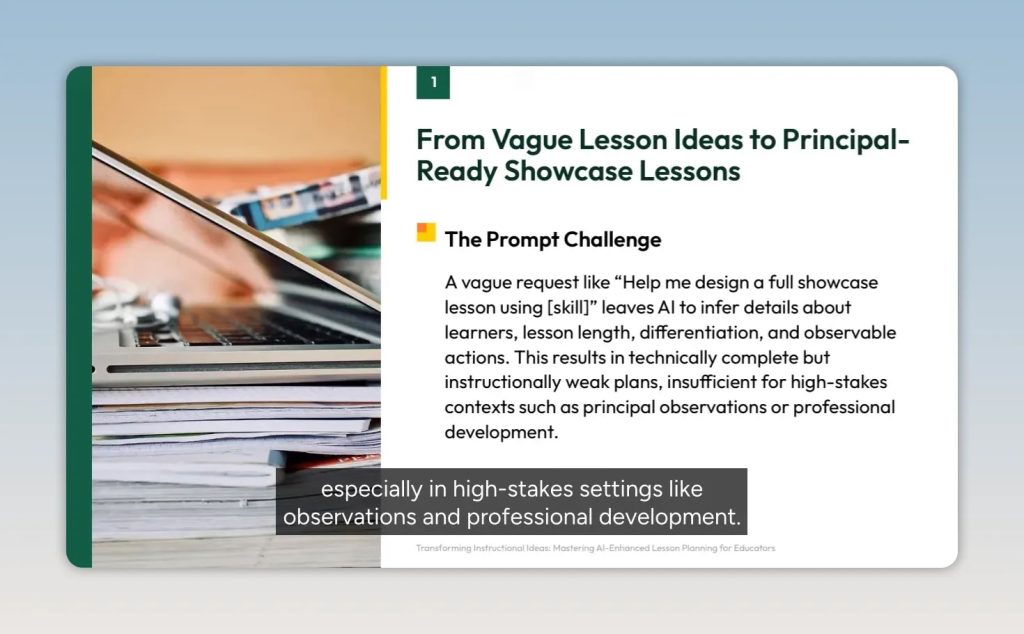
A prompt such as “Help me create a showcase lesson using Think-Pair-Share” leaves essential decisions to the AI: learner needs, subject content, lesson duration, observable outcomes, differentiation, assessment alignment, and the precise role of the named strategy. The result may look polished while remaining difficult to teach, assess, or defend during a principal observation.
For high-stakes settings—including classroom observations, curriculum rollouts, and professional learning—technical completeness is not instructional quality. A stronger approach turns a broad request into a clear design brief, then subjects the AI’s output to professional review.
Key Takeaways
- Strong lesson prompts specify role, context, duration, learner needs, and observable outcomes.
- Name the primary strategy, secondary structures, and content focus separately to prevent misalignment.
- Minimax M3 most explicitly operationalized Think-Pair-Share; all model outputs still require expert review.
- Guided AI assistants can reduce prompt-engineering effort by asking for missing information.
Table of Contents
- The Prompt Transformation: Raw Request vs. Optimized Brief
- Why This Structure Produces Stronger Outputs
- Make the Pedagogical Skill Explicit
- Case Study: A Professional-Learning Showcase Lesson
- What Three AI Models Revealed
- Move From Prompt Engineering to Guided Assistance
- Final Thoughts
The Prompt Transformation: Raw Request vs. Optimized Brief
The starting request has a sensible foundation: it asks for an objective, engagement hook, main activity, differentiation, formative assessment, and reflection. But it does not explain what those elements must look like in practice.
The Raw Prompt
Act as a Master Teacher and Curriculum Designer. Help me design a full showcase lesson that integrates [skill]. Include:
1. A clear learning objective
2. A hook to engage students
3. A main activity using the new skill with differentiation
4. A formative assessment
5. A student reflection

The skill and lesson topic: [Insert skill and topic]
This version asks the model to make too many assumptions. “Full lesson” could mean a five-part outline or a minute-by-minute plan. “Differentiation” could become generic advice. And if the relationship between the strategy and content is unclear, activities may be coherent but misaligned.
The Optimized Prompt
You are an expert Master Teacher and highly experienced Curriculum Designer specializing in high-impact, observable lessons.

Design a comprehensive, full-period Showcase Lesson suitable for principal observation and evaluation.

Primary pedagogical skill: [skill]
Lesson content and topic: [topic]
Audience or grade level: [learners]
Lesson length: [minutes]

Explicitly include:
1. A clear, measurable learning objective
2. A compelling student engagement hook
3. A main activity where the skill is actively used
4. Specific, actionable differentiation for varied learner needs
5. An embedded formative assessment aligned to the objective
6. A student reflection that supports metacognition and transfer

For every phase, include timing, teacher actions, student actions, materials, and observable evidence of learning.
The optimized version does not guarantee a strong lesson. It does, however, make quality visible. It establishes an expert role, defines the observation context, clarifies the core inputs, and gives the model an auditable checklist.
Why This Structure Produces Stronger Outputs
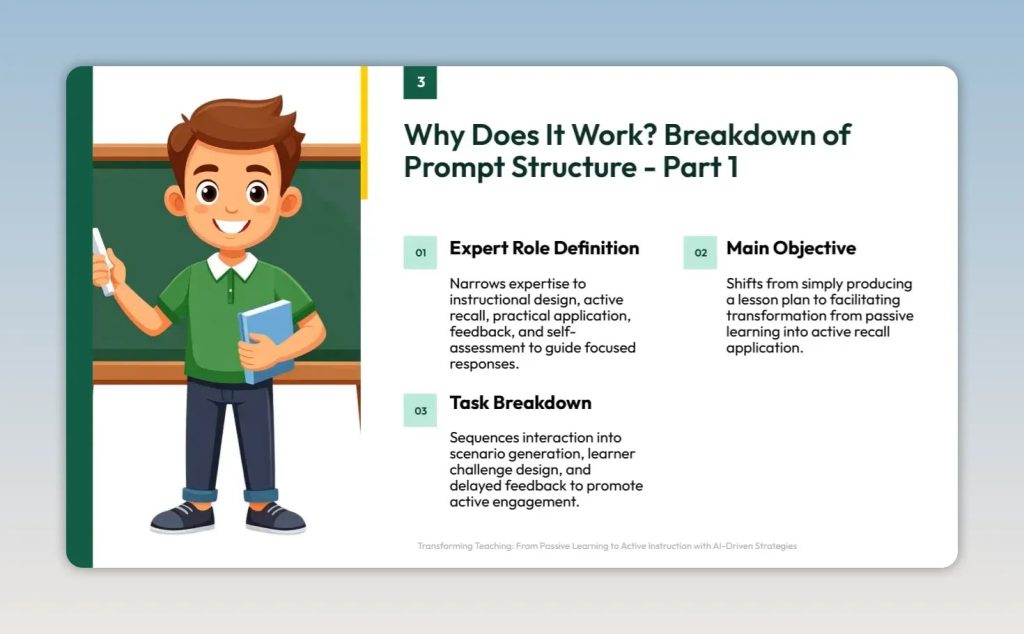
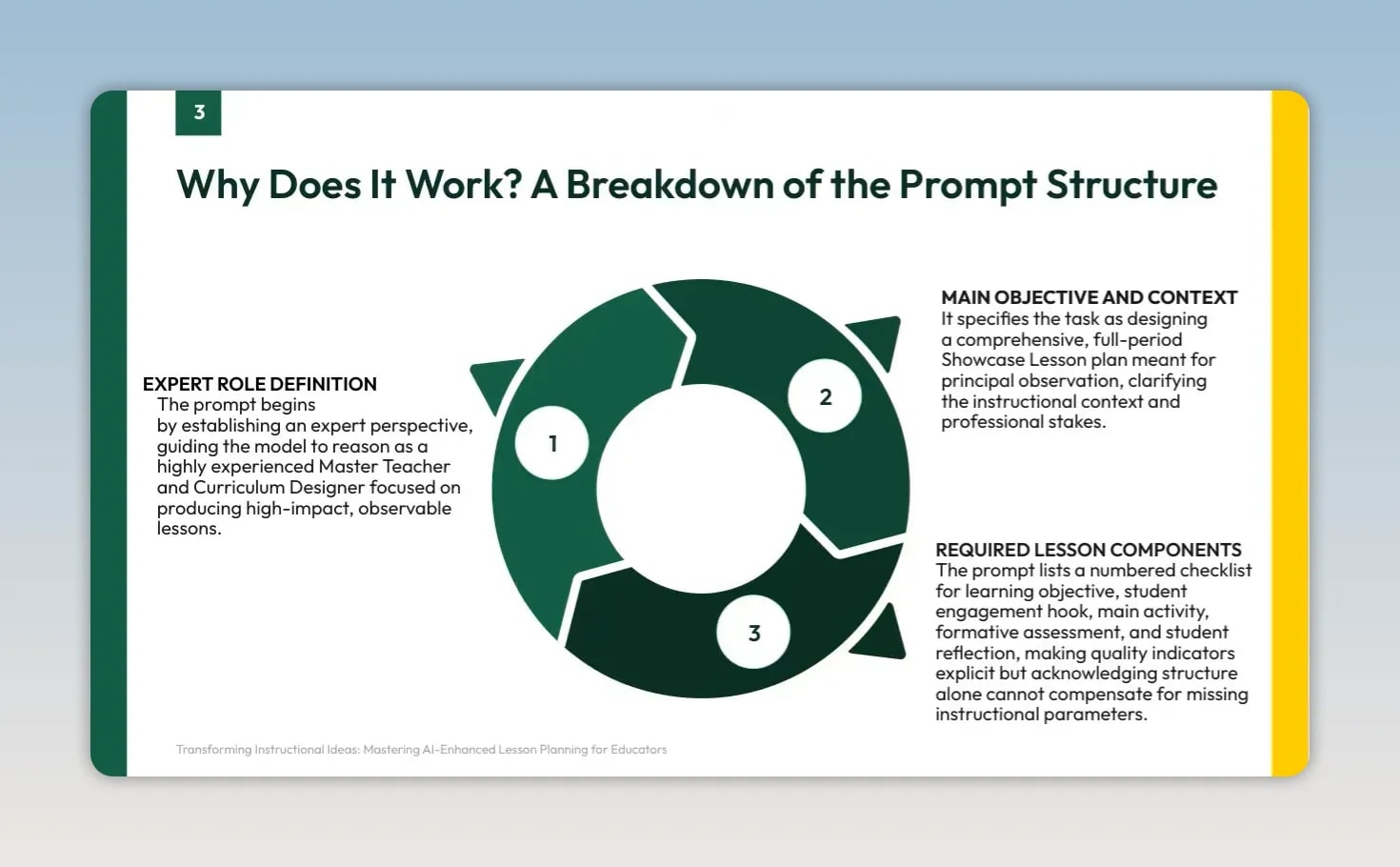
A reliable lesson-planning prompt has three connected parts: role, context, and requirements. Each serves a different purpose.
- Expert role: Asking for a master teacher and curriculum designer specializing in observable lessons directs the response toward evidence of engagement, facilitation, checks for understanding, and student ownership.
- Objective and context: “Full-period” and “principal observation” signal that the lesson needs more than isolated activities. It needs a coherent opening, transitions, discussion, assessment, and closure.
- Required components: A numbered list makes omissions easier to spot and reduces the chance that differentiation or reflection will become an afterthought.
One variable still deserves special attention: time. A 45-minute period, 60-minute class, and 90-minute block require different sequences. Always state the duration rather than expecting the model to infer it.
Make the Pedagogical Skill Explicit
The named strategy must be central to the learning design, not merely mentioned in a heading. A prompt should distinguish among the primary pedagogical skill, any secondary discussion structure, and the subject content.
For example, Think-Pair-Share can be the primary participation routine; Socratic Seminar can be a secondary discussion structure; and effective formative assessment can be the instructional content. Without that distinction, an AI may focus on the seminar, mention differentiation, and omit Think-Pair-Share altogether.
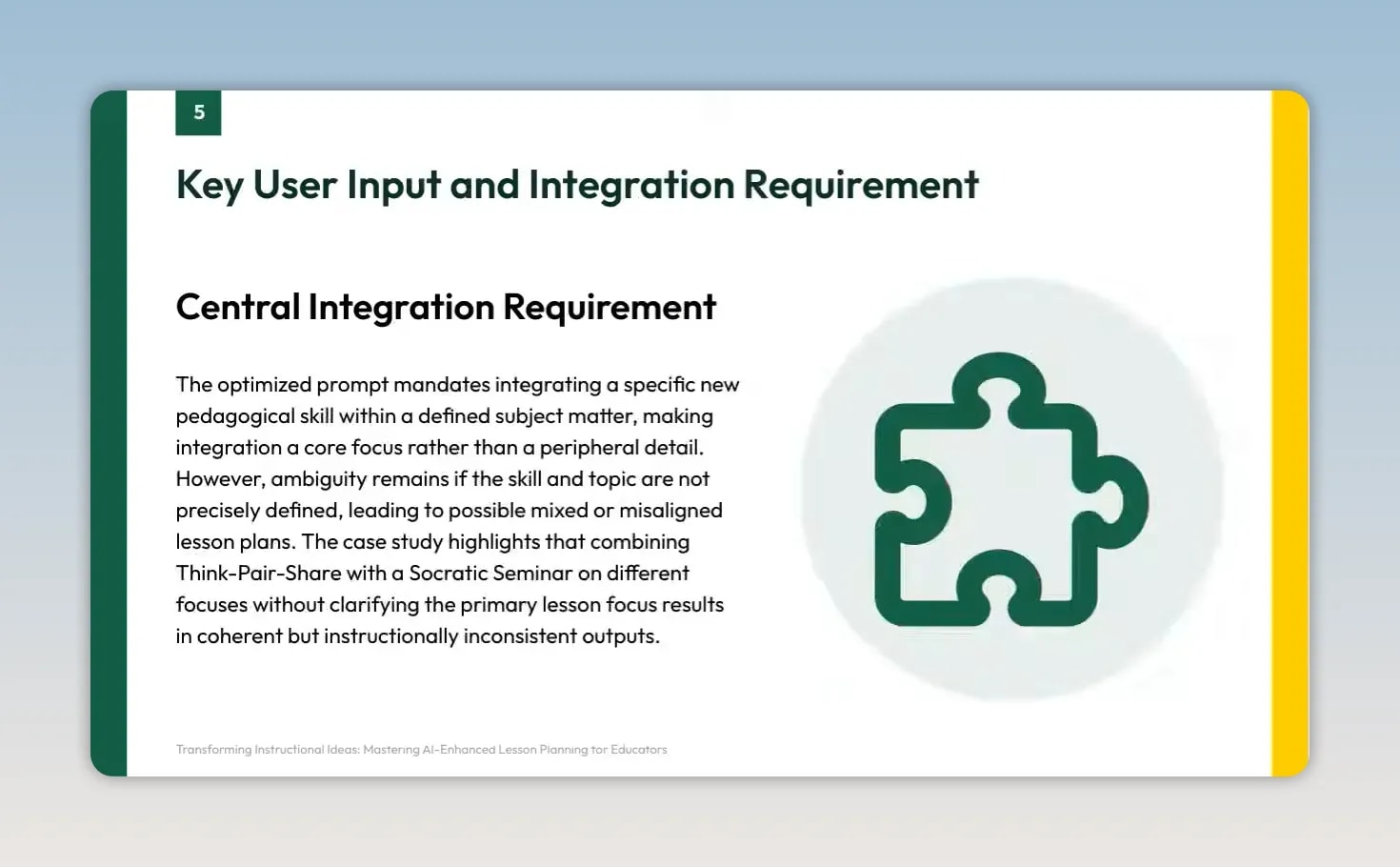
A useful prompt should answer three questions: What will learners study? What strategy will they experience or use? What observable outcome should the strategy enable?
Case Study: A Professional-Learning Showcase Lesson
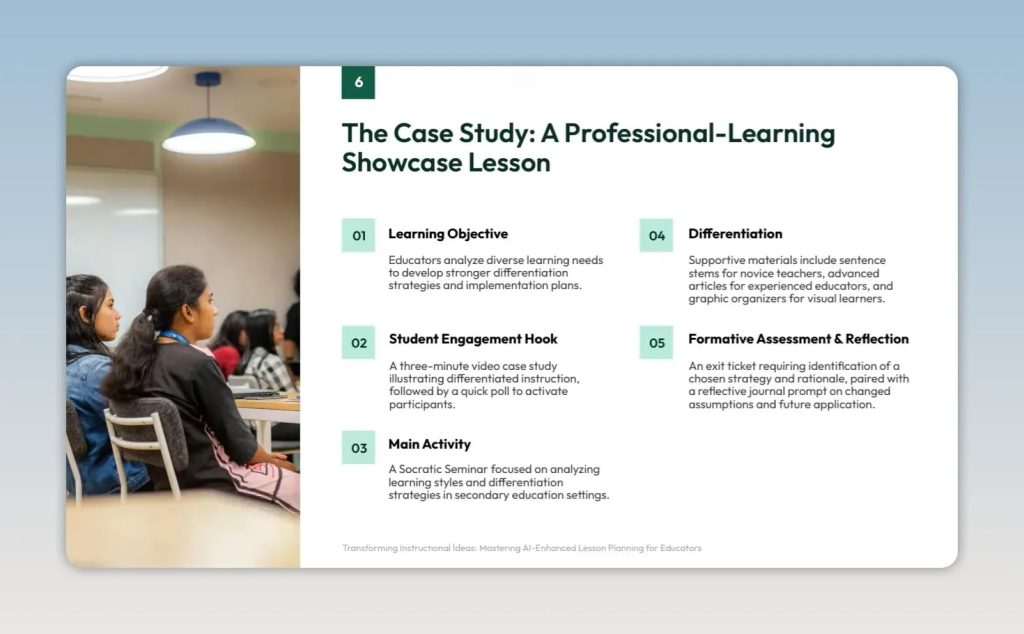
The case study centers on a professional-learning session for secondary educators. Participants analyze diverse learning needs, begin with a short video case and poll, deepen discussion through a Socratic Seminar, receive differentiated supports, and finish with an exit ticket and reflective journal.
The intended objective is for educators to analyze and evaluate at least three differentiation strategies, then create an implementation plan for their own classroom context. Novice participants may receive sentence stems and guided questions; experienced educators may receive advanced readings; all participants may use organizers and curated strategy resources.
There is also an important caution. Learning-style labels should not be treated as fixed identities or as a reliable basis for matching instruction. More evidence-informed differentiation considers prior knowledge, language access, disability-related accommodations, executive-function needs, demonstrated performance, and meaningful choices. The Universal Design for Learning guidelines offer a useful framework for planning multiple routes to engagement, representation, and action.
What Three AI Models Revealed
The optimized prompt was tested with Claude Sonnet 4.6, Gemini 3.1 Pro Preview, and Minimax M3. Each produced recognizable lesson elements: a measurable objective, video-and-poll hook, main discussion activity, formative check, and reflection.
- Claude Sonnet 4.6 provided a concise outline of the requested components, but omitted Think-Pair-Share.
- Gemini 3.1 Pro Preview added broader resources and audience-specific supports while emphasizing Socratic Seminar and differentiation.
- Minimax M3 most directly incorporated Think-Pair-Share through explicit Think, Pair, and Share stages.
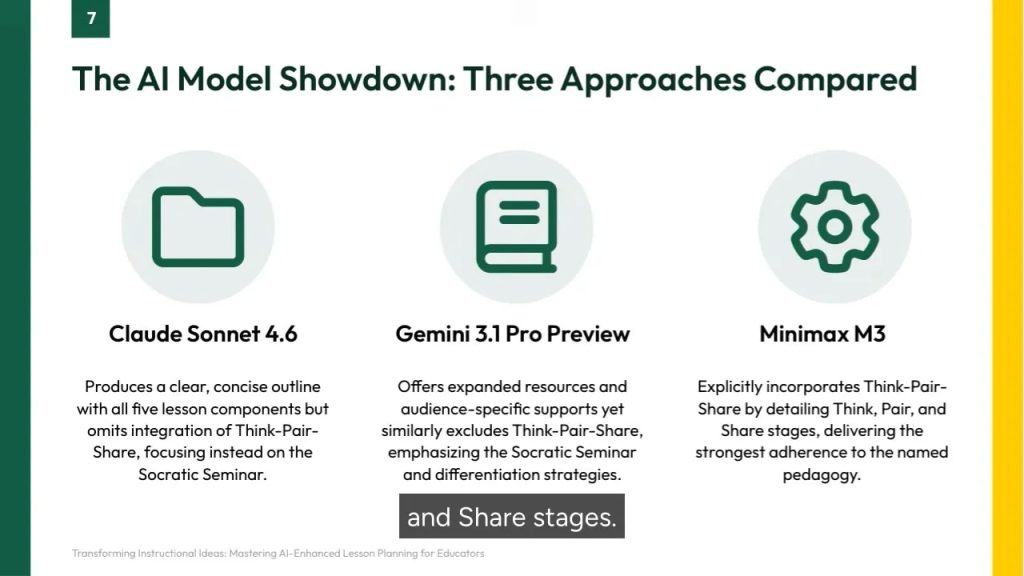
The practical conclusion is not that one model solves planning. Minimax M3 showed the strongest fidelity to the named routine because it translated Think-Pair-Share into observable actions. Gemini offered useful resource breadth. Claude supplied a clean, quick scaffold. Yet none should be treated as a final, observation-ready lesson without checking timing, content alignment, differentiation, and assessment evidence.
Move From Prompt Engineering to Guided Assistance
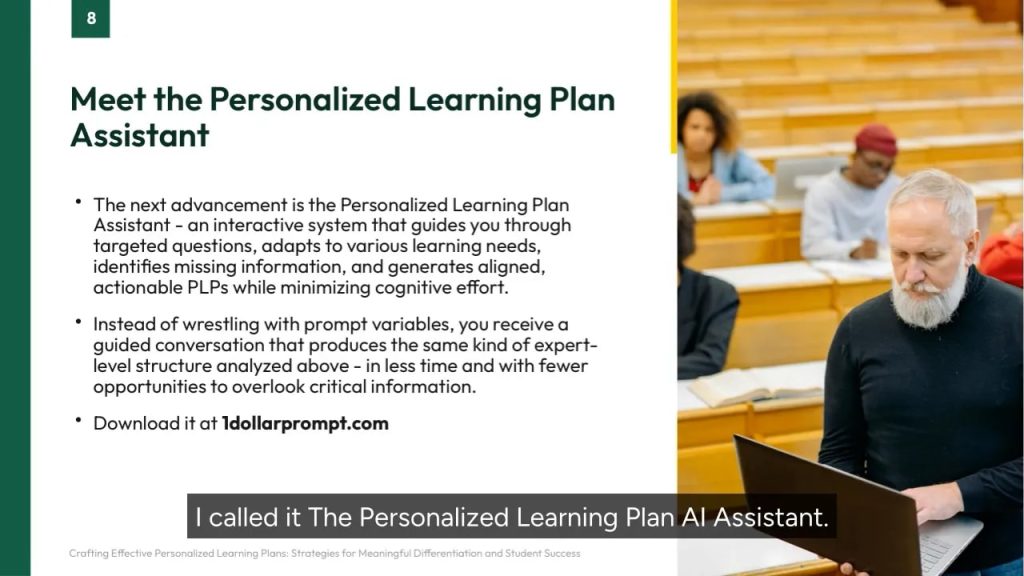
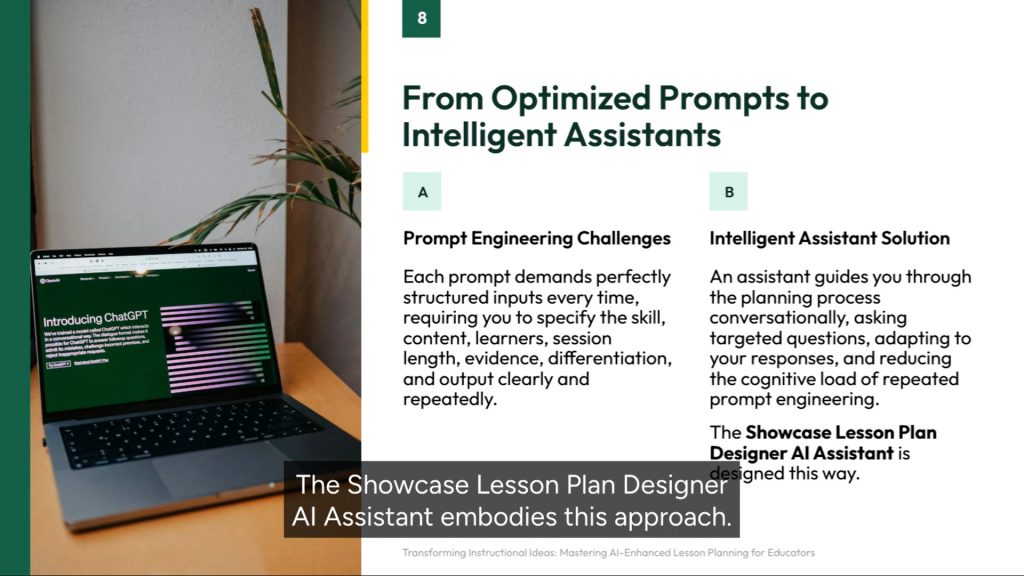
Even an excellent template places a cognitive burden on the educator. Every new request requires remembering the strategy, topic, audience, duration, assessment target, supports, and output requirements. Missing one detail can lead to a polished but misaligned hybrid lesson.
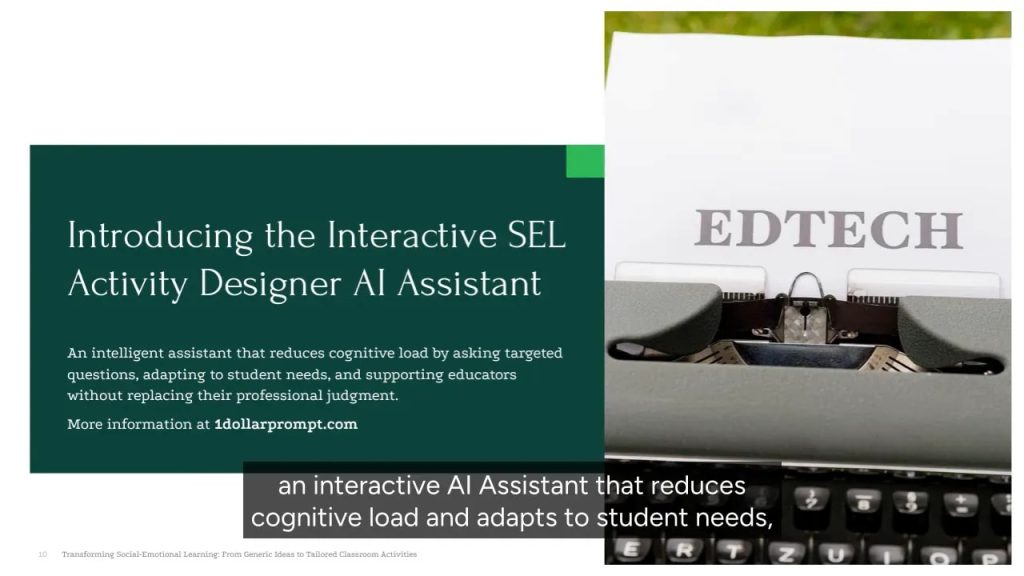
An intelligent lesson-planning assistant offers a more conversational alternative. Rather than requiring every parameter up front, it asks targeted questions, identifies ambiguity, adapts to responses, and reduces repeated setup work. A Showcase Lesson Plan Designer can clarify whether Think-Pair-Share is the primary method, whether Socratic Seminar is secondary, and how the exit ticket should connect to the objective.
Final Thoughts
The progression is clear: vague requests force AI to guess; optimized prompts establish meaningful constraints; guided assistants can gather those constraints through conversation. But human judgment remains essential. Educators must decide whether the objective, activities, supports, and evidence genuinely fit their learners and educational setting.
Use AI to accelerate drafting, surface options, and organize planning. Then apply the standards that matter most in real instruction: alignment, accessibility, timing, observable learning, and sound professional expertise.
Frequently Asked Questions
What makes an AI lesson plan principal-ready?
A principal-ready plan has a measurable objective, a complete sequence with timing, visible teacher and student actions, actionable supports, aligned formative assessment, and a purposeful closure.
Why should Think-Pair-Share be written as separate stages?
Writing the Think, Pair, and Share phases explicitly makes the strategy observable. It clarifies what learners do independently, how they collaborate, and how their ideas inform the whole-group discussion.
Can AI replace an instructional coach or teacher’s judgment?
No. AI can draft and organize a plan, but educators must verify instructional alignment, feasibility, accessibility, content accuracy, and fit for the learners and context.