Differentiating a lesson is more demanding than creating three versions of a worksheet. It means preserving a common learning objective while adjusting the level of support, independence, complexity, and evidence of mastery for different student needs.
AI can accelerate that work, but only when the request provides an instructional structure. A vague request may produce reasonable-sounding ideas while leaving important choices unresolved: What stays consistent? What changes? How should assessment align with instruction? And how can a support pathway increase access without lowering rigor?
A stronger prompt turns AI from an idea generator into a more reliable planning partner. It defines the intended expertise, names readiness tiers, requires adjustments to content, process, and product, and asks for classroom-ready instruction, activities, and assessments.
Key Takeaways
- Effective differentiation preserves the common learning objective while changing access, independence, complexity, and evidence.
- An optimized prompt should specify an expert role, readiness tiers, content-process-product changes, and classroom-ready outputs.
- Gemini provided the strongest organization and alignment in the water-cycle comparison; Claude offered the widest strategy range.
- All AI-generated lesson plans require professional review for timing, materials, safety, and assessment alignment.
Table of Contents
- The Prompt Transformation: Raw Prompt vs. Optimized Prompt
- Why the Structure Works
- Move From Theory to Classroom Practice
- Case Study: Amelia’s Fifth-Grade Water Cycle Lesson
- What the Model Comparison Reveals
- From Reusable Prompt to Guided Planning Assistant
The Prompt Transformation: Raw Prompt vs. Optimized Prompt
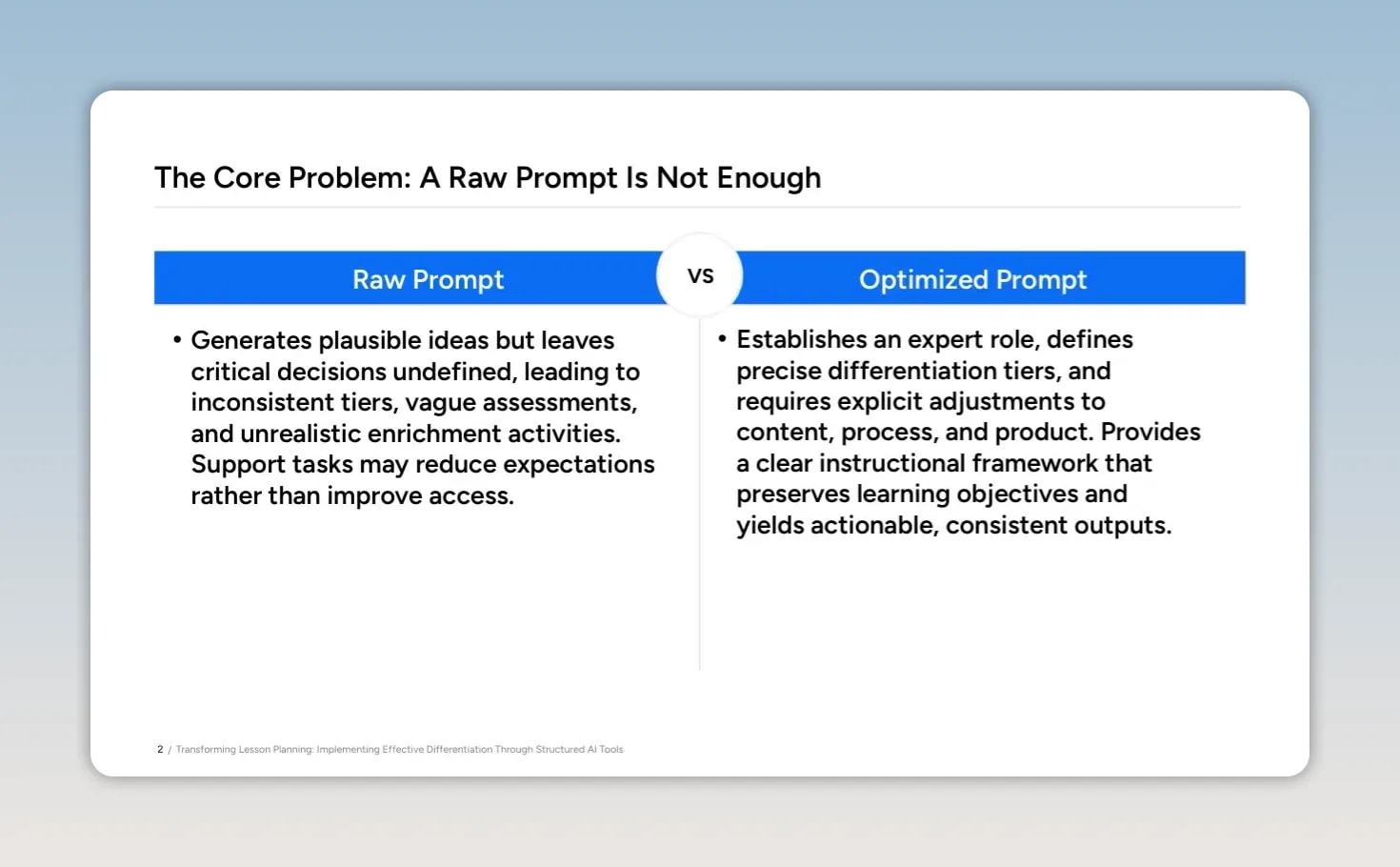
A raw request has the right intention but leaves too much to interpretation. The result can be inconsistent tiers, generic scaffolds, enrichment that does not fit the period, or assessments that fail to measure the shared goal.
The Raw Prompt
Take this lesson plan [PASTE LESSON PLAN] and create three differentiated versions to accommodate:
1. Students who are below grade level or need additional support
2. Students who are at grade level
3. Students who need enrichment or are above grade level

For each version, adjust the content complexity, process, and product while maintaining the same learning objectives. Include specific modifications for instruction, activities, and assessments.
This request asks for differentiation, but it does not establish what meaningful content, process, and product changes look like. It also does not give the model an instructional lens or a repeatable response structure.
The Optimized Prompt
You are an expert Instructional Designer and Differentiation Specialist with experience in K-12 curriculum adaptation and Universal Design for Learning principles.

Analyze the provided lesson plan and generate three distinct, fully differentiated versions based on student readiness. Preserve the core learning objectives while adjusting content, process, and product.

Create these tiers:
1. Support/Intervention: students needing significant scaffolding
2. On-Grade Level: students meeting expected standards
3. Enrichment/Extension: students needing advanced challenge

For each tier, explicitly address:
- Content Complexity: depth, breadth, or abstraction
- Process: instructional strategies, grouping, pacing, and scaffolding
- Product: how students demonstrate mastery
- Instruction: specific teaching techniques or supports
- Activities: specific learning tasks
- Assessments: specific evidence of understanding

Analyze this lesson plan:
[PASTE LESSON PLAN]
The optimized version gives the AI a role, a clear goal, operational readiness tiers, and a consistent output format. It also protects the central principle of differentiation: pathways may differ, but the intended learning destination remains shared.
Why the Structure Works
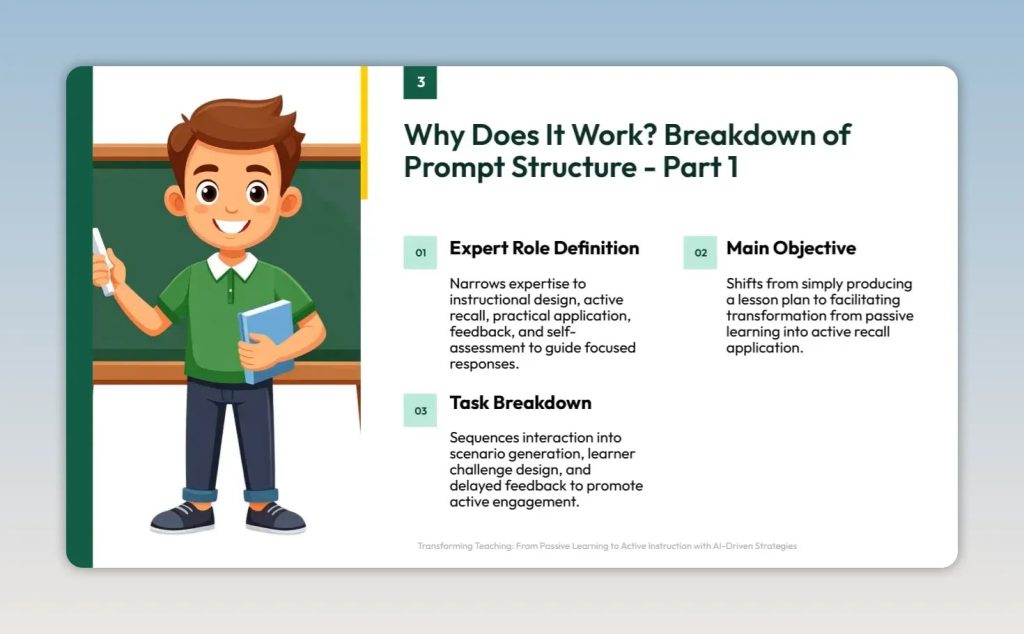
The prompt rests on three connected choices: define the expert role and objective, identify readiness tiers, and require specific changes to instruction, activities, and assessment.
1. Give AI a Professional Lens
An instructional designer and differentiation specialist role encourages attention to K–12 adaptation, accessibility, and Universal Design for Learning guidelines. It does not replace professional judgment, but it establishes the vocabulary and priorities expected in the response.
2. Define Readiness Tiers Clearly
Labels such as “low,” “middle,” and “high” are vague and can unintentionally communicate fixed ability. Support, on-grade level, and enrichment instead describe the type of learning design required.
- Support/Intervention: greater modeling, structure, visual support, guided practice, and feedback.
- On-Grade Level: independent work toward expected standards with appropriate collaboration and practice.
- Enrichment/Extension: deeper analysis, abstraction, transfer, or problem-solving.
3. Differentiate Content, Process, and Product
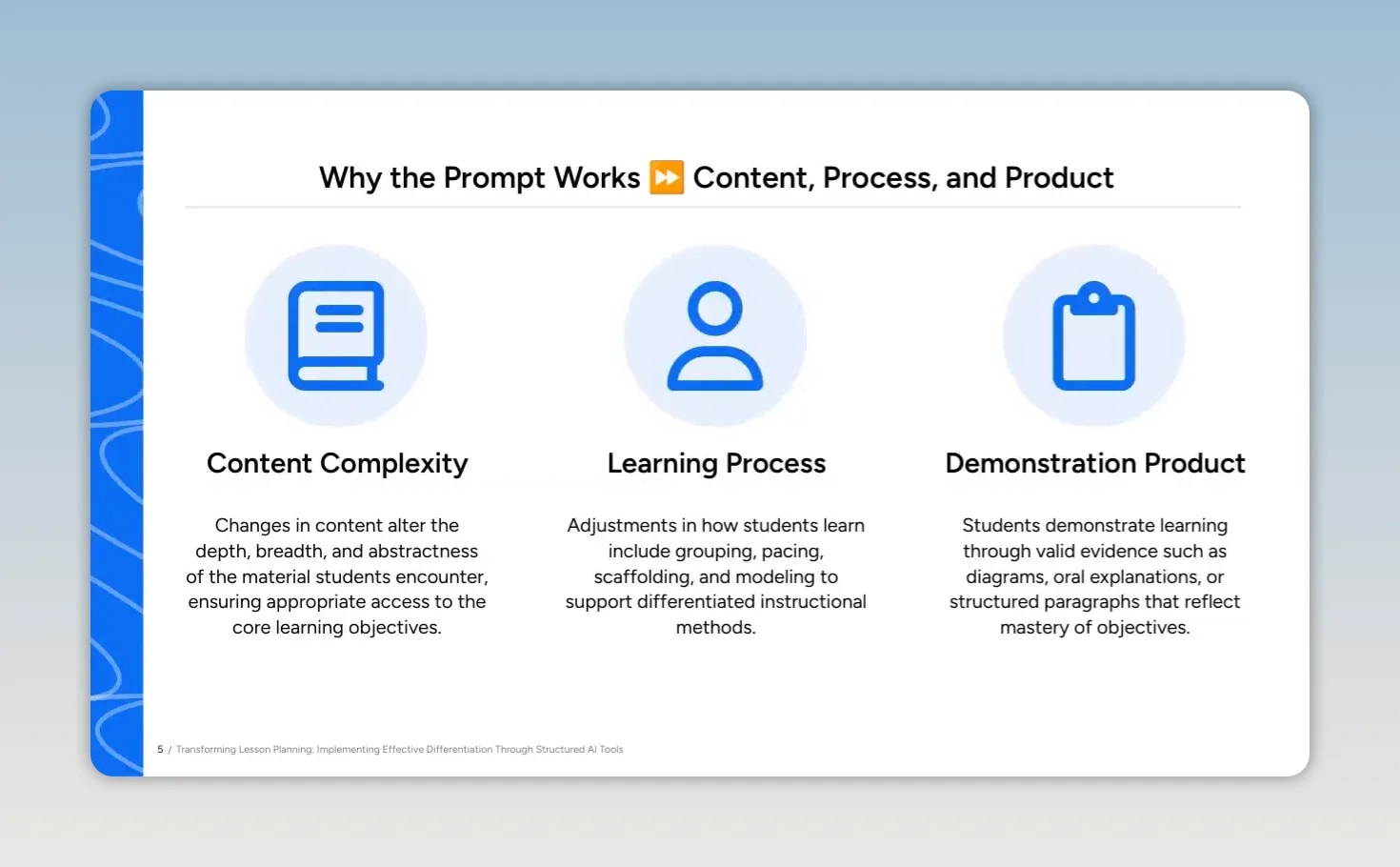
Content complexity concerns what students encounter: vocabulary, number of examples, conceptual depth, and abstraction. Process concerns how students learn through pacing, grouping, teacher modeling, chunking, graphic organizers, or peer collaboration. Product concerns how mastery is shown, such as through a labeled diagram, oral explanation, paragraph, model, or evidence-based recommendation.
The crucial test is alignment. A supported product may be simpler in form, but it must still offer valid evidence that the student understands the core objective.
Move From Theory to Classroom Practice
General directions such as “add scaffolding” are not enough. A useful planning response should separate three classroom-facing components:
- Instruction: the teaching moves, supports, and models used by the teacher.
- Activities: the tasks and experiences students complete.
- Assessments: the evidence used to verify readiness and mastery.
This structure makes misalignment easier to spot. If instruction covers every part of a scientific process but the exit task checks only one part, the assessment does not yet support the objective. Requiring all three components also moves an AI response beyond a loose strategy list and toward an implementable planning document.
Case Study: Amelia’s Fifth-Grade Water Cycle Lesson
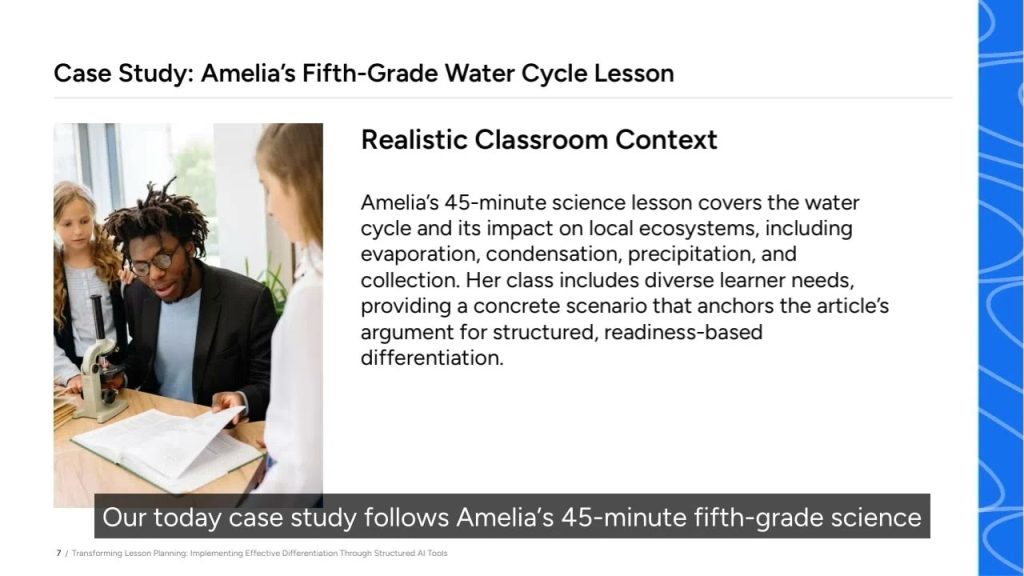
Consider Amelia, a fifth-grade science teacher preparing a 45-minute lesson on the water cycle and its effects on local ecosystems. Students explore evaporation, condensation, precipitation, and collection while connecting those stages to their community watershed.
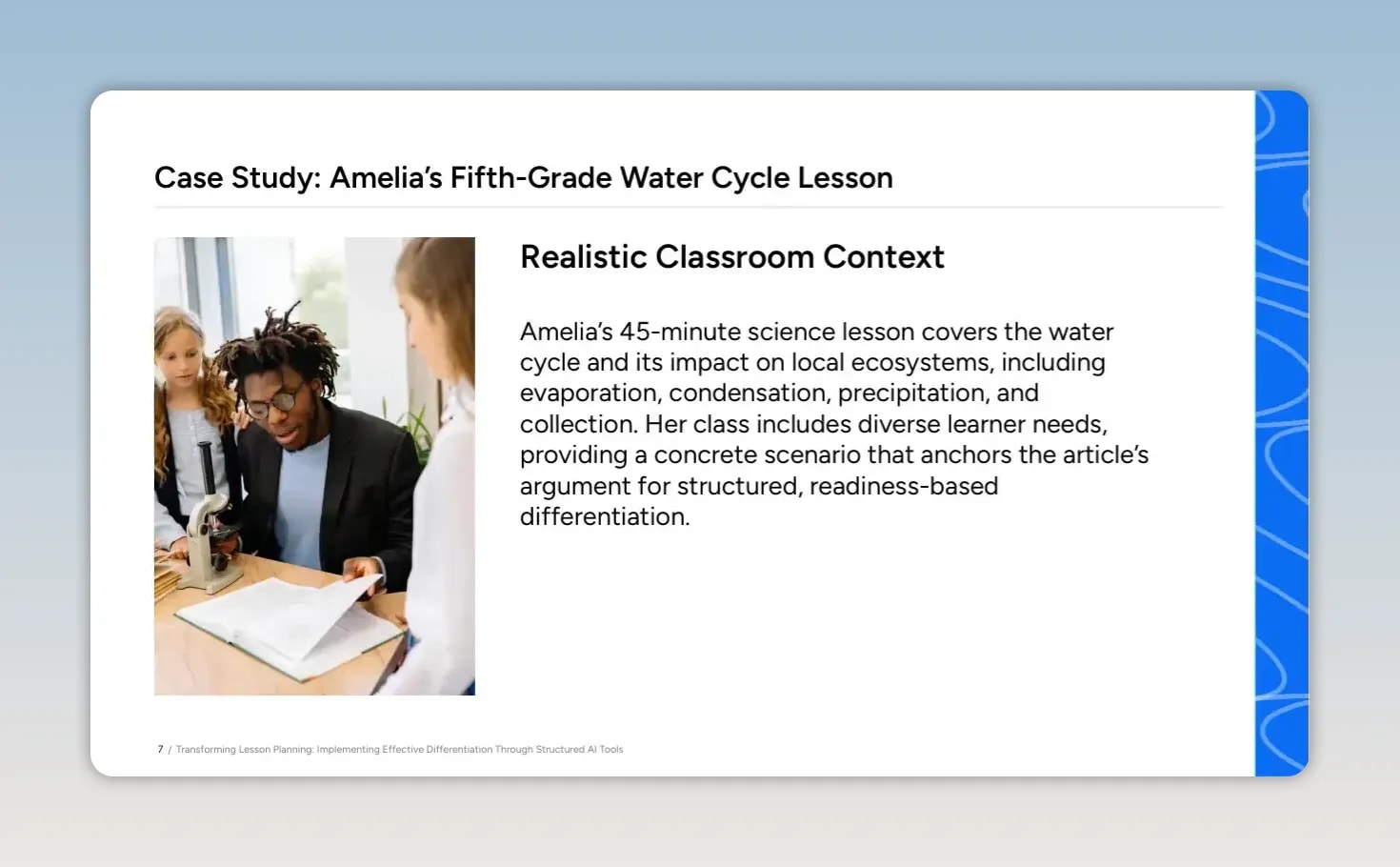
The lesson is a useful test because it includes a fixed duration, a defined scientific objective, a local application, and varied learner needs. A quality response should not remove the ecosystem connection for students receiving support. Instead, it should create an accessible route to that connection—for example, through visual vocabulary cards, a partially completed water-cycle diagram, teacher modeling, and a sentence frame such as “When it rains, water goes into our river.”
On-grade students might independently create and explain a diagram that includes local features. Enrichment students could analyze a local environmental issue or consider how drought, flooding, or human activity affects the watershed. The extension should deepen transfer and reasoning, not simply add more work.
What the Model Comparison Reveals
Applied to Amelia’s lesson, Claude Sonnet 4.6 offered the broadest strategy bank. Its useful options included simplified vocabulary, pre-filled graphic organizers, peer teaching, and examples tied to the local watershed. That range is valuable, although an educator would need to select and trim ideas to fit a 45-minute period.
Gemini 3.1 Pro Preview stood out for consistent organization. It separated content, process, product, instruction, activities, and assessments in a way that supports direct comparison between tiers. That structure makes it easier to turn generated material into a planning template or use it in professional learning.
Minimax M3 was the most concise. Its efficiency made the response easier to scan, but concision came with a meaningful drawback: the support tier weakened the local ecosystem objective. This is the central instructional warning. Differentiation should improve access to the goal, not quietly remove part of it.
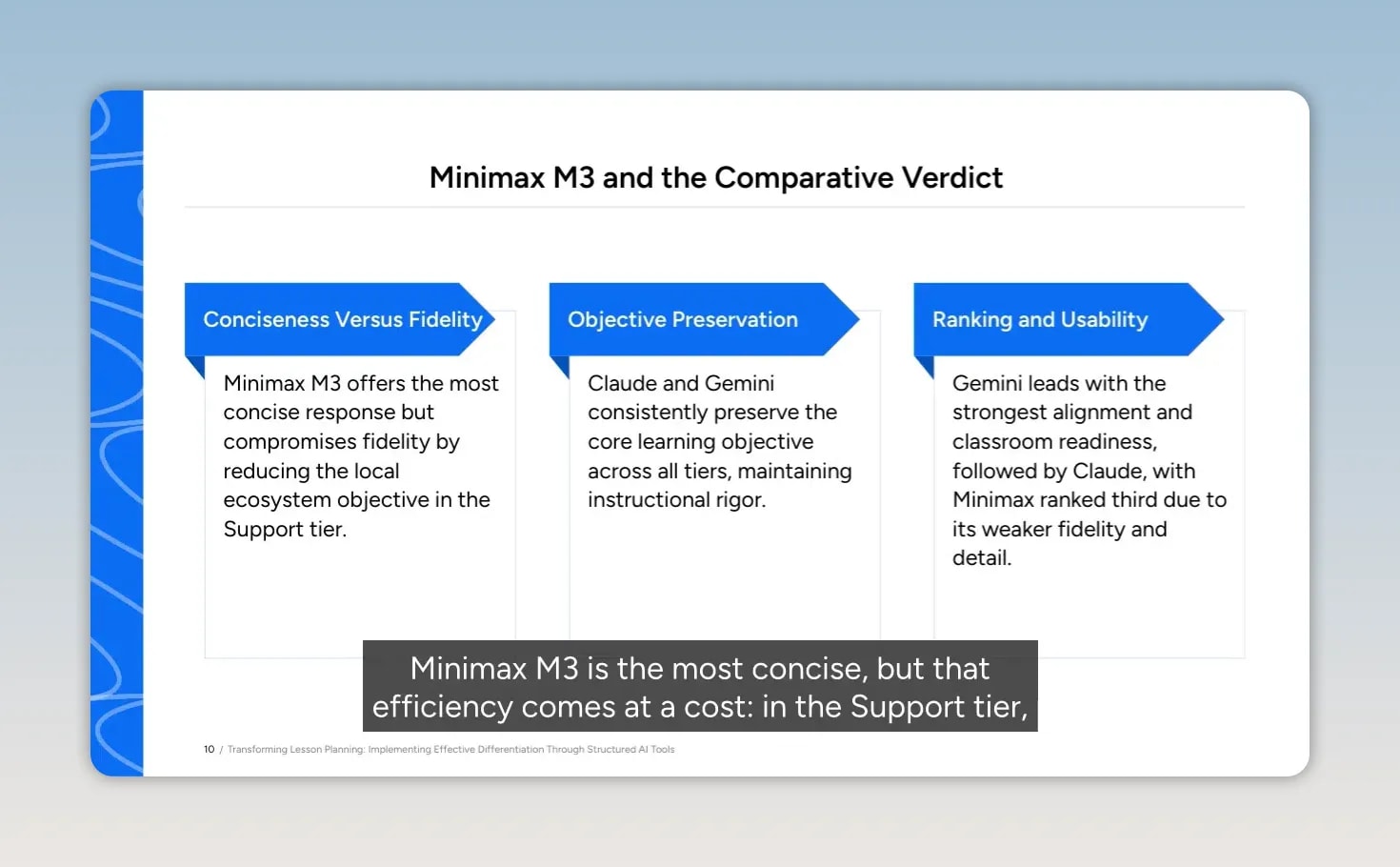
For alignment and classroom readiness, Gemini ranked first, followed by Claude and then Minimax. Yet every output still needs review for realistic pacing, available materials, assessment validity, and safety. AI can draft a strong foundation; the educator remains responsible for deciding what works for the actual class.
From Reusable Prompt to Guided Planning Assistant
An optimized prompt is a major improvement, but it still asks teachers to remember the framework, format the lesson context, and identify missing variables every time. A conversational differentiated lesson-planning assistant can reduce that repeated cognitive work by gathering information step by step.
Instead of requiring a perfectly formed input, the Differentiated Lesson Plan Generator AI Assistant starts asking for the grade, subject, shared objective, available time, learner needs, materials, and expected evidence of mastery. It can then surface missing constraints before generating options.
The progression is simple: begin with a basic request, use a structured prompt to improve the result, and move toward a guided workflow that helps preserve rigor while making planning more manageable. Educational AI is most useful when it supports—not substitutes for—professional instructional judgment.
Frequently Asked Questions
What is the difference between differentiation and lowering expectations?
Differentiation changes the pathway to learning through supports, pacing, complexity, or response format. Lowering expectations removes part of the intended objective. Support-tier students should still work toward the shared goal.
What should every differentiated AI prompt include?
Include the grade and subject, learning objective, lesson duration, readiness tiers, required content-process-product changes, and specific expectations for instruction, activities, and assessment.
Why is assessment alignment important in differentiated lessons?
Assessment must provide evidence of the same core learning objective taught during instruction. The format may vary by tier, but it should still demonstrate meaningful mastery.