A professional learning cycle can create real classroom change—and still end with a reflection that barely captures what changed, why it mattered, and what should happen next.
The familiar questions, What went well? and What would you do differently?, are not wrong. They are simply too broad on their own. They often produce sincere but general answers, leaving educators without a clear account of new capabilities, confidence, student outcomes, or next-cycle actions.
That is not necessarily a reflection problem. It is often a prompt-design problem.
A well-designed AI reflection prompt can turn a loose retrospective into a structured coaching debrief. It can help educators identify what they can now do, calibrate readiness to use the skill again, connect instruction to observable student impact, and make a practical implementation plan.
Key Takeaways
- Explicit roles, categories, evidence requirements, and contextual boundaries make AI reflection prompts more consistent.
- A strong debrief covers capabilities, confidence in the full skill, observable student impact, and actionable process changes.
- Claude Sonnet 4, Gemini 3.1 Pro Preview, and MiniMax M3 each showed different trade-offs in scope, detail, and context fidelity.
- Adaptive one-at-a-time questioning can reduce the cognitive load of static prompts.
Table of Contents
- Why Generic Reflection Prompts Fall Short
- The Prompt Transformation: Before → After
- Four Elements of an Evidence-Based Debrief
- Case Study: Deborah’s Differentiated-Instruction Cycle
- What Three AI Models Reveal
- From Static Prompts to an Adaptive Debrief Assistant
- Final Thoughts
Why Generic Reflection Prompts Fall Short
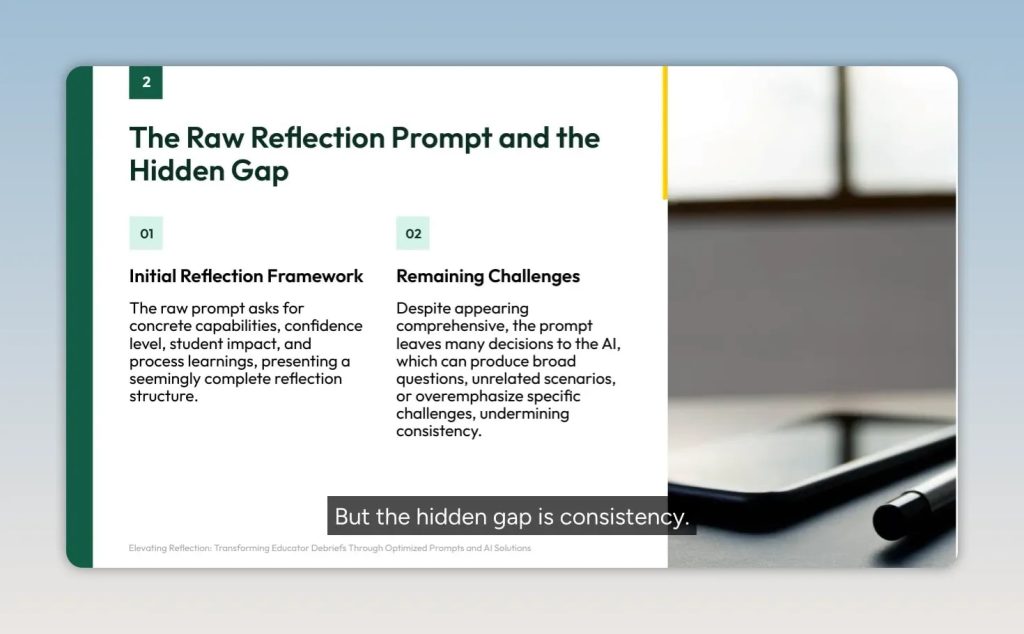
A raw reflection prompt may appear complete because it mentions important topics: capability, confidence, student impact, and process learning. Yet it leaves too much interpretation to the AI system. One response may become overly broad, another may emphasize a single challenge, and another may introduce an unrelated instructional scenario.
The hidden gap is consistency. If the prompt does not specify the AI’s role, expected evidence, required categories, and contextual limits, the resulting debrief may sound polished without being useful.
The goal is not to ask AI to write an evaluation for the educator. The goal is to have it facilitate reflection: ask focused questions that turn experience into actionable insight.
The Prompt Transformation: Before → After
The Raw Prompt
The following starting point contains the right general framework, but its instructions are open to interpretation.
Act as a reflective practice coach. I have completed my 30-day
implementation cycle for [skill].

Guide me through a structured debrief to consolidate my learning.

Ask me to reflect on:
1. Concrete Capabilities: “I can now...” statements describing new abilities.
2. Confidence Level: Rate my confidence from 1–10 and explain why.
3. Student Impact: What observable changes did I see in engagement or learning?
4. Process Learnings: What worked best and what would I change next time?

My experience: [Summarize the journey, including a highlight and challenge.]
This prompt is a reasonable beginning. But it does not clearly define the coaching expertise, require evidence-rich questioning, protect the four categories from scope drift, or instruct the system to integrate the educator’s experience across every part of the debrief.
The Optimized Prompt
The stronger version turns a broad request into a controlled coaching specification.
You are an expert Reflective Practice Coach specializing in professional
development for educators. Your goal is to facilitate a deep, structured
debrief that helps the user consolidate learning from a recent 30-day
implementation cycle and turn experience into actionable insight.

Guide reflection using exactly these four categories:

1. Concrete Capabilities: Elicit “I can now...” statements describing
   specific new abilities.
2. Confidence Level: Require a 1–10 confidence rating for future use of
   the complete skill, followed by a justification.
3. Student Impact: Focus on observable, measurable changes in student
   engagement or learning.
4. Process Learnings: Identify effective elements of the 30-day plan and
   specific, actionable changes for the next cycle.

Use the educator’s experience summary, including the highlight and
challenge, throughout the coaching. Do not introduce unrelated scenarios.
The difference is not simply more detail. Each instruction resolves a common failure mode: generic advice, missing categories, unsupported assumptions, or a confidence question that measures a narrow barrier rather than the whole professional skill.
Four Elements of an Evidence-Based Debrief
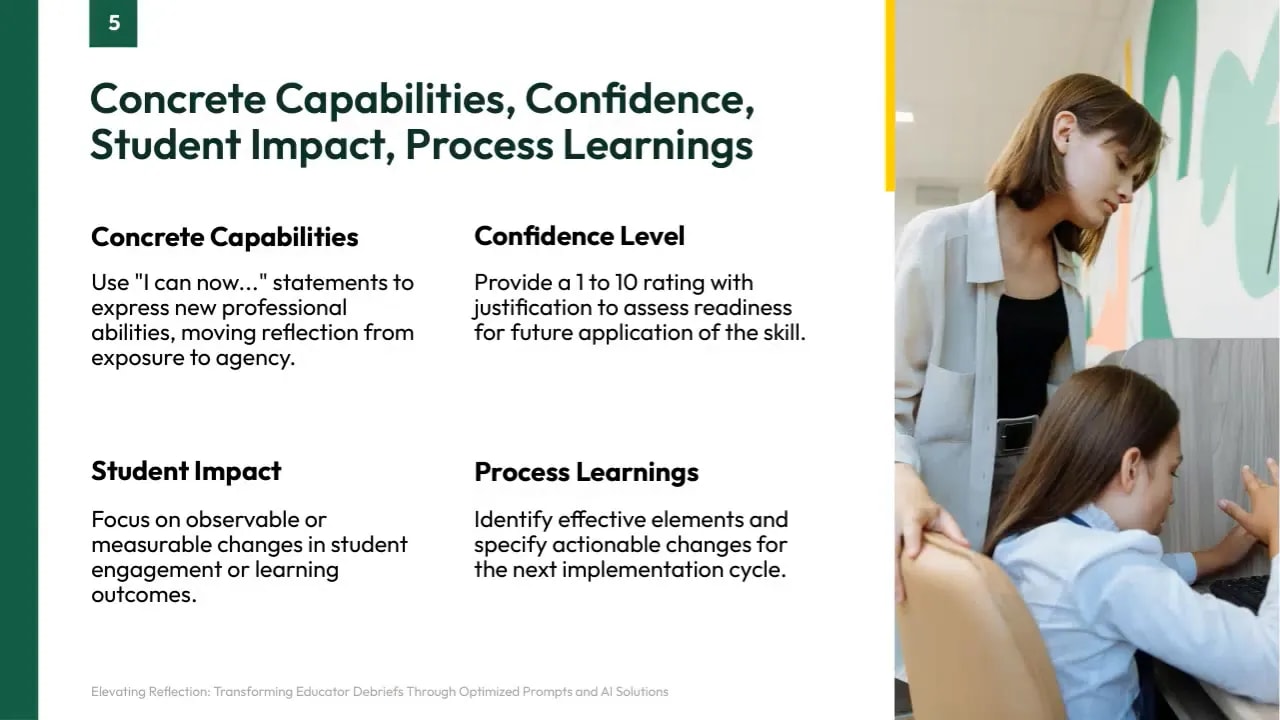
1. Concrete Capabilities
Require “I can now…” statements. This moves reflection beyond exposure—I learned about learning stations—and toward agency: I can now design learning stations for different readiness levels and adapt tasks during the lesson.
These statements can support coaching records, portfolios, self-assessment, and future professional goals because they name usable capabilities rather than vague learning.
2. Confidence Level
A 1–10 rating provides a useful calibration point, but only when it includes a justification. Ask educators to explain what evidence from the implementation cycle supports their rating and what conditions still create uncertainty.
Importantly, confidence should concern future application of the complete skill. A transition challenge may affect confidence, but it should not replace a broader assessment of confidence in differentiated instruction, formative assessment, or another target practice.
3. Student Impact
“The lesson went well” is not evidence of impact. A stronger debrief asks what changed and how the educator knows. Depending on the evidence available, this might include participation, task completion, formative assessment results, the quality of student explanations, or structured observations of time on task.
Not every implementation cycle requires formal research data. The essential distinction is between an impression and an observable change.
4. Process Learnings
The final category separates the skill itself from the process used to implement it. Instead of concluding, “I need better time management,” the educator should identify a change that can be tested:
- Reduce the number of stations.
- Prepare materials before the lesson begins.
- Add a visible transition timer.
- Rehearse movement routines before launching activities.
That shift—from a general frustration to a designed adjustment—is where reflection begins shaping the next cycle.
Case Study: Deborah’s Differentiated-Instruction Cycle
Consider Deborah, a seventh-grade science teacher working in a mixed-ability classroom. During a 30-day cycle focused on differentiated instruction, she implemented learning stations successfully and increased hands-on engagement. Her implementation challenge was time management: transitions between activities repeatedly ran beyond the planned schedule.
A generic debrief could celebrate engagement and recommend “better time management.” An optimized prompt preserves the balance between success and friction by asking Deborah to examine four connected questions:
- Capabilities: What can she now do when designing and facilitating differentiated learning stations?
- Confidence: How confident is she in applying differentiated instruction in a future science unit, and why?
- Student impact: What visible changes occurred in hands-on engagement, participation, or learning?
- Process: Which parts of the cycle should remain, and what transition routine should change?
This context is also a boundary. A useful AI response should not suddenly shift the discussion to an unrelated unit, strategy, or classroom condition. It should help Deborah make sense of the instructional experience she actually had.
What Three AI Models Reveal
When the optimized prompt was used across Claude Sonnet 4, Gemini 3.1 Pro Preview, and MiniMax M3, all three systems recognized the four-part structure. Their differences emerged in relevance, scope, and usability.
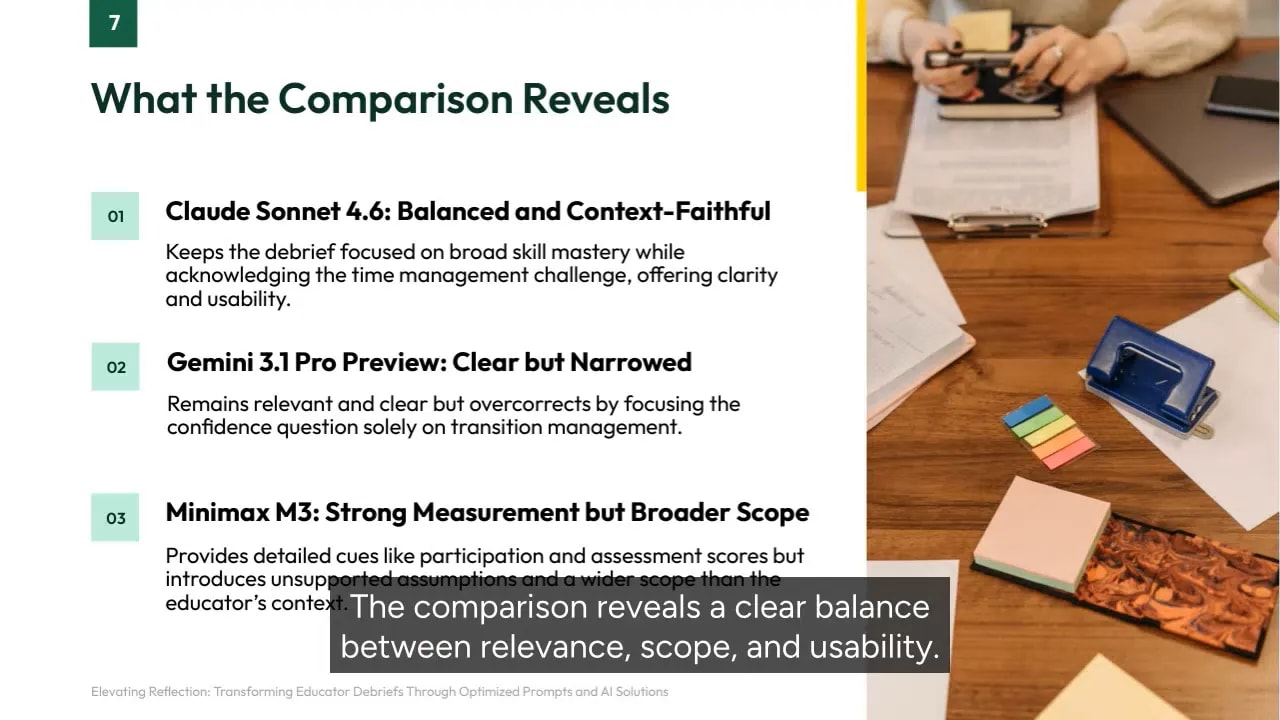
- Claude Sonnet 4 stayed closest to Deborah’s context. It balanced the broader differentiated-instruction skill with her transition-time challenge, producing a clear and facilitation-friendly sequence.
- Gemini 3.1 Pro Preview remained structured and relevant but narrowed its attention more strongly toward transition management. That can be useful operationally, though it risks making one challenge stand in for the wider skill.
- MiniMax M3 added valuable measurement cues, such as participation and formative assessment evidence, but assumed a broader context than Deborah had supplied.
The lesson is not that one model is universally best. It is that model outputs still require professional judgment. More detail is helpful only when it remains grounded in the educator’s actual evidence and does not overload the reflection with unnecessary prompts.
A practical design pattern is to preserve Claude’s context-faithful scope while adding neutral evidence cues: ask whether participation, assessment results, or student-reported understanding changed, and in what direction. Do not assume improvement, and do not require data that were never collected.
From Static Prompts to an Adaptive Debrief Assistant
Even a well-optimized prompt creates cognitive load. The educator must provide the skill, experience summary, highlight, challenge, available evidence, and desired structure at once. They must also inspect the response for missing categories or assumptions.
An adaptive Reflective Practice Debrief Assistant addresses that limitation through one-at-a-time reverse questioning. Rather than demanding a perfectly formatted summary at the start, it can ask for a skill, clarify the implementation context, explore a highlight, investigate a challenge, and then guide evidence collection progressively.
For example, if an educator says, “Students seemed more engaged,” an assistant can ask a useful follow-up: What did engagement look like? Did more students start tasks promptly, complete station work, contribute to discussions, or ask questions?
This creates a more natural path from classroom experience to a structured debrief. The educator remains the source of professional judgment and evidence; the assistant protects the reflection framework and helps uncover details that might otherwise remain unspoken.
Final Thoughts
A short reflection prompt can be useful. An optimized prompt is more reliable because it defines an expert coaching role, protects four non-negotiable categories, requests appropriate evidence, and keeps the discussion grounded in the educator’s lived context.
The best debrief does not merely ask whether a cycle went well. It identifies capability, calibrates confidence, examines student impact, and turns implementation lessons into a specific next step. That is how AI-supported reflection becomes more than a summary—it becomes a practical tool for professional growth.
Frequently Asked Questions
What makes a reflection prompt evidence-based?
An evidence-based reflection prompt asks for specific capabilities, a justified confidence rating, observable student changes, and concrete next-cycle adjustments rather than relying only on broad impressions.
Why use “I can now…” statements?
“I can now…” statements turn general learning into clear descriptions of usable professional capability. They help distinguish awareness of a strategy from the ability to apply it.
Should every educator collect numerical student data?
No. A strong reflection can use structured observations when numerical data are unavailable. The priority is identifying what changed, for whom, and what evidence supports that conclusion.
Why is an adaptive debrief assistant useful?
It can gather context through focused follow-up questions instead of requiring every input at once. This reduces setup effort while maintaining the structure of capabilities, confidence, student impact, and process learning.