Gamification often sounds easier than it is.
The initial idea is appealing: give a unit an immersive theme, let students make choices, reward progress, and build collaboration into the experience. But practical questions arrive quickly. How will the game reinforce the actual learning objectives? Will the challenges build skills instead of simply adding entertainment? Can the system work for English language learners, students with IEPs, and a classroom with limited technology? And where are the handouts, source packets, rubrics, rules, and teacher procedures?
A short AI request may generate an engaging concept, but it leaves too many instructional decisions open. The result can be imaginative without being usable. Better prompt structure closes that gap by treating gamification as instructional design—not as a layer of points added after the lesson is planned.
Key Takeaways
- Strong gamification prompts define an expert role, a classroom-ready deliverable, clear inputs, and named design constraints.
- Elaine’s Civil Rights Movement case requires primary-source analysis, perspective-taking, collaboration, accessibility, and practical technology planning.
- Claude is most balanced, Gemini is most expansive, and Minimax is most compact—but all require materials review before classroom use.
Table of Contents
- The Prompt Transformation: Before to After
- Why the Optimized Structure Works
- Case Study: Elaine’s Civil Rights Movement Unit
- Three Model Approaches to the Same Design Challenge
- What the Comparison Reveals
- From Prompt Engineering to Guided Design
- Final Thoughts
The Prompt Transformation: Before to After
A raw prompt commonly includes the right ingredients, but it does not explain the standard of completion. In particular, the phrase “all necessary materials” is too vague. It may produce a list of resources rather than the materials needed to run the unit.
The Raw Prompt
Design a gamified learning experience for teaching [TOPIC] to my [GRADE LEVEL] students.

The gamification elements should:
- Have clear learning objectives aligned with: [LIST OBJECTIVES]
- Include a compelling narrative or theme
- Feature progressive challenges that build skills
- Incorporate meaningful choices for students
- Include a point system or rewards that motivate learning
- Allow for both individual achievement and collaboration
- Be manageable in my classroom setting: [DESCRIBE SETTING]

Please provide all necessary materials, rules, and implementation instructions.
This is a promising starting point. Yet it does not assign an expert perspective, define the expected level of thoroughness, or specify what “materials” must include. An AI can satisfy the request with broad suggestions while omitting source documents, student organizers, scoring tools, rubrics, and mastery criteria.
The Optimized Prompt
You are an expert Instructional Designer specializing in gamification and K-12 learning.

Your primary task is to design a comprehensive, fully realized gamified learning experience based on the user's specifications. The design must result in a complete set of materials, rules, and step-by-step implementation instructions suitable for immediate classroom use.

The design must strictly address:
- Learning Alignment: Map activities clearly to [LIST OBJECTIVES].
- Narrative: Use a compelling, age-appropriate theme.
- Progression: Scaffold challenges so skills build over time.
- Agency: Include meaningful choices that affect learning or gameplay.
- Motivation: Use rewards that support both intrinsic and extrinsic motivation.
- Social Structure: Balance individual achievement and structured collaboration.
- Practicality: Fit the specified classroom setting: [DESCRIBE SETTING].

The specific context is:
- Topic: [TOPIC]
- Target Audience: [GRADE LEVEL] students
- Learning Objectives: [LIST OBJECTIVES]
- Classroom Setting: [DESCRIBE SETTING]
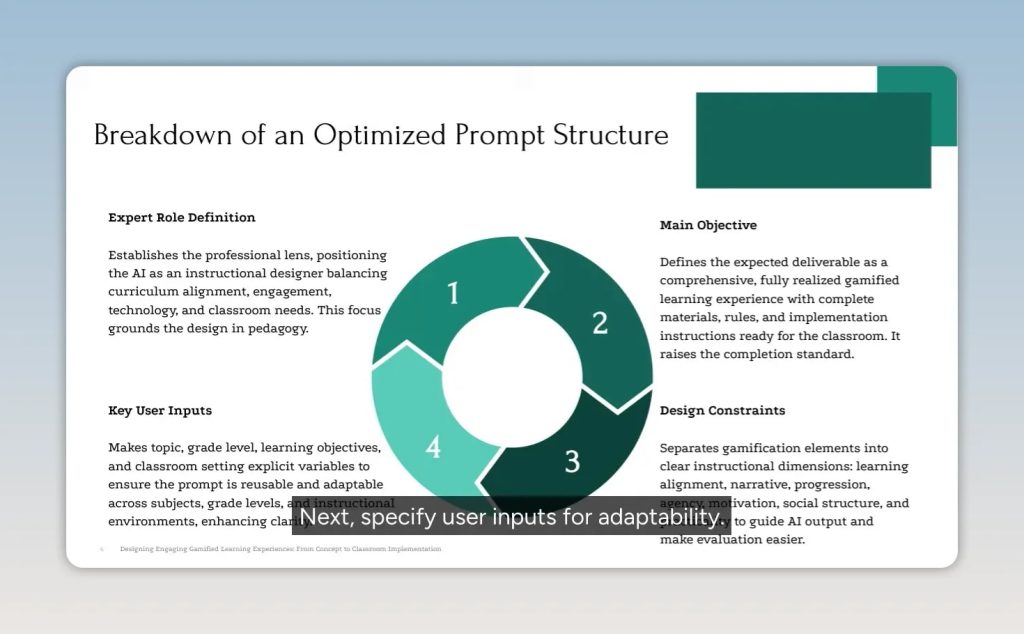
The difference is not decorative language. The optimized version creates a professional brief: it defines the AI’s role, establishes a classroom-ready deliverable, identifies reusable inputs, and turns broad gamification preferences into explicit design constraints.
Why the Optimized Structure Works
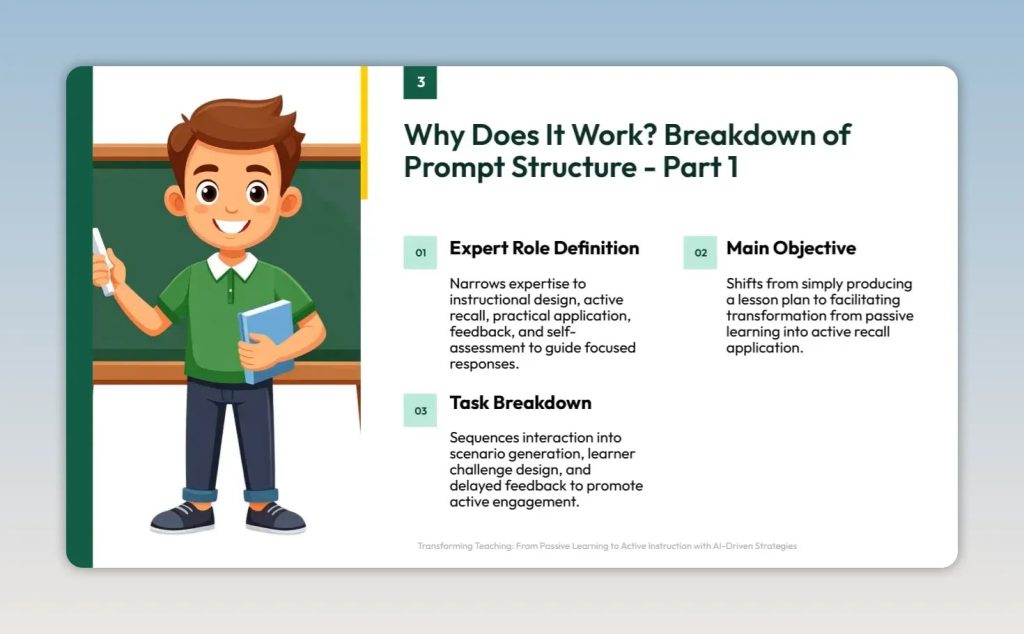
The first improvement is the expert role. Asking for an instructional designer specializing in gamification and K–12 learning directs the response toward pedagogy, not simply technology, narrative, or entertainment. A strong learning game needs curriculum alignment, developmental appropriateness, differentiation, feedback, and workable classroom routines.
The next improvement is defining the deliverable. “A comprehensive, fully realized experience” sets a higher standard than “design an activity.” It signals that the output should cover the learning sequence, rules, materials, procedures, and assessment supports.
The seven design constraints create a practical quality-control checklist:
- Learning alignment: Each challenge should practice a stated objective.
- Narrative: The theme should give students purpose without distracting from content.
- Progression: Tasks should move from foundational work toward analysis and synthesis.
- Agency: Choices should influence investigation, strategy, or final products—not merely cosmetic details.
- Motivation: Points and rewards should reinforce mastery, feedback, and persistence.
- Social structure: Individual accountability should coexist with meaningful collaboration.
- Practicality: Time, technology, student needs, and classroom realities must shape the mechanics.
Case Study: Elaine’s Civil Rights Movement Unit
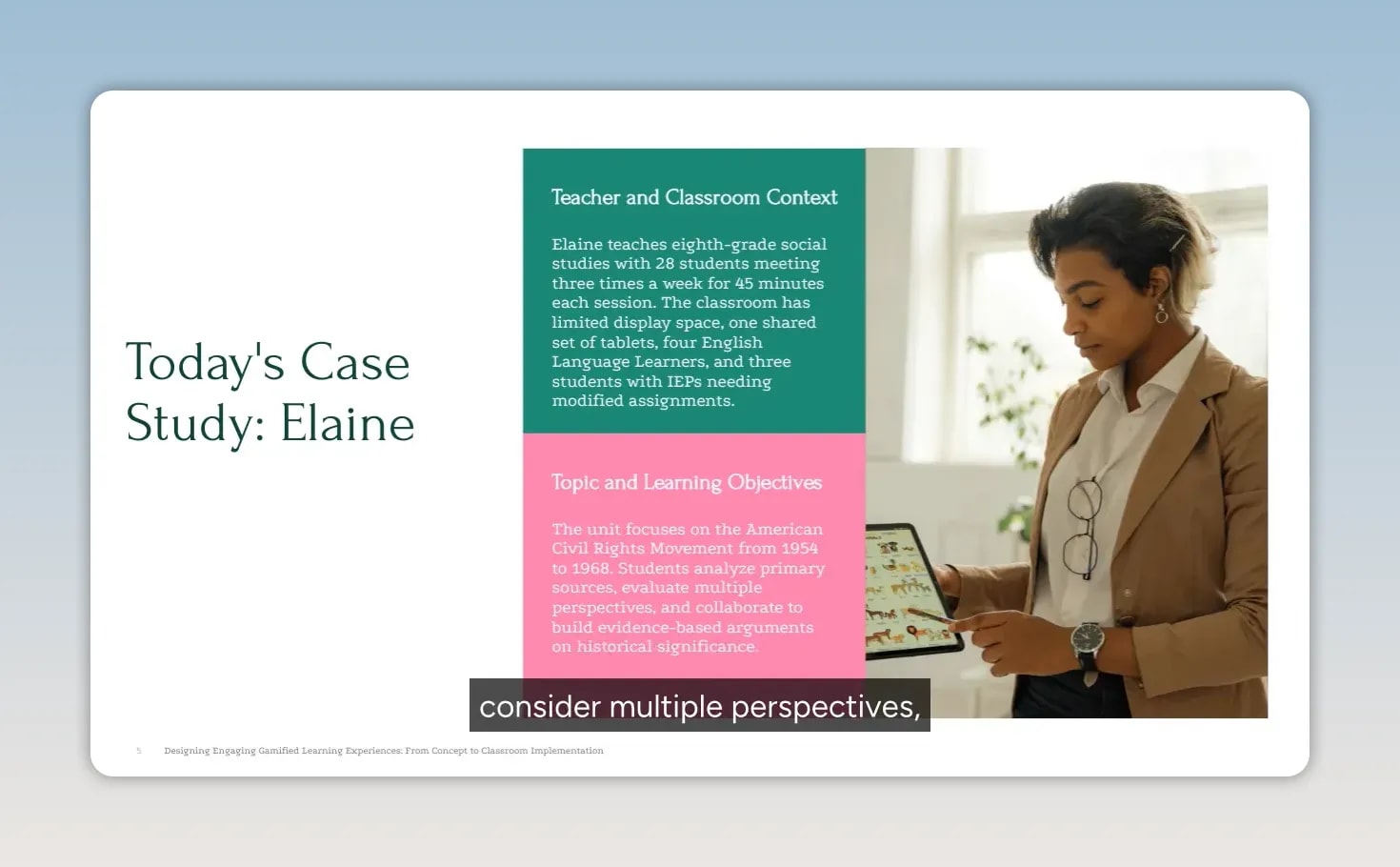
Consider Elaine, an eighth-grade social studies teacher working with 28 students, including English language learners and students with IEPs, in a classroom with limited technology. Her unit on the Civil Rights Movement asks students to analyze primary sources, consider multiple perspectives, and collaborate on evidence-based arguments about historical significance.
These details matter because they turn a generic request into a real instructional design problem. The game must not reward speed at the expense of careful reading. It must support access to complex sources. It must also build toward historical argument rather than stopping at a theme, a timeline, or a point total.
Using the same optimized prompt, three AI models produced distinct approaches. Their differences show why a well-structured prompt improves quality but does not eliminate the need for professional review.
Three Model Approaches to the Same Design Challenge
Claude Sonnet: Balanced Alignment and Narrative
Claude frames students as aspiring “Time Weavers” who repair fractured timelines through Evidence Scrolls, Viewpoint Archives, and Coalition Quests. Its progression moves from source analysis toward synthesis and pairs a coherent narrative with collaboration and differentiation.
This is the strongest overall balance because the named activities remain closely connected to Elaine’s objectives. However, the teacher must still supply the underlying sources, handouts, rubrics, and scoring tools before implementation.
Gemini: Expansive Phased Implementation
Gemini casts students as historical archivists building a museum exhibit in 2076. It offers the broadest rollout, organized in phases, and makes its point structure concrete with incentives such as 50 Insight Points for timely completion and 150 per presentation.
The tradeoff is management. Its larger project structure can create more teacher overhead, and some activities can drift from the central work of primary-source analysis and cause-and-effect reasoning. A chronological sorting activity may build background knowledge, for example, but it does not independently demonstrate historical analysis.
Minimax M3: Compact Missions and Trials
Minimax takes a streamlined path. Students become Civil Rights Timekeepers who complete sequential missions and trials. Perspective Cards and cause-and-effect chains create a direct route from examining viewpoints to connecting events and building evidence-based claims.
Its compact structure is easier to imagine in a regular classroom routine. Still, it acknowledges an important limitation: sources, organizers, rubrics, and mastery criteria remain missing. A described activity is not the same as a ready-to-use classroom material.
What the Comparison Reveals
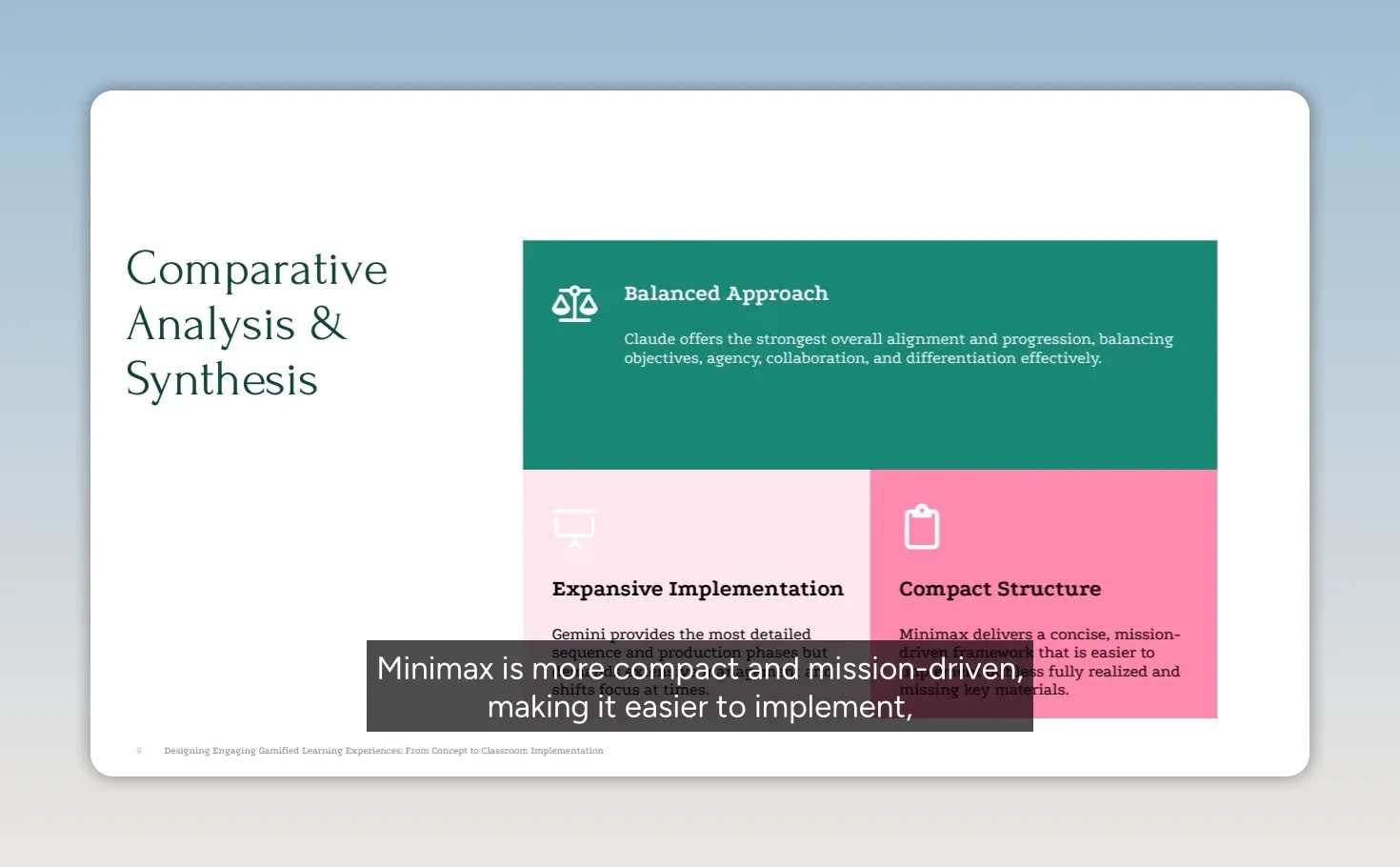
Claude offers the strongest overall balance of objectives, agency, collaboration, and differentiation. Gemini provides the most extensive implementation sequence, though it requires more management. Minimax is the most compact and mission-driven, making it easier to implement, but it lacks some key materials and depth.
The shared lesson is significant: strong prompt design creates better structure, but it does not automatically create a complete instructional package. Before using an AI-generated gamified unit, check for the essential operational details:
- Primary-source excerpts or content materials
- Student-facing directions and accessible organizers
- Teacher procedures and timing guidance
- Rubrics, answer keys, and mastery criteria
- Fair point rules and individual accountability
- Supports for language access and IEP accommodations
- Low-tech or offline alternatives
Gamification succeeds when the game mechanics serve the learning. Narrative can make a task memorable, progression can build confidence, and rewards can make progress visible. But evidence analysis, discussion, reflection, and assessment must remain at the center.
From Prompt Engineering to Guided Design
An optimized prompt reduces ambiguity, yet it still asks the educator to remember the variables: objectives, grade level, time, technology access, learner supports, assessment plans, collaboration preferences, and reward philosophy. The educator must also identify omissions in a polished response.
A guided Gamified Learning Experience Designer helps reduce that cognitive load by asking focused questions in sequence: What should students know or do? How much time is available? What resources can they access? Which supports matter? How competitive should the experience feel? Which materials are required?
The goal is not to replace professional judgment. It is to preserve instructional quality while making the design process more manageable. Better educational AI should help educators clarify constraints, generate useful materials, and keep learning objectives visible from the first mission to the final assessment.
Final Thoughts
A raw gamification prompt can spark an idea. An optimized prompt can produce a far more coherent learning system by defining the expert role, the complete deliverable, the user inputs, and the constraints that protect instructional quality.
Elaine’s case also shows the limit of even a well-designed request. Each model generated useful concepts, but each still required careful evaluation and likely follow-up work. The practical next step is simple: use the optimized prompt for an upcoming unit, then audit the response against the objectives and request the missing materials explicitly.
Educational gamification is not ultimately about making lessons feel more like games. It is about designing purposeful systems in which engagement, access, collaboration, and rigor reinforce one another.
Frequently Asked Questions
What makes a gamification prompt classroom-ready?
It should request not only a narrative and activities, but also student materials, teacher procedures, assessment criteria, scoring rules, differentiation, and implementation guidance.
Why should an AI be assigned an instructional designer role?
The role helps ground recommendations in pedagogy, K–12 learning needs, alignment, accessibility, and classroom practicality rather than entertainment alone.
Which model produced the best Civil Rights Movement gamification design?
Claude offered the strongest overall balance of objective alignment, agency, collaboration, and differentiation. Gemini was the most expansive, while Minimax offered the most compact mission-based structure.