Asking AI for social-emotional learning activities sounds simple: cover the key competencies, keep materials minimal, make the work engaging, and adapt it for a particular group of students.
But a plausible answer is not necessarily a usable lesson. Activities may have uneven timing, repeat the same discussion format, overlook emotional regulation in favor of emotion identification, or fail to address the peer conflict and anxiety that made support necessary in the first place.
The difference between a generic request and a classroom-ready result is instructional architecture. A stronger prompt gives the model a professional lens, a measurable deliverable, clear constraints, and a meaningful student context. It also gives educators a practical rubric for reviewing what comes back.
Key Takeaways
- Optimized SEL prompts define a professional role, measurable deliverables, constraints, and student context.
- Requiring exactly five distinct activities makes SEL competency coverage easier to verify.
- Claude offered depth, Gemini the strongest ready-to-use balance, and Minimax the clearest concise format.
- AI-generated activities still require educator review for timing, safety, materials, and contextual fit.
Table of Contents
- The Prompt Transformation: Before and After
- Why Stronger Prompt Structure Produces Better Lessons
- Case Study: Fiona’s Targeted Middle School Mini-Unit
- What the Three-Model Comparison Revealed
- From Optimized Prompt to Interactive Assistant
- Final Thoughts
The Prompt Transformation: Before and After
A raw SEL prompt can include the right ingredients while leaving the relationships among them unclear. It identifies desired activities, timing, needs, and reflection, but it does not make the priority of each requirement explicit.
The Raw Prompt
Design 5 activities to support social-emotional learning for my [GRADE LEVEL] students. Create activities that address:
1. Self-awareness and emotional regulation
2. Empathy and perspective-taking
3. Responsible decision-making
4. Relationship skills
5. Stress management and coping strategies

Each activity should:
- Take approximately [TIME] to implement
- Include clear objectives and instructions
- Be age-appropriate and engaging
- Require minimal special materials
- Include discussion questions or reflection components

My students' social-emotional needs include: [DESCRIBE NEEDS]
This is a useful starting point, but it can still lead to uneven outputs. The model may satisfy the list superficially without treating student needs as the central design driver, or it may provide five activities that are similar in format and instructional purpose.
The Optimized Prompt
You are an expert curriculum designer specializing in K-12 Social-Emotional Learning programs. Create practical, engaging, and research-informed activities tailored to specific student needs and time constraints.

Your primary objective is to design exactly five distinct, high-impact activities that support students' social-emotional development and comprehensively cover the competencies below:

1. Self-awareness and emotional regulation
2. Empathy and perspective-taking
3. Responsible decision-making
4. Relationship skills
5. Stress management and coping strategies

The activities must be specifically designed to address the unique social-emotional needs described in the Key Contextual Input section.

Each activity must adhere strictly to these constraints:
- Duration: approximately [TIME] to implement fully
- Clarity: clearly defined learning objectives and step-by-step instructions
- Engagement: highly age-appropriate and engaging
- Resources: minimal or no special materials
- Reflection: meaningful discussion questions or structured reflection

Grade Level: [GRADE LEVEL]
Specific Student Needs: [DESCRIBE NEEDS]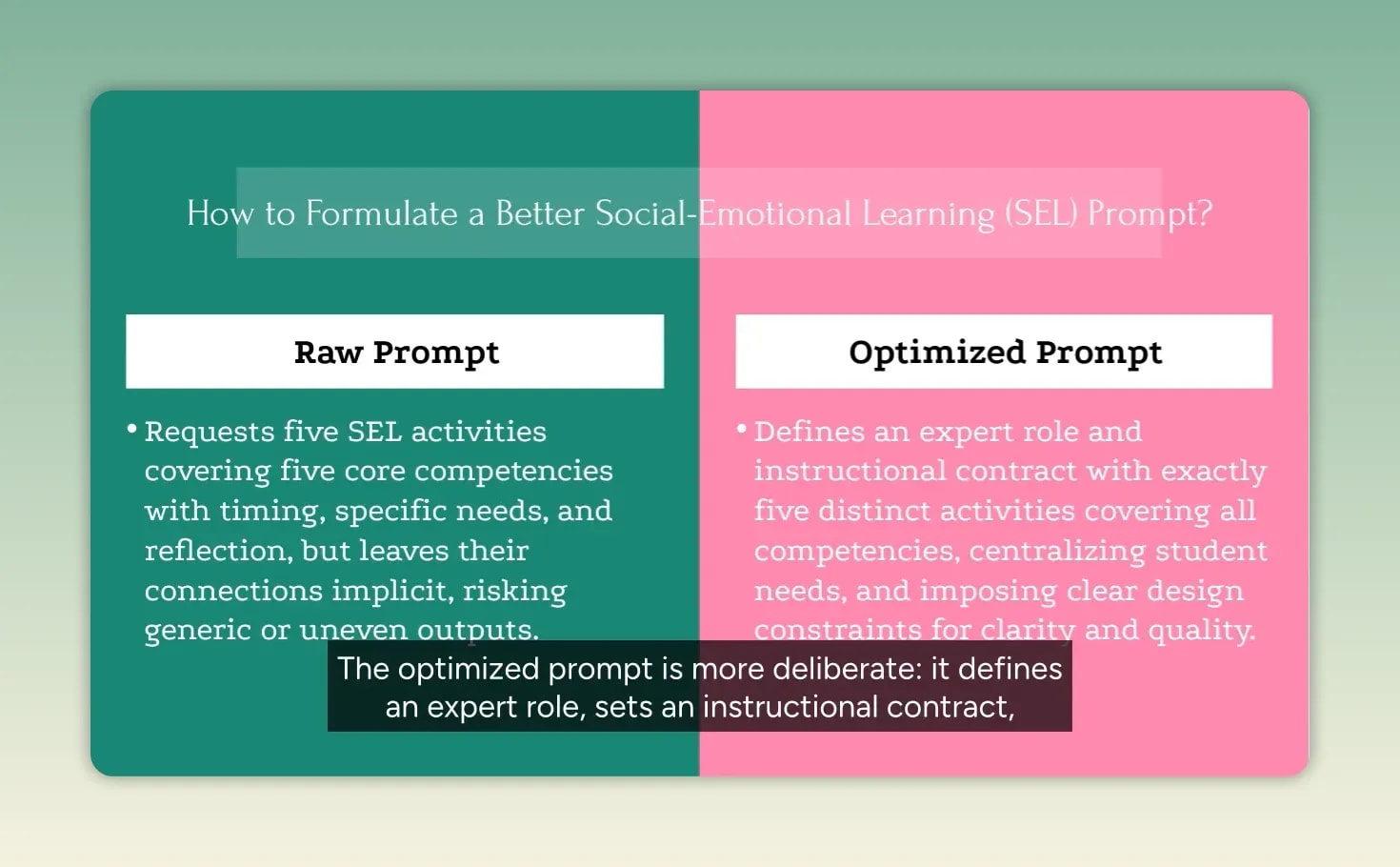
The improvement is not simply more wording. The optimized version establishes an expert role, requires exactly five distinct activities, names all required competency areas, and turns practical requirements into auditable criteria.
Why Stronger Prompt Structure Produces Better Lessons
Give the model a relevant professional lens
“You are an expert curriculum designer specializing in K–12 SEL programs” directs the model away from generic brainstorming. It frames the task around classroom practicality, developmental appropriateness, student engagement, research-informed methods, limited instructional time, and real implementation constraints.
Make the deliverable measurable
Requiring exactly five high-impact activities removes ambiguity. It discourages a response that returns four partial ideas, adds unnecessary extensions, or repeats the same role-play structure across every competency.
Distinct activities should serve distinct instructional functions. Students might interpret social cues in one lesson, practice perspective-taking in another, evaluate choices in a third, rehearse communication in a fourth, and build coping strategies in a fifth.
Protect complete competency coverage
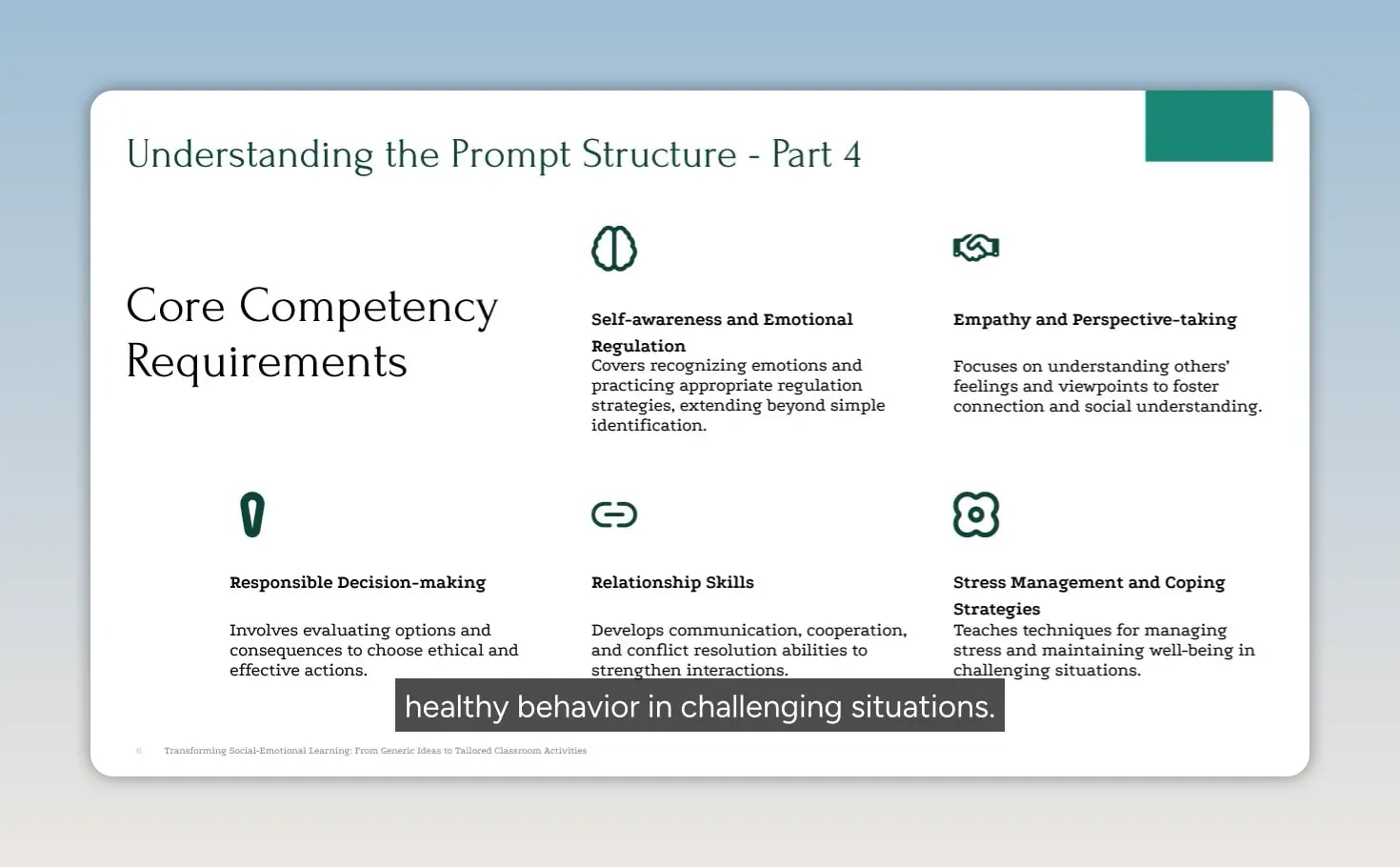
The framework includes five SEL competencies: (1) self-awareness and emotional regulation, (2) empathy, (3) responsible decision-making, (4) relationship skills, and (5) stress management. Naming each area makes omissions easier to catch. It also matters that emotional regulation goes beyond merely labeling feelings: students should have an opportunity to notice an emotion and choose an appropriate response.
Put student needs at the center
Context cannot be an afterthought. A general middle school activity may be age-appropriate yet still fail to help students who are misreading tone, feeling anxious in social situations, or becoming frustrated during group work.
The instruction that activities “must be specifically designed” around identified needs changes the task. It asks AI to adapt scenarios, reflection questions, participation structures, and skill practice—not merely attach a generic activity to an SEL label.
Case Study: Fiona’s Targeted Middle School Mini-Unit
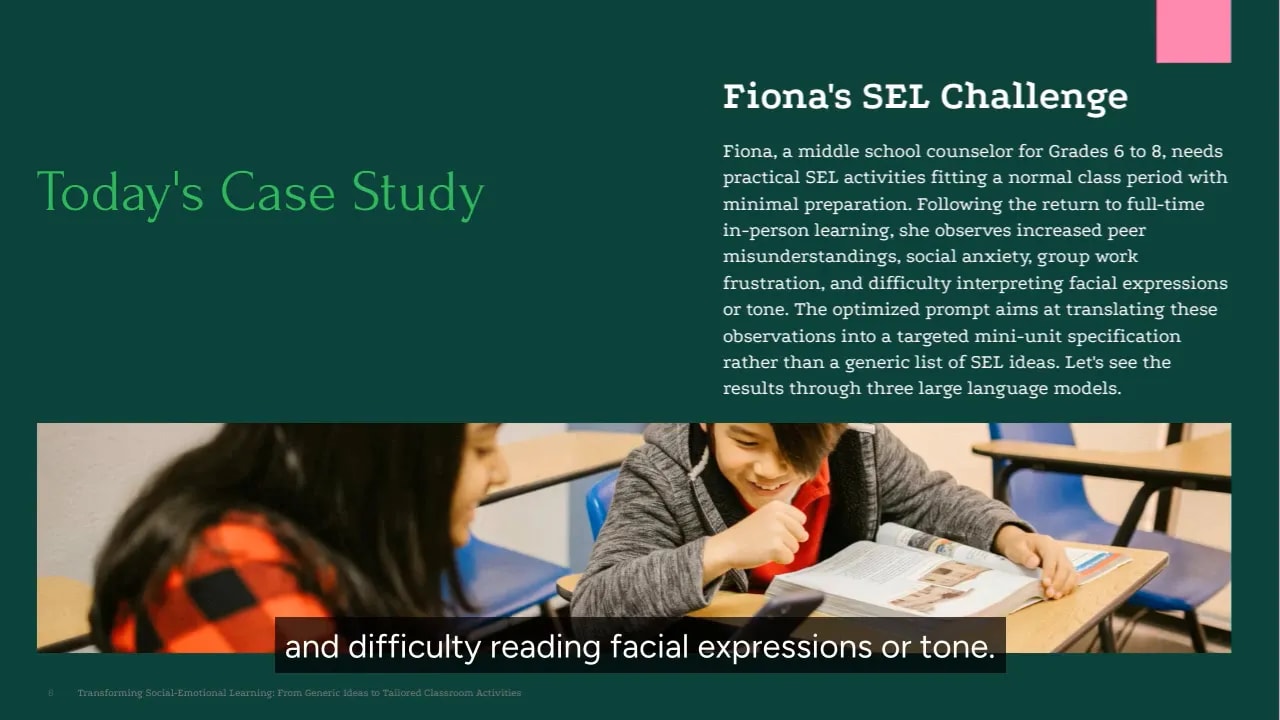
Fiona, a middle school counselor serving Grades 6–8, needs practical SEL activities that fit a regular class period and require little preparation. She is seeing peer misunderstandings, social anxiety, group-work frustration, and difficulty interpreting facial expressions or tone.
In the fuller case, Fiona is supporting teachers after students returned to full-time in-person learning following an extended period of remote instruction. Some students withdraw from collaboration; others react defensively when their ideas are challenged. The goal is not a collection of generic ideas. It is a focused mini-unit that helps students navigate the situations they are actually encountering.
| Input | Fiona’s case-study value |
|---|---|
| Duration | 30–45 minutes |
| Grade level | Middle school, Grades 6–8 |
| Student needs | Peer conflict, social anxiety, difficulty reading social cues, group-work frustration, and challenges expressing emotions appropriately |
This context should shape every activity. A social-cue activity can focus on facial expressions, body language, and tone without pressuring students to disclose personal experiences. A group-work lesson can include role rotation and communication practice. A reflection can offer hypothetical alternatives so participation remains emotionally safer for students with social anxiety.
What the Three-Model Comparison Revealed
Running the same optimized prompt across three language models revealed a useful reality: prompt quality matters, but model behavior still varies.
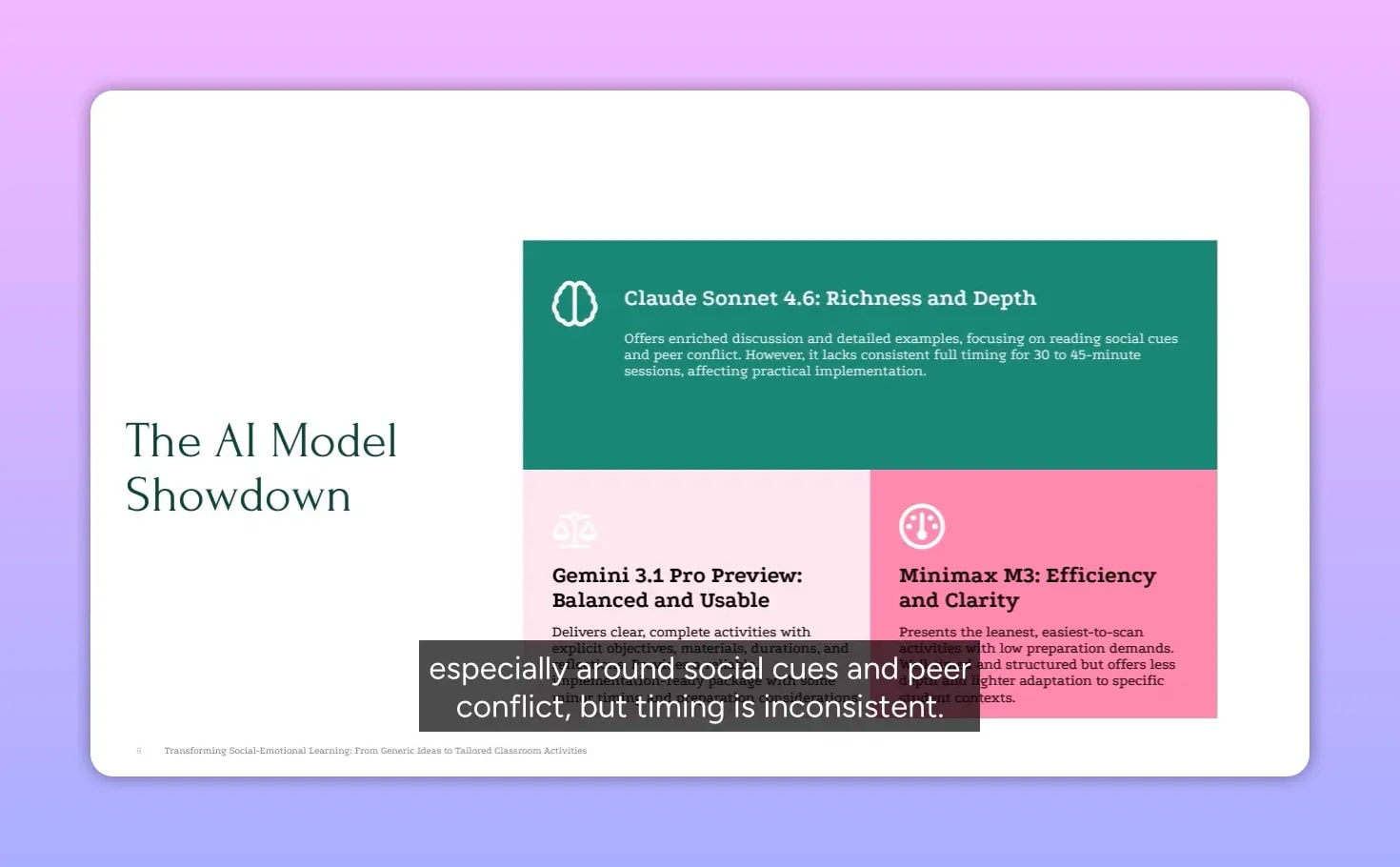
- Claude Sonnet provided the richest discussion of social cues and peer conflict. Its weakness was inconsistent timing, making it less reliable when a complete 30–45-minute lesson was required.
- Gemini Pro Preview produced the most balanced, implementation-ready package, with clearer alignment among objectives, materials, procedures, durations, and reflection.
- Minimax M3 was the clearest and most efficient option, but it offered less detail and less flexibility for adaptation.
The comparison illustrates why a prompt should double as an evaluation rubric. Before using any generated activity, review whether it has a complete duration, manageable materials, clear instructions, meaningful reflection, and a visible connection to the students’ stated needs.
From Optimized Prompt to Interactive Assistant
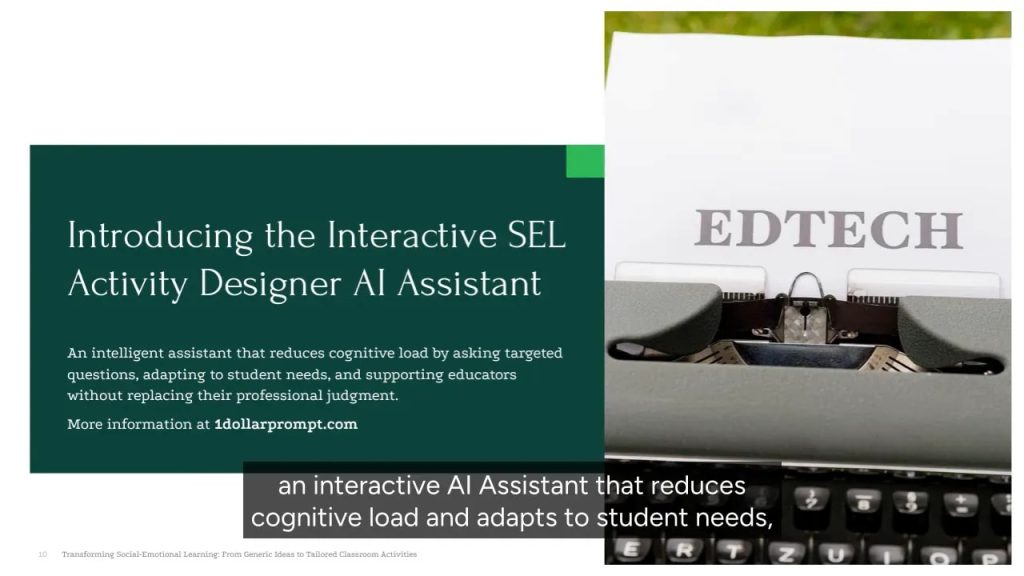
An optimized prompt reduces ambiguity, but it still asks educators to manage placeholders, describe context, remember safeguards, and inspect the finished output for gaps. A guided assistant can reduce this cognitive load by collecting the needed information through targeted questions.
For example, this Interactive SEL Activity Designer AI Assistant starts asking about grade level, available time, materials, room setup, recurring social-emotional patterns, comfort with personal reflection, and whether activities should stand alone or build into a sequence. It can then organize those answers into a structured request while leaving professional judgment with the educator.
The aim is not one-click lesson generation. It is a more reliable planning workflow: the system handles structure and missing-information checks, while the educator decides what is safe, culturally appropriate, feasible, and right for the students in front of them.
Final Thoughts
Generic AI outputs are often a prompt-design problem before they are a model problem. By defining the role, specifying exactly what must be delivered, setting operational constraints, naming required SEL competencies, and foregrounding student needs, educators can move closer to materials that are practical and relevant.
Still, no output should be used without review. Check full-session timing, strengthen regulation practice, offer low-material alternatives, build connections across activities, and provide opt-out or hypothetical options whenever reflection could become sensitive. Educational AI is most useful when it reduces planning friction while supporting—not substituting—the expertise of teachers and counselors such as Fiona.
Frequently Asked Questions
What makes an SEL prompt classroom-ready?
A classroom-ready prompt specifies the grade level, total duration, required competencies, materials limits, learning objectives, step-by-step instructions, reflection, and the particular student needs the activities must address.
Why require exactly five SEL activities?
“Exactly five” establishes a measurable deliverable and supports deliberate coverage across the five requested competency areas. It also makes the response easier to audit for omissions or unnecessary repetition.
Can an AI-generated SEL lesson be used without editing?
No. Educators should review timing, material requirements, participation structures, emotional safety, and relevance to their students. AI can organize ideas, but professional judgment remains essential.