A rubric can determine whether an assignment feels transparent or arbitrary. When expectations are concrete, students can plan, self-assess, revise, and understand how their work will be evaluated. When expectations are vague, students may focus on the wrong details while instructors spend more time clarifying requirements and defending grades.
Generative AI can draft a rubric quickly, but polished language does not automatically create a reliable assessment instrument. A generic request may overlook standards alignment, formative assessment, accessibility, collaboration, or required deliverables. The answer is not simply asking for a longer rubric. It is providing a stronger instructional design framework.
Key Takeaways
- AI-generated rubrics become more reliable when prompts define an expert role, purpose, constraints, and structured inputs.
- Every rubric should make performance levels, accessible language, content mastery, skill development, and standards alignment explicit.
- Different models vary in completeness and usability, so professional review remains essential before implementation.
Table of Contents
- Start With the Difference Between a Request and a Framework
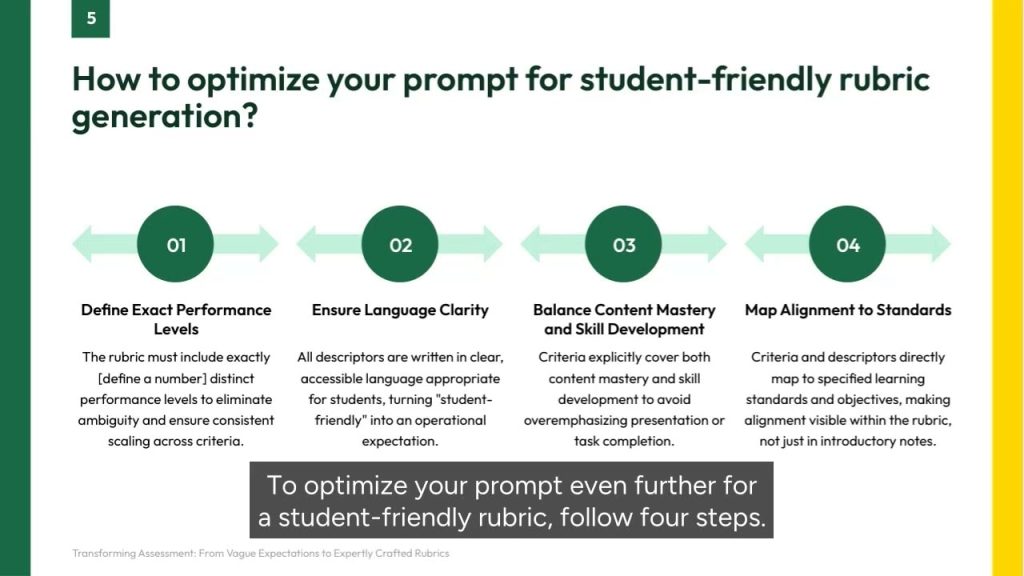
- Four Requirements That Make Rubrics More Reliable
- Case Study: Secondary Mathematics and Educational Technology
- What Three AI Models Revealed
- Move From a Static Prompt to a Guided Assessment Workflow
- Final Thoughts
Start With the Difference Between a Request and a Framework
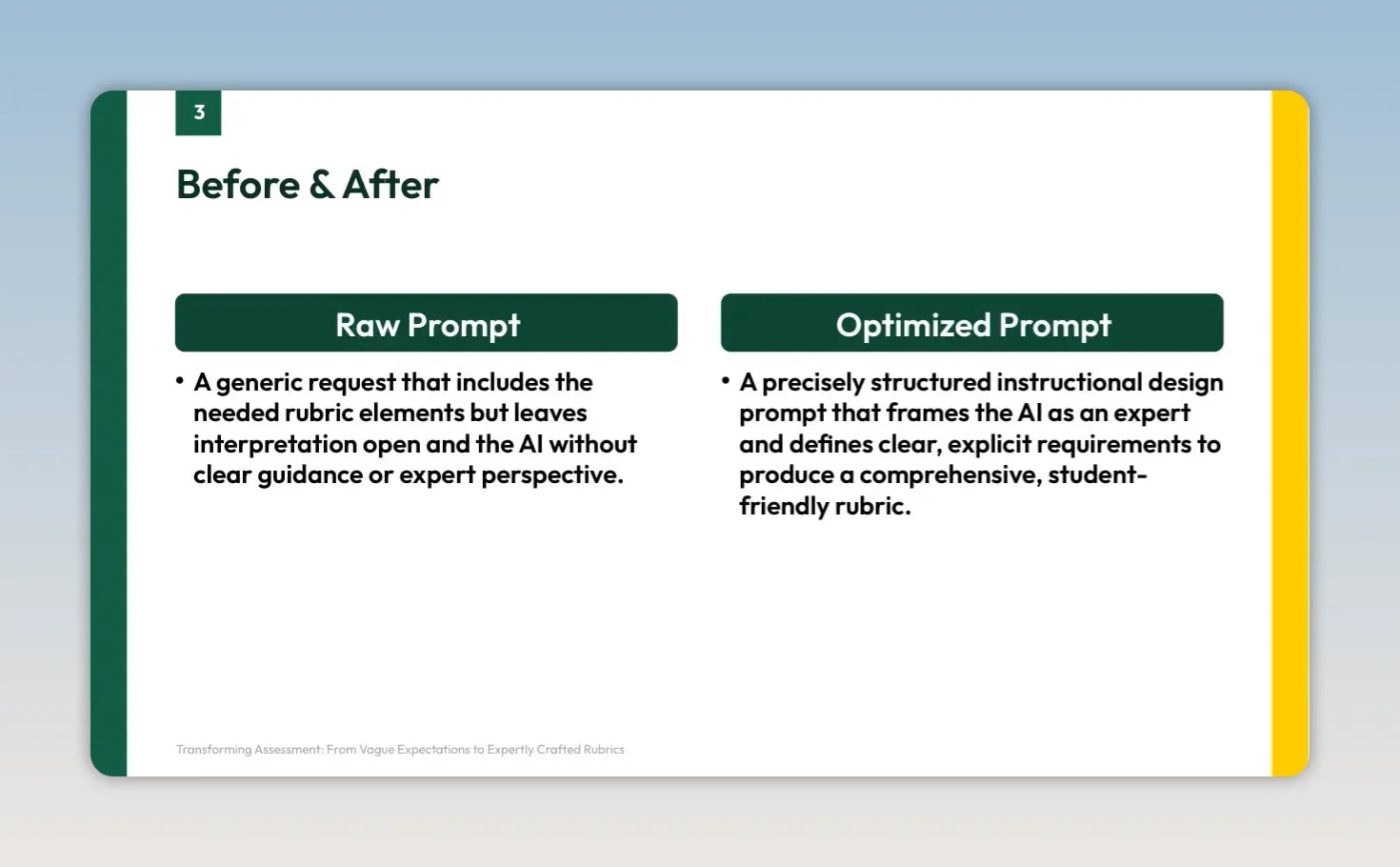
A basic prompt often includes the right ingredients: performance levels, standards, content knowledge, skills, and a table. Yet it leaves crucial decisions open to interpretation. What matters most? What counts as observable evidence? How should academic understanding differ from performance?
The Raw Prompt
Create a detailed, student-friendly rubric for assessing [ASSIGNMENT TYPE] in my [SUBJECT] class. The rubric should:
- Address these key components: [LIST COMPONENTS]
- Include 4 performance levels with clear descriptors for each
- Use language that students can understand
- Align with these standards/objectives: [LIST STANDARDS/OBJECTIVES]
- Include both content mastery and skill development components
- Be formatted in a clear, easy-to-use table

The assignment requirements are: [DESCRIBE ASSIGNMENT]
This prompt is a reasonable beginning, but it provides limited direction about priorities, professional expectations, or how to make the distinction between what learners know and what they can demonstrably do.
The Optimized Prompt
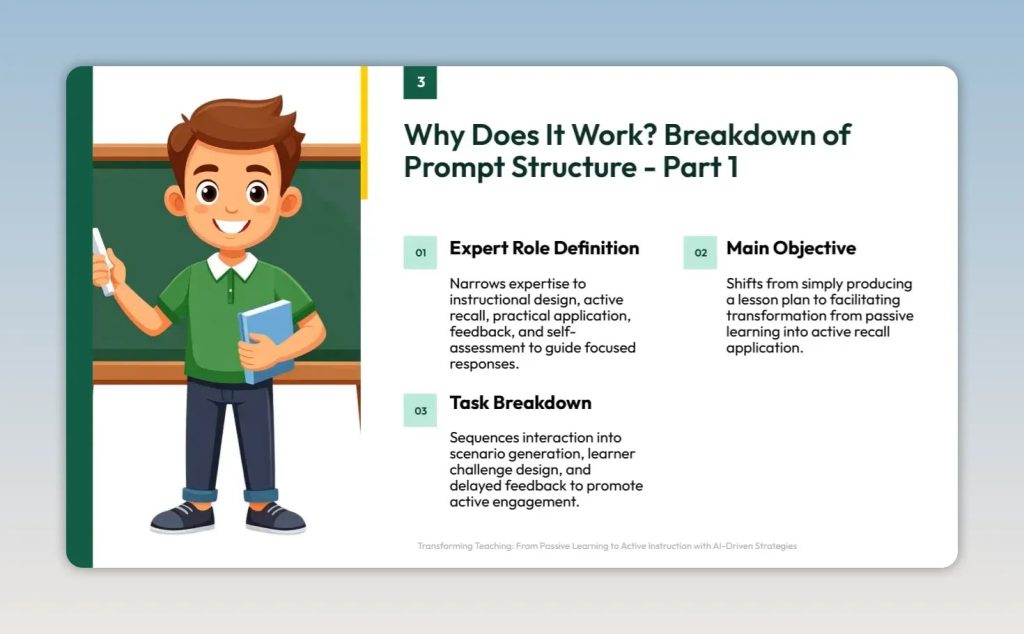
You are an expert Instructional Designer and Curriculum Specialist with experience creating clear, equitable assessment tools for K-12 and higher education.

Develop a comprehensive, student-friendly assessment rubric that translates the learning objectives below into observable evidence and supports fair evaluation.

The rubric must:
- Include exactly four distinct performance levels.
- Use clear, accessible language for the target learners.
- Explicitly assess both content mastery and skill development.
- Directly map criteria and descriptors to the stated standards and objectives.
- Present the result in a clear, easy-to-use table.

Use these inputs:
- Assignment Type: [ASSIGNMENT TYPE]
- Subject/Course: [SUBJECT]
- Key Assessment Components: [LIST COMPONENTS]
- Governing Standards/Objectives: [LIST STANDARDS/OBJECTIVES]
- Detailed Assignment Requirements: [DESCRIBE ASSIGNMENT]
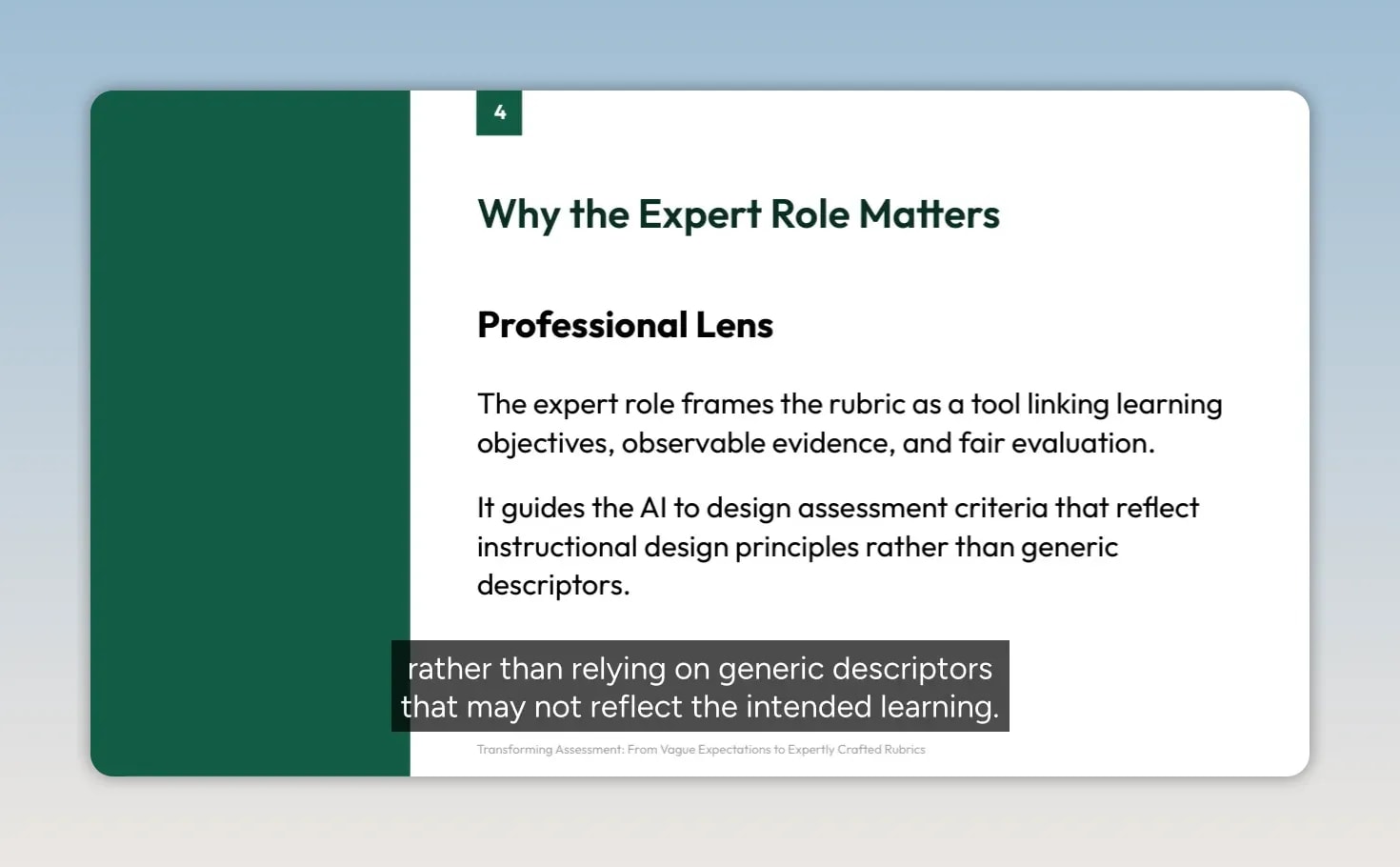
The difference is structural. The optimized version assigns an expert instructional lens, defines the rubric’s educational purpose, makes constraints non-negotiable, and separates reusable instructions from assignment-specific context. Rather than producing generic descriptors such as “excellent” or “sophisticated,” it is directed to connect learning objectives with observable evidence and fair evaluation.
Four Requirements That Make Rubrics More Reliable
Strong prompts reduce ambiguity by stating what cannot be left to inference.
- Specify the exact number of performance levels. “Exactly four” prevents inconsistent scales or extra categories.
- Require accessible language. Student-friendly does not mean simplistic; it means that expectations can be understood and acted upon.
- Balance mastery and performance. Assess what a learner understands alongside what they can design, explain, demonstrate, collaborate on, or reflect upon.
- Make alignment visible. Standards and objectives should map directly to criteria and descriptors, not appear only in a preliminary note.
This final requirement strengthens instructional coherence and makes assessment decisions easier to explain. Accessibility should also be designed deliberately; the CAST Universal Design for Learning Guidelines offer useful context for considering learner variability and multiple ways to demonstrate learning.
Case Study: Secondary Mathematics and Educational Technology
Consider a teacher-education course on Educational Technology Integration in Secondary Mathematics. Pre-service teachers are designing for grades 9 and 10, so the assignment must assess more than a finished lesson plan.
| Assignment element | Requirement |
|---|---|
| Lesson design | A 45-minute secondary mathematics lesson integrating educational technology |
| Teaching performance | A 15-minute micro-lesson with peer teaching |
| Professional defense | A 10-minute Q&A |
| Written reasoning | A 1,500–2,000-word rationale |
| Design expectations | Inclusive, standards-aligned, and supported by formative assessment |
A complete rubric for this project should capture technology selection, mathematics standards, pedagogy, accessibility, teaching practice, reflection, and rationale. It must also ensure that the formative assessment, full lesson design, collaboration, and Q&A do not disappear simply because they are embedded in the assignment description rather than listed as headline criteria.
What Three AI Models Revealed
Using the same optimized framework, Claude Sonnet 4.6 produced the broadest and most diagnostic criteria, spanning pedagogy, standards, technology integration, Universal Design for Learning, peer teaching, reflection, rationale, and overall integration. Its detailed structure makes it valuable when an instructor needs granular feedback, though density can increase scoring effort.
Gemini 3.1 Pro Preview generated the shortest response. Its practical thresholds were useful, especially where minimum requirements needed to be visible, but the organization was less efficient. Its fragmented multi-table format also omitted key requirements, including formative assessment and collaboration.
Minimax M3 supplied a compact, conventional matrix with clear standards language and practical descriptors. This makes it easier to scan, but its consolidation of pedagogy and UDL means that two distinct areas of performance cannot be evaluated independently.
The practical lesson is clear: a well-structured prompt improves results across models, but it does not replace professional review. Before adopting an AI-generated rubric, check every required deliverable, look for observable differences between adjacent levels, confirm that standards are directly represented, and decide whether criteria should carry equal weight.
Move From a Static Prompt to a Guided Assessment Workflow
An optimized prompt is powerful, but it still requires the educator to remember variables, organize assignment context, identify non-negotiables, and detect omissions. A guided rubric-building workflow can reduce that cognitive load by asking focused questions: What will learners create? Which outcomes matter most? What evidence demonstrates proficiency? Which accommodations, standards, or assessment practices must be visible?
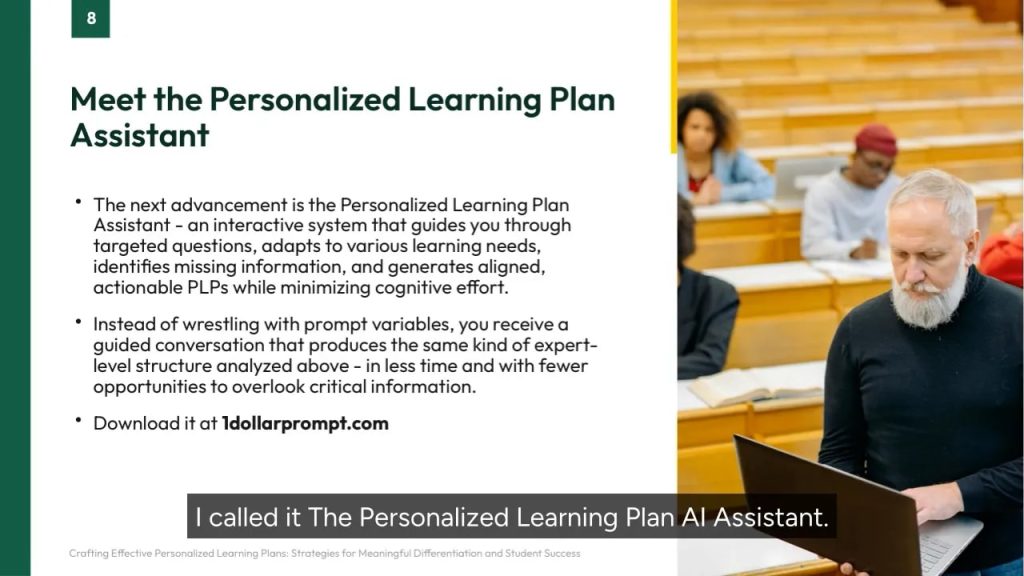
The Student-Friendly Assessment Rubric Builder follows this conversational approach. It organizes context, asks for clarification, and keeps professional oversight with the educator. The goal is not to automate instructional judgment. It is to create an educational AI workflow that thinks alongside educators while supporting clearer instruction and more defensible assessment.
Final Thoughts
Reliable rubrics begin with a shift in mindset. Do not ask AI merely to “create a rubric.” Ask it to translate objectives, standards, requirements, and evidence into an assessment tool that learners can use and educators can trust.
Define the expert role. State the performance-level structure. Separate knowledge from observable performance. Make standards alignment explicit. Then review the output for what the system may have compressed or missed. That is how a vague request becomes a transparent assessment system.
Frequently Asked Questions
Why is a generic rubric prompt not enough?
Generic prompts can produce professional-looking tables while leaving key decisions to AI interpretation. They may omit assignment deliverables, formative assessment, accessibility considerations, or direct standards mapping.
What should an optimized rubric prompt include?
Include an expert role, the rubric’s educational purpose, an exact number of performance levels, accessible-language requirements, a balance of content and skills, direct standards alignment, and clearly organized assignment details.
Can an AI-generated rubric be used without revision?
It should be reviewed before use. Confirm that all required deliverables are assessed, descriptors show observable progression, standards are visible, and scoring weights reflect the importance of each criterion.